Pay Per Appointment: What It Costs and When It's Worth It
What pay per appointment lead generation costs, what triggers the bill, the contract terms to check, and how a per-meeting price compares with a flat monthly caller.
Pay per appointment is a way of paying for outsourced appointment setting: you pay a fee for each sales meeting a provider books for you, instead of a monthly fee for their time. Published prices run from about $50 to $900 a meeting, and the biggest difference between quotes is what triggers the bill: a meeting booked, a meeting held, or a qualified meeting held.
This guide covers what pay per appointment costs, how each billing trigger works, the contract terms to check, and how a per-meeting price compares with a flat monthly caller. One thing to know upfront: Switchstack charges a flat monthly fee per caller, not per meeting, so we have a stake in that comparison. We've kept every figure linked to its source so you can check it.
Table of Contents
- What Is Pay Per Appointment?
- How Much Does Pay Per Appointment Cost?
- Booked, Held or Qualified: What Triggers the Bill?
- Pay Per Appointment vs a Monthly Caller: The Real Cost per Meeting
- When Is Pay Per Appointment Worth It?
- 9 Contract Terms to Check Before You Sign
- How to Compare Pay Per Appointment Companies
- How Switchstack Fits
What Is Pay Per Appointment?
Pay per appointment, also called pay per meeting, is a pricing model for B2B appointment setting. The provider finds prospects that match your ideal customer, contacts them, and books meetings with your seller. You pay an agreed fee for each meeting that meets the terms of the contract.
It usually works in five steps:
- You define the target: the companies, the job titles and what makes a meeting qualified.
- The provider builds or takes a list and contacts prospects by phone, email, LinkedIn or a mix.
- Interested prospects are qualified and booked onto your calendar.
- Your seller runs the meeting and reports whether it met the definition.
- You're billed for each meeting that counts under the contract.
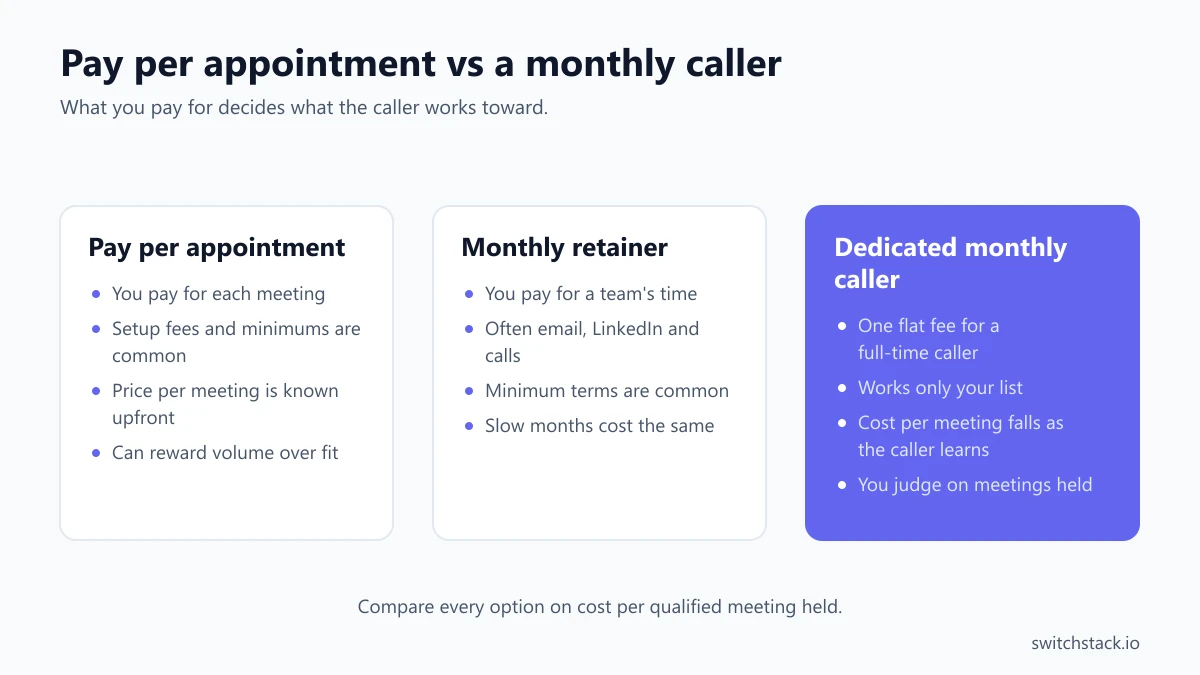
Pay per appointment is one of four common ways providers charge. The others are a monthly retainer, a hybrid of a lower monthly base plus a fee per meeting, and a dedicated caller for a flat monthly fee. Our guide to how much appointment setting costs compares all four.
How Much Does Pay Per Appointment Cost?
Most pay per appointment companies don't publish a rate card. They quote after a call, because the price depends on how hard your buyers are to reach. The published figures we could find, checked on November 17, 2026:
| Source | What it says | Type of source |
|---|---|---|
| Intelemark's appointment setting pricing guide | About $50 to $300 per meeting, and $3,000 to $10,000 a month for agency retainers | An agency's price guide |
| Prospeo's pay per appointment guide | $75 to $500 per scheduled meeting, $300 to $600 per held meeting, $600 to $900 per qualified meeting held | A data vendor's benchmark table |
| Belkins' pay-per-appointment page | From $750 per appointment, a $1,500 one-time setup fee, and packages from 10 appointments | One agency's own rate card |
Three things push the price up:
- Seniority. A meeting with a CTO at a large company costs more than one with an office manager at a small one, because fewer calls reach the right person.
- A strict definition. The more boxes a meeting has to tick, the fewer meetings count, so each one costs more.
- The billing trigger. Paying only for qualified meetings held moves the risk to the provider, and the price per meeting goes up to match.
Setup fees and minimums matter as much as the headline price. On Belkins' published terms, a first package of 10 appointments costs at least $9,000: 10 × $750, plus the $1,500 setup fee, which is $900 per meeting before any discount.
Booked, Held or Qualified: What Triggers the Bill?
Two quotes of "$300 a meeting" can cost very different amounts, depending on when a meeting starts to count.
| Billing trigger | You pay when | No-shows | Main risk |
|---|---|---|---|
| Booked | The prospect accepts the invite | Usually still billed | Paying for meetings that never happen |
| Held | The prospect joins the meeting | Not billed, often rebooked | Paying for meetings with the wrong person |
| Qualified and held | The prospect joins and meets your written definition | Not billed | Disputes about what "qualified" means, unless it's in writing |
The safest trigger for you is a qualified meeting held, with the definition written into the contract. Expect a higher price per meeting for it, and compare quotes only after converting them to the same trigger.
Pay Per Appointment vs a Monthly Caller: The Real Cost per Meeting
A flat monthly caller costs less than pay per appointment once it books more qualified meetings a month than its fee divided by the price per meeting. Below that number, pay per appointment is cheaper. To compare any two models, use the same number for both:
Cost per qualified meeting held = total spend ÷ qualified meetings held
Here's one month priced three ways. The meeting counts are made up to show the math. They aren't a forecast for any provider, including us.
Option A: $300 per booked meeting. The provider books 14 meetings, so you pay $4,200. Three prospects don't show up and one isn't a fit. That leaves 10 qualified meetings held at $420 each, not $300.
Option B: $750 per qualified meeting held, plus a $1,500 setup fee. Ten qualified meetings cost $7,500, plus the setup fee in the first package: $9,000, or $900 each. Later packages without the setup fee cost $750 each.
Option C: a dedicated caller for a flat $2,199 a month. This is our lowest price for a managed caller. If your caller books 5 qualified meetings held, each costs $440. At 10, each costs about $220. In a slow month with 2, each costs about $1,100.
That gives you a simple break-even:
Break-even meetings per month = monthly fee ÷ price per meeting
At $750 a meeting, a $2,199 caller costs less once it produces 3 qualified meetings held in a month. At $420 a meeting, it takes 6. Below that number, pay per appointment is cheaper. Above it, the flat fee is.
What the example shows:
- Pay per appointment caps your risk in a slow month. You don't pay for meetings that don't happen, if the trigger is right.
- A flat fee gets cheaper per meeting as the caller learns your offer. The first month is the most expensive.
- Setup fees and minimum packages change the math more than the headline price does.
Track your own numbers for at least a month before you decide. Our guide to how many cold calls it takes to book a meeting shows how to track each step, from dials to meetings held.
When Is Pay Per Appointment Worth It?
Pay per appointment is worth it when one meeting is worth far more than its price and nobody on your team can manage a caller. It tends to work when:
- One meeting is worth a lot to you. If a closed deal is worth tens of thousands, paying several hundred per meeting is easy to justify.
- Nobody on your team can manage a caller. The provider runs the targeting, the script and the follow-up.
- You need a fixed cost per result to get a budget approved.
- You're testing a provider with a small package before a bigger commitment.
It tends to be poor value when:
- Your product is cheap or sold on short contracts. A $750 meeting doesn't pay off on a small deal.
- Your market is a tiny niche. Providers either decline or price every meeting high, because there are so few prospects to call.
- Your product needs explaining. Per-meeting pricing rewards a quick yes, not a careful conversation.
- You want to hear every call and shape the pitch. A flat-fee caller who works only for you is easier to coach.
- You plan to run outbound for a year or more. Once a caller reliably books more than the break-even number, a flat fee costs less per meeting.
9 Contract Terms to Check Before You Sign
The billing trigger and your written definition of a qualified meeting decide most of what you pay, so settle those two first. Ask for each of these terms in writing. A good provider will answer every one without hesitation.
| Term | Why it matters | A good answer |
|---|---|---|
| Billing trigger | Decides whether you pay for no-shows | You pay for qualified meetings held |
| Qualified meeting | Decides what you're paying for | Your written definition: company, person, reason to talk, meeting held |
| No-shows and reschedules | No-shows are common | Not billed, and the provider tries to rebook |
| Dispute window | Lets you reject a meeting that didn't fit | A set number of days after the meeting, with the call recording or notes |
| Setup fee and minimum | Can double the cost of a first test | Stated upfront, with what you get for it |
| Delivery deadline | A package can drag on for months | A date, and a refund or credit for meetings not delivered |
| Exclusivity | Your prospects shouldn't hear the same pitch for a competitor | No competitor of yours is booked from the same campaign |
| Data ownership | You'll want the list and notes if you leave | Lists, notes and recordings stay yours |
| Exit terms | You may need to stop | Short notice, with no fee for leaving early |
Belkins' published terms are one example of how agencies handle these: no-shows don't use up an appointment, you can dispute one that didn't qualify, and packages are delivered within six months of launch, with a partial refund for appointments not delivered. Check whether the provider you're talking to offers the same.
For more questions to ask, take our 12 questions to ask a cold calling agency into every sales call.
How to Compare Pay Per Appointment Companies
Compare pay per appointment companies on what one qualified meeting held costs you, including setup fees and minimums, not on the headline price. Put every quote on the same basis first:
- Convert to the same trigger. Ask each provider what one qualified meeting held costs, including setup fees and minimums.
- Ask which channel books the meetings. Many pay per appointment companies work mainly by email and LinkedIn. If your buyers answer the phone, ask how much of the work is calling, and who makes the calls.
- Ask to hear calls. Sample recordings tell you more than a pitch deck.
- Check the calling rules in your markets. They differ by country. In the UK, numbers are screened against the TPS and CTPS registers, and in Germany B2B calls need at least presumed consent. Our cold calling laws by country cover each market.
- Look for published prices. A provider that publishes its prices is easier to compare. Our list of cold calling companies compared shows the published price and terms of nine providers.
How Switchstack Fits
Switchstack doesn't sell pay per appointment. We supply a dedicated, full-time caller for one flat monthly fee, because a caller paid the same whatever happens has no reason to book meetings that don't fit. Every call is made by a real person and recorded.
- We Call for You: with our appointment setting services, we supply, train and manage a dedicated caller who books qualified meetings onto your calendar, from $2,199 a month per caller.
- Hire a Caller: when you hire cold callers through us, a vetted, full-time caller joins your team and reports to you, from $1,499 a month.
There's no setup fee and no charge per meeting, and it's month to month with 30 days' notice. If you'd like proof before you commit, our 60-day cold calling pilot costs 20% less, from $1,759 a month with We Call for You, and ends on its own unless you choose to continue. To talk it through, book a 30-minute call.
Frequently Asked Questions
What does pay per appointment mean?
How much does pay per appointment cost?
Is pay per appointment worth it?
What is the difference between pay per appointment and pay per lead?
Do pay per appointment companies charge for no-shows?
How do I avoid paying for bad meetings?
Does Switchstack offer pay per appointment?
Want us to make these calls for you?
Tell us who you want to reach. We'll make the calls and book the meetings, or find you a caller of your own. Pick a time for a free 30-minute call below.
- Free 30-minute call, no obligation
- 20% off the first 2 months
- No setup fee, month-to-month
- Free replacement in the first 30 days
Prefer email? hello@switchstack.io
See all pricesWritten by
Switchstack Team
Switchstack
Guides on cold calling and hiring callers from the Switchstack team.
Newsletter
Tactics worth your inbox.
Outbound tactics and product updates — only when we have something genuinely worth sharing.