SDR vs BDR: What's the Difference? (With 2026 Salaries)
SDR vs BDR explained: inbound vs outbound, the day-to-day work, how each is measured, 2026 salaries, how both differ from an account executive, and which one to hire first.
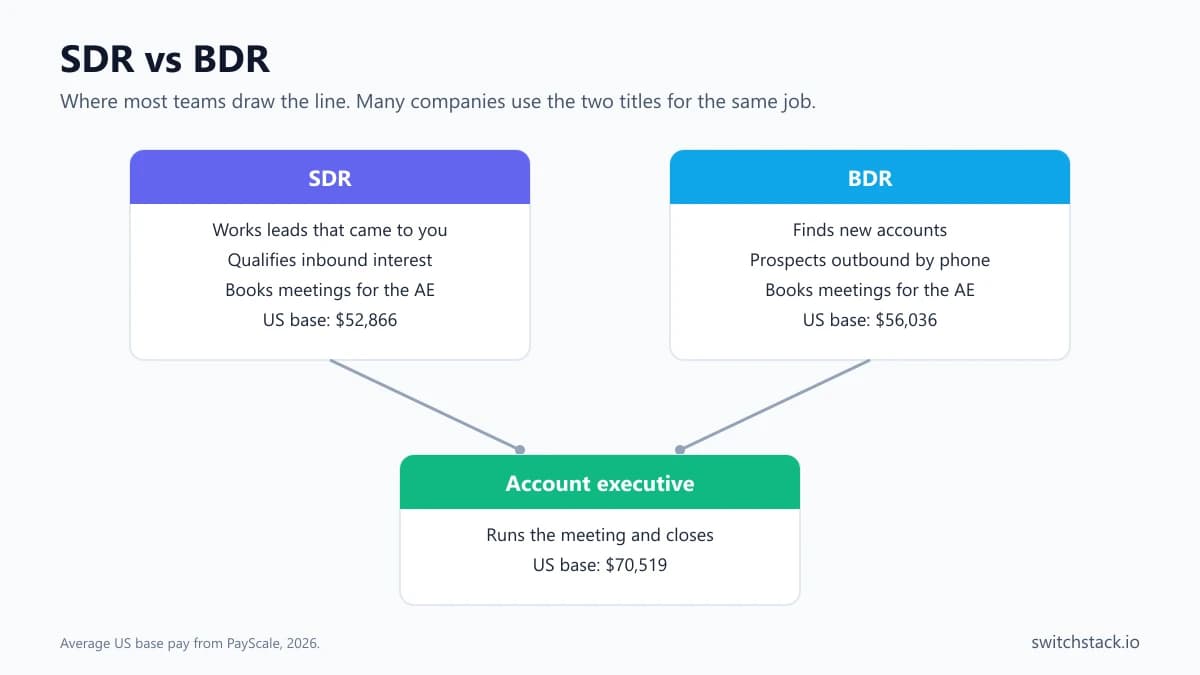
SDR vs BDR comes down to where the leads come from. An SDR (sales development representative) usually qualifies inbound leads: people who came to you through your website, ads or content. A BDR (business development representative) usually prospects outbound: companies that haven't heard of you yet. Both book meetings for an account executive, who runs the meeting and closes the deal.
That's where most teams draw the line, but not all of them. Many companies use the two titles for the same job, so always read the job description, not just the title. This guide covers the day-to-day work of each role, how each is measured, the skills to test for, 2026 salaries, how both differ from an account executive, and which one to hire first.
Table of Contents
SDR vs BDR at a Glance
| SDR | BDR | |
|---|---|---|
| Main job | Qualify leads and book meetings | Find new accounts and book meetings |
| Where leads come from | Mostly inbound: forms, demo requests, event lists | Mostly outbound: target lists of new accounts |
| Main channels | Phone and email follow-up, often within minutes of a request | Cold calls and emails, often with research first |
| Measured on | Speed to lead, meetings booked, meetings held | Conversations, meetings booked, meetings held |
| Key skill | Fast, friendly qualifying | Persistence and handling brush-offs |
| Average US base pay | $52,866 | $56,036 |
| Usual next role | Account executive | Account executive |
Pay figures are PayScale's 2026 US averages. Your local market, your industry and the company's commission plan all change the numbers.
What an SDR Does
On the SDR side of the SDR vs BDR split, the rep handles leads that already raised a hand. Someone fills out a form, asks for a demo, downloads a guide or signs up at an event, and the SDR follows up.
A typical day looks like this:
- Responding fast. The quicker the follow-up, the more likely the lead still remembers why they reached out.
- Qualifying. The SDR asks a few questions to check fit: do they have the problem you solve, are they the right person, and is there a reason to act now?
- Booking. When the lead fits, the SDR books a meeting with an account executive and passes on what they learned.
- Recycling. Leads that aren't ready get a later follow-up rather than being dropped.
What a BDR Does
On the BDR side of the SDR vs BDR split, the rep goes after companies that haven't contacted you. They start from a list of target accounts, find the right person at each one, and reach out cold, mostly by phone and email.
A typical day looks like this:
- Research. Picking the right person and a reason to call each company.
- Calling in blocks. Focused hours of calls during the prospects' business day.
- Handling brush-offs. Most first answers are "not interested" or "send me an email," so the BDR needs calm, short replies.
- Booking. When a prospect fits and agrees, the BDR books a meeting for an account executive.
Our B2B cold calling tips cover the daily habits that make outbound calling work.
SDR vs BDR Metrics
Both roles are judged on meetings, but the numbers that lead up to a meeting differ:
| Metric | Why it matters for an SDR | Why it matters for a BDR |
|---|---|---|
| Speed to lead | Inbound leads cool off fast, so minutes count | Rarely relevant: the BDR starts the contact |
| Connect rate | Usually high: the lead expects contact | Shows whether the list and calling times work |
| Conversations | Most contacts become conversations | The main daily effort measure |
| Meetings booked | The main output | The main output |
| Meetings held | Shows the booked meetings were real | Shows the booked meetings were real |
Outbound work takes more attempts per meeting than inbound, so BDR meeting targets tend to be lower than SDR targets. Set targets from your own numbers, not someone else's. Our guide to how many cold calls it takes to book a meeting shows how to work them out.
SDR vs BDR Skills and How to Test Them
The two roles need overlapping skills, with a different weight on each:
- SDR: speed and judgment. Following up within minutes, asking two or three sharp questions, and saying no politely to leads that don't fit. Test it with a role-play where you play an inbound lead who's only "just looking."
- BDR: persistence and calm. Opening a cold call well, handling a brush-off without arguing, and calling again next week. Test it with a role-play where you play a busy prospect who says "send me an email" in the first ten seconds.
- Both: clear speaking and listening. Can they explain what you sell in one sentence, and use what the prospect said in their next question?
Our guide to evaluating sales reps with role-play scenarios has three scenarios and a scoring sheet you can use for either role.
SDR vs BDR Salary
In the US, BDRs earn slightly more than SDRs on average, according to PayScale's 2026 data:
| Role | Average base | Middle 80% of base pay | Total pay with commission | Profiles |
|---|---|---|---|---|
| Sales development representative | $52,866 | $41,000 to $68,000 | $46,000 to $83,000 | 699 |
| Business development representative | $56,036 | $42,000 to $78,000 | $44,000 to $89,000 | 612 |
The gap is about $3,200 a year in base pay, and the BDR range reaches higher. One likely reason is that outbound prospecting is harder to do well and harder to hire for. Some companies also give the BDR title to more senior reps who open larger accounts.
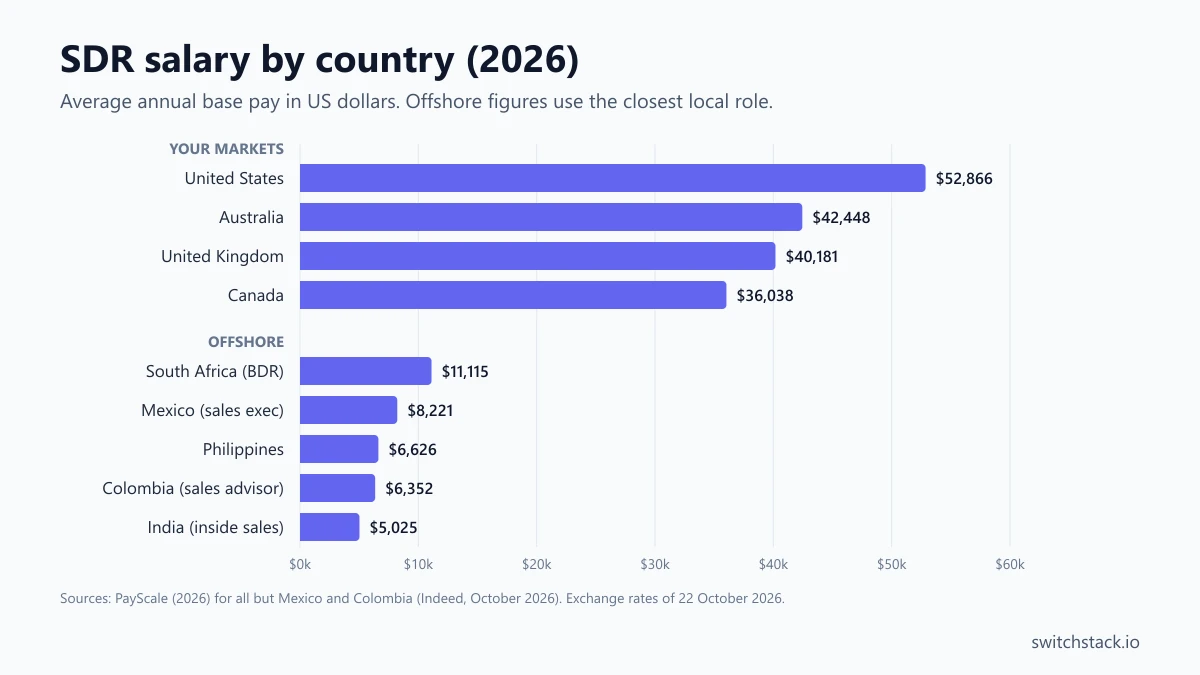
Pay also varies by country. Our guide to SDR salary by country compares the US with the UK, Canada, Australia and five offshore countries.
SDR vs BDR vs Account Executive
The account executive (AE) is the next step in the sales process, and often the next step in an SDR's or BDR's career.
- SDRs and BDRs start conversations. Their job ends when a qualified meeting is on the calendar.
- AEs run the meetings and close the deals. They handle discovery, proposals, pricing and negotiation, and they're paid on revenue.
That's reflected in pay. PayScale puts the average US account executive base salary at $70,519, from 2,800 profiles, with commission of up to about $66,000 a year and total pay of $49,000 to $137,000.
Splitting the roles lets each person focus. An AE who also has to make every cold call usually ends up doing neither job well, because closing work always feels more urgent than prospecting.
Which Role Does Your Team Need?
Hire for the work you need done, not the title:
- Hire an SDR first if inbound leads are piling up, follow-up takes days, and your AEs are spending their time qualifying people who aren't a fit.
- Hire a BDR first if inbound is thin, your calendar is empty, and you need meetings with companies that don't know you yet.
- Hire one person to do both if you're a small team. Most early sales hires split their day between following up on inbound leads and calling outbound.
Whichever you choose, write down what a qualified meeting is before the first call. Our guide to B2B appointment setting explains how.
SDR vs BDR Job Descriptions
A clear job description attracts the right people and tells candidates which job it really is. Here is the core of each, in plain words:
SDR (inbound focus):
You'll follow up on people who contact us, usually within minutes, by phone and email. You'll ask a few questions to see if we can help, book meetings for our account executives, and keep in touch with leads who aren't ready yet. You'll be measured on response time and on meetings booked and held.
BDR (outbound focus):
You'll find and contact companies that don't know us yet, mostly by phone. You'll research each account, open calls with a clear reason, handle "not interested" calmly, and book meetings for our account executives. You'll be measured on conversations and on meetings booked and held.
Add your market, your buyers' job titles, the hours, and how pay and commission work.
In-House, Offshore or Outsourced?
Once you know the role, decide who fills it:
- In-house. Full control, but the highest cost and the most management time. A US SDR costs about $75,500 a year with benefits before commission.
- An offshore caller you hire yourself. Lower pay, but you still recruit, test, pay and manage them across borders.
- Outsourced. An agency or provider supplies the caller. This works best for outbound BDR-style work, because it's a repeatable process of calling, qualifying and booking.
Our guide to in-house SDR vs outsourced cold calling compares the three options on cost, control, ramp time and risk.
Switchstack covers the outsourced options. With Hire a Caller, you get a vetted, full-time caller who works your list and reports to you, from $1,499 a month. With our B2B appointment setting services, we supply, train and manage a dedicated caller who books meetings on your calendar, from $2,199 a month. Both run month to month, with no setup fee.
Common Mistakes When Hiring Either Role
- Hiring on the title. "SDR" and "BDR" mean different things at different companies. Read past job descriptions and ask what the person actually did each day.
- Giving an inbound SDR an outbound target with no training. Cold prospecting is a different skill from following up warm leads. Train for it, or hire for it.
- Measuring dials instead of meetings held. A busy-looking day isn't the goal. Count meetings that happen and fit your definition.
- Expecting closed deals from a first hire. SDRs and BDRs create meetings. Revenue depends on what happens in those meetings.
- Skipping the role-play test. Ten minutes of live role-play tells you more than a resume.
For quick definitions of each role, see our glossary entries for SDR and BDR.
Frequently Asked Questions
What is the difference between an SDR and a BDR?
Do BDRs earn more than SDRs?
Is a BDR the same as an account executive?
Should I hire an SDR or a BDR first?
Can I outsource SDR or BDR work?
Want a caller like this on your team?
Tell us who you need to reach. We'll find and test a dedicated caller for you, or make the calls ourselves. Pick a time for a free 30-minute call below.
- Free 30-minute call, no obligation
- 20% off the first 2 months
- No setup fee, month-to-month
- Free replacement in the first 30 days
Prefer email? [email protected]
See all pricesWritten by
Switchstack Team
Switchstack
Guides on cold calling and hiring callers from the Switchstack team.
Newsletter
Tactics worth your inbox.
Outbound tactics and product updates — only when we have something genuinely worth sharing.