How Many Cold Calls to Book a Meeting? Work Out Your Number
There is no universal number of cold calls per meeting. Here is how to measure your own from one week of calls and set a weekly target you can hit.
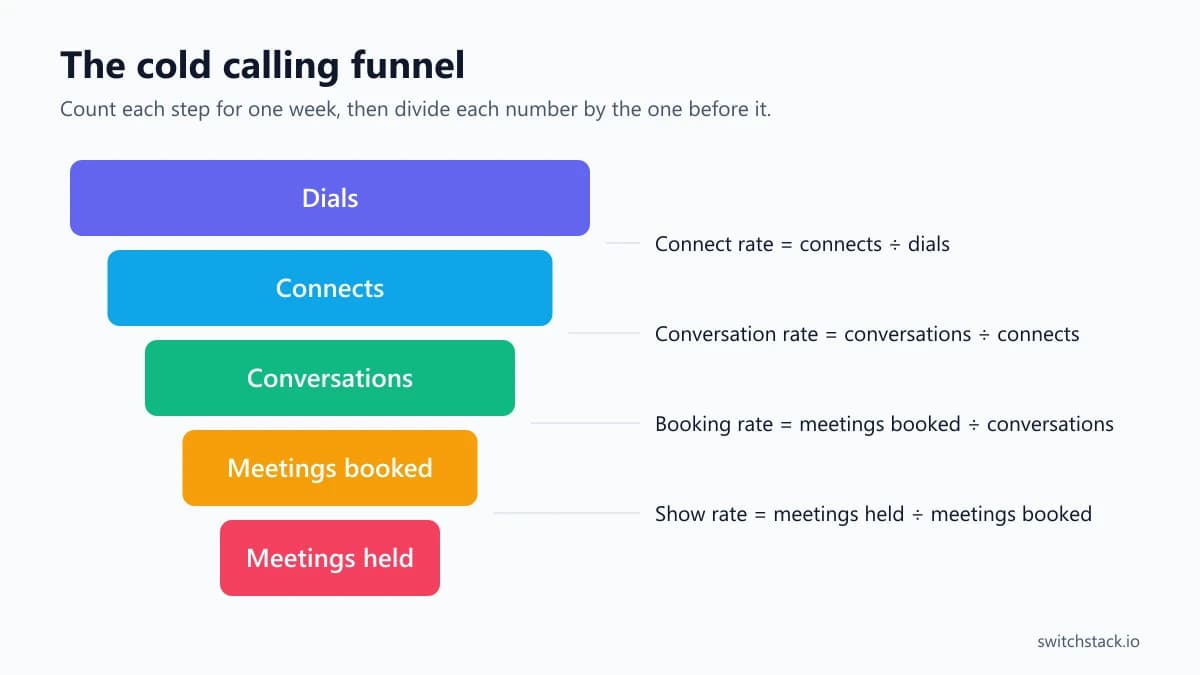
There is no single answer to how many cold calls it takes to book a meeting. The number depends on your list, your market, the time you call and what your caller says. The useful answer is your own number, and you can work it out from one week of calls by tracking five counts: dials, connects, conversations, meetings booked and meetings held.
Benchmarks you see online vary widely, because they come from different industries, list types and definitions. This guide shows you the method instead, so you can measure your own funnel, find the weak step and set a weekly target based on real data.
Table of Contents
- The Cold Calling Funnel Step by Step
- How to Calculate Each Rate From a Week of Calls
- A Worked Example With Made-Up Numbers
- What Moves Each Rate
- How to Set a Realistic Weekly Target
- Common Measurement Mistakes
- Getting Help With the Calls
The Cold Calling Funnel Step by Step
Every cold call either moves a prospect to the next step or stops. Track each step separately, and agree on what counts before you start. If two callers define a "conversation" differently, your numbers mean nothing.
Here are the five steps and simple definitions you can use:
| Step | What counts |
|---|---|
| Dial | Any attempt to call a number, whether anyone answers or not. |
| Connect | A live person picks up. This includes gatekeepers and wrong people. |
| Conversation | You reach the right person and they stay on past your opener. Pick a clear rule, such as "the target person talked for 30 seconds or more". |
| Meeting booked | A specific date and time is agreed and a calendar invite is sent. |
| Meeting held | The meeting actually happens with the right person. |
Voicemails, busy signals and no-answers are all dials but not connects. A gatekeeper who says "she's not in" is a connect but not a conversation. Keep these lines firm.
How to Calculate Each Rate From a Week of Calls
Once you have a week of counts, each rate is one number divided by the one before it:
- Connect rate = connects ÷ dials
- Conversation rate = conversations ÷ connects
- Booking rate = meetings booked ÷ conversations
- Show rate = meetings held ÷ meetings booked
Then work out the two numbers that matter most:
- Dials per meeting booked = dials ÷ meetings booked
- Dials per meeting held = dials ÷ meetings held
The second one is your real answer to "how many cold calls to book a meeting", because a booked meeting that never happens does not help your pipeline.
To collect the counts, a simple spreadsheet works. One row per day, one column per step. Your caller fills it in at the end of each calling block, not from memory at the end of the week. If calls are recorded, spot-check a few each week to make sure the "conversation" rule is applied the same way every time.
A Worked Example With Made-Up Numbers
These numbers are invented and rounded to make the maths easy. They are not a benchmark and not a target. Your own numbers may be much higher or lower.
Say one caller logs this in a week:
| Step | Count | Rate |
|---|---|---|
| Dials | 500 | |
| Connects | 50 | 10% of dials |
| Conversations | 25 | 50% of connects |
| Meetings booked | 5 | 20% of conversations |
| Meetings held | 4 | 80% of booked |
From this example:
- Dials per meeting booked = 500 ÷ 5 = 100
- Dials per meeting held = 500 ÷ 4 = 125
So in this made-up case, the answer is about 100 dials to book a meeting and 125 dials to get one that actually happens.
The rates also tell you where to look first. Multiply them together and you get the share of dials that turn into held meetings: 10% × 50% × 20% × 80% = 0.8%. If you improve any one step by the same relative amount, the end result moves by the same amount. So the question is not "which rate looks low?" but "which rate is easiest for us to improve?"
What Moves Each Rate
Each step has its own levers. Change one thing at a time and give it at least a week, or you won't know what worked.
Connect rate: list quality and timing
- Direct numbers beat main lines. A list of mobile or direct-dial numbers will usually connect more often than a list of main office lines. Check your list source before blaming the caller.
- Remove bad data. Wrong numbers, disconnected lines and people who left the company all count as dials. Clean the list and your connect rate goes up without any extra effort.
- Test call times. Log the hour of each dial for a couple of weeks. Then compare connect rates by time block and move more of your calling into the blocks that work best for your market.
- Call more than once. Many prospects only pick up on a later attempt. Decide on a set number of attempts per contact, spread over different days and times, before you mark them as done.
Conversation rate: the right person and the opener
- Reach the right person. If many connects are gatekeepers or the wrong role, fix the list or the targeting, not the pitch.
- Use a short, honest opener. The first ten seconds decide whether they stay on. Say who you are and why you called in plain words. Our post on cold calling openers that actually work has three you can test.
- Listen to recordings. Find the exact moment people hang up. If it's always right after the same sentence, change that sentence.
Booking rate: the ask
- Ask for something small. A 15-minute call is easier to agree to than a "demo".
- Offer two specific times. "Tuesday at 10 or Wednesday at 2?" is easier to answer than "When are you free?"
- Give a clear reason. Tell them what they will get from the meeting, in one sentence tied to something they said on the call.
- Qualify lightly. Pushing every conversation into a meeting can raise your booking rate but lower your show rate and the quality of the meetings. One or two questions about fit protect both.
Show rate: what happens after the call
- Book close in. A meeting set for later this week tends to stick better than one set three weeks out.
- Send the invite right away, while they are still on the phone if possible, with a one-line agenda.
- Confirm the day before with a short email or message that makes it easy to reschedule instead of just not turning up.
How to Set a Realistic Weekly Target
Work backwards from the outcome you need, using your own rates.
- Start with meetings held. Decide how many held meetings per week your sales team can actually handle and follow up on well.
- Divide by your show rate to get meetings you need to book.
- Divide by your booking rate to get conversations needed.
- Divide by your conversation rate to get connects needed.
- Divide by your connect rate to get dials needed.
Using the made-up example rates above, a goal of 8 held meetings a week looks like this:
- 8 held ÷ 80% = 10 meetings booked
- 10 booked ÷ 20% = 50 conversations
- 50 conversations ÷ 50% = 100 connects
- 100 connects ÷ 10% = 1,000 dials a week, or about 200 a day over five days
Now check that number against reality. Have your caller log how many dials they can make in a full day, including research, notes and follow-up emails. If the target needs more dials than one person can make, you have three choices: improve one of the rates, lower the target, or add another caller. Don't just tell the caller to dial faster. That usually cuts research and note-taking, and the rates drop.
A few more rules help:
- Give new callers a ramp. Expect lower rates in the first few weeks while they learn the script and the market. Our SDR hiring guide includes a 90-day ramp plan.
- Use a rolling average. Set targets from the last four weeks, not last week alone.
- Review monthly. As the list, script and caller improve, your rates change. Recalculate and reset the target.
- Track activity daily, outcomes weekly. Dials and conversations show effort every day. Meetings held is the result you review each week.
Common Measurement Mistakes
- Mixing definitions. If one caller counts every pickup as a conversation and another doesn't, comparing them is pointless.
- Trusting tiny samples. Five meetings in a week is a small number. One more or one fewer changes the booking rate a lot. Look at several weeks together.
- Mixing lists. A list of warm referrals and a cold purchased list will have very different rates. Track them separately.
- Only counting booked meetings. A high booking rate with a poor show rate means the calls are pushing too hard, or the follow-up is weak.
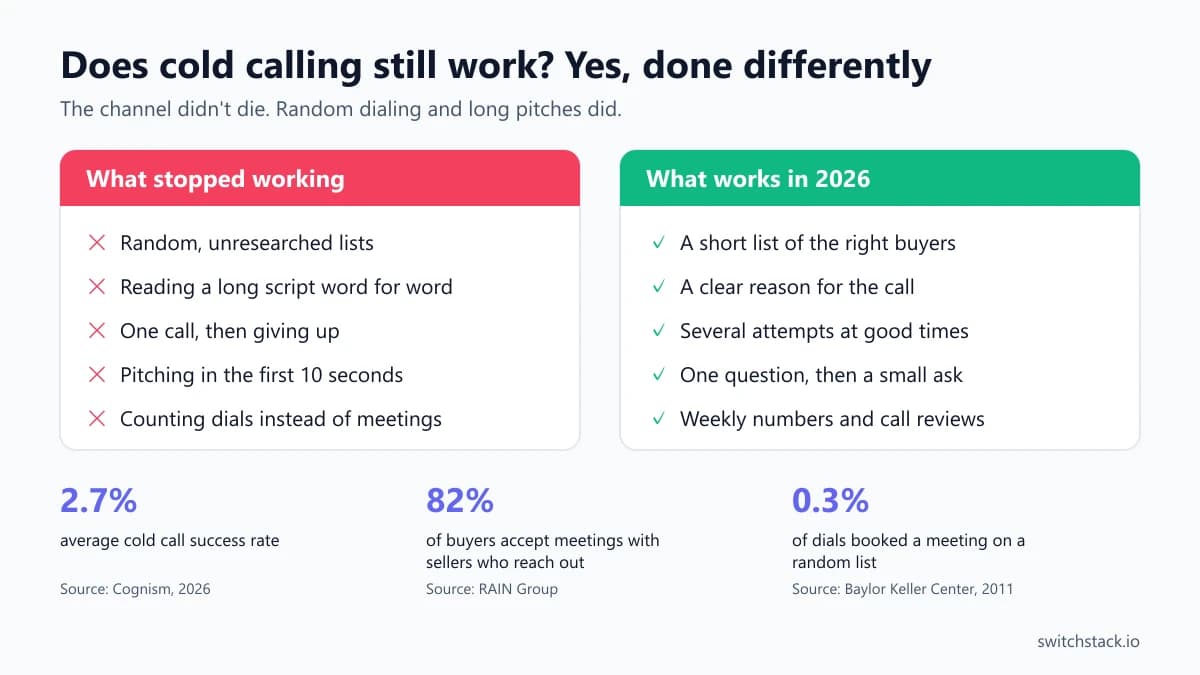
- Comparing yourself to someone else's benchmark. Their list, market and definitions are different. Compare yourself to your own numbers from last month. (If you want context anyway, our look at whether cold calling still works in 2026 covers the published averages and their limits.)
If you're judging a caller rather than a process, our guide on how to evaluate Filipino sales reps covers what to look for beyond the raw numbers.
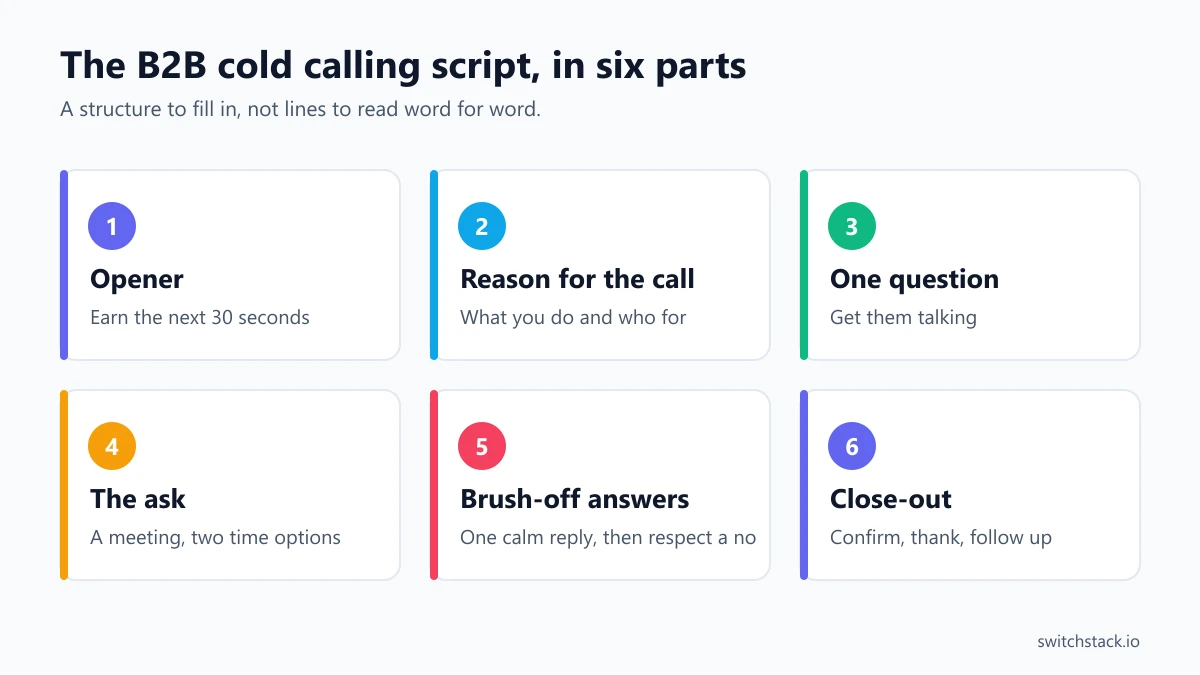
If your conversation-to-meeting rate is low, the script is usually the place to start. Our B2B cold calling script template walks through each part.
Getting Help With the Calls
If you've worked out your number and don't have the hours to make the calls, Switchstack offers two options. With We Call for You, we supply, train and manage a dedicated Filipino caller who books meetings on your calendar, for $2,499 a month per caller, with a script written with you, daily quality checks, call recordings and a weekly report. With Hire a Caller, you get a vetted, full-time Filipino caller who works your list and reports to you, for $1,799 a month per caller. Both have no setup fee, run month-to-month with 30 days' notice, and every call is recorded, so you can track the funnel above from day one. See pricing for details.
Frequently Asked Questions
How many cold calls does it take to book one meeting?
How long should I track calls before I trust my numbers?
Should I count a meeting when it is booked or when it is held?
What is a realistic number of dials for one caller per day?
Written by
Switchstack Team
Switchstack
Guides on cold calling and hiring callers from the Switchstack team.
Newsletter
Tactics worth your inbox.
Outbound tactics and product updates — only when we have something genuinely worth sharing.