Hire SDRs in the Philippines: The 2026 Strategy Guide
How to hire an SDR in the Philippines in 2026: the three hiring routes, how to vet candidates, a 90-day plan, and what to track.
Building an outbound sales team is expensive. For many B2B companies, hiring a full team of US-based Sales Development Representatives (SDRs) means spending a lot before you know if your message works.
That is why many sales leaders look to the Philippines. If you want to hire SDRs in the Philippines, you get access to a large pool of English-speaking sales talent that is used to working with US companies.
Finding people is the easy part. The hard part is vetting, training and managing a remote caller so they perform at the level you expect. This guide covers how to hire, ramp and manage a Filipino SDR, and the mistakes to avoid.
Table of Contents
- Why You Should Hire SDRs in the Philippines for B2B Outbound
- 3 Ways to Build Your Team
- How to Vet a Filipino SDR
- The 90-Day SDR Onboarding Plan
- Setting KPIs and Managing the Work
- How Switchstack Can Help
Why You Should Hire SDRs in the Philippines for B2B Outbound
The Philippines has a long history of working with US companies. English is widely used in schools and business, and many workers have years of experience on US-facing phone teams. That makes it easier to find callers who understand how US buyers talk and what they expect on a call.
Time zones also work in your favor. Many Filipino sales professionals already work night shifts in Manila so they can cover US business hours. A caller on that schedule is on the phone when your prospects are at their desks.
English level and accent still vary from person to person. Where someone lives does not tell you how they sound on a call. That is why vetting matters so much.
3 Ways to Build Your Team
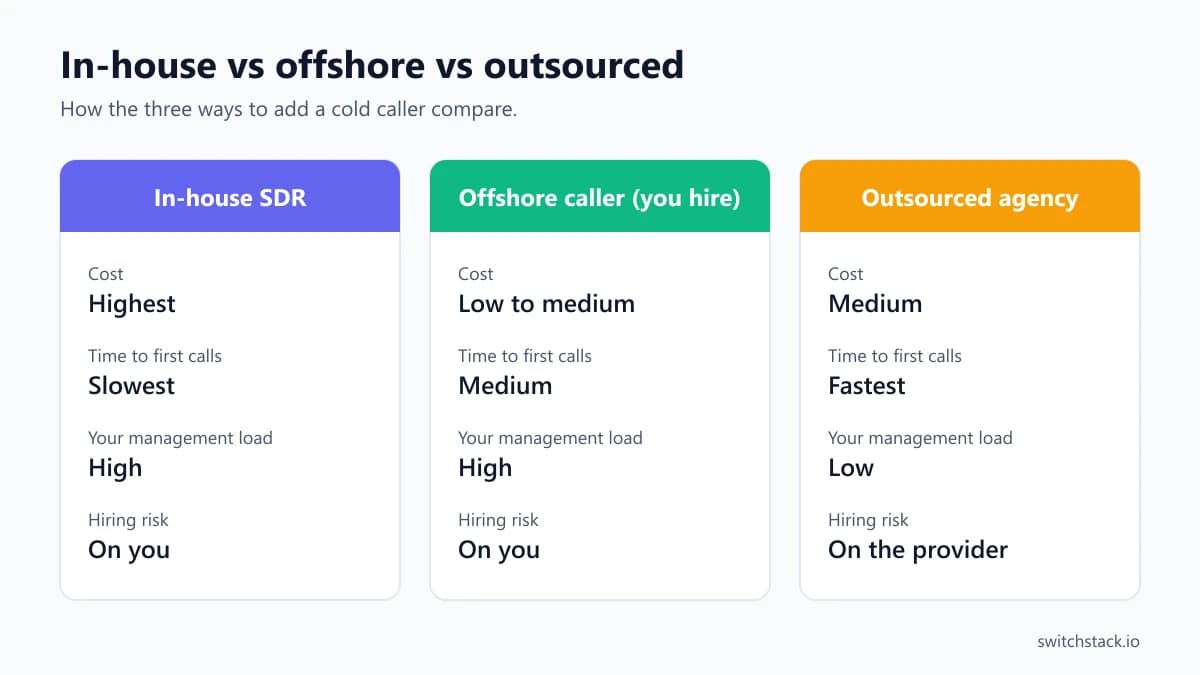
How you set up the team decides how much work lands on you. Here are the three main paths.
1. Hire Directly Through Job Sites
You can post on job sites like OnlineJobs.ph or Upwork and hire a caller yourself.
- Pros: The lowest cost per hour on paper.
- Cons: You handle sourcing, vetting, payroll and compliance. You also train and manage the caller. If they leave, you start the search again.
2. Employer of Record (EOR)
A service like Deel or Remote lets you hire full-time employees in the Philippines legally.
- Pros: Payroll, contracts and compliance are handled for you. You can offer benefits that help you keep good people.
- Cons: You still find, vet, train and manage the caller yourself. If they do not book meetings, the cost is yours.
3. A Managed Calling Partner
A cold calling agency in the Philippines finds and vets the caller for you. Depending on the setup, it may also train and manage them.
- Pros: Less hiring work on your side. A good partner replaces a caller who does not work out.
- Cons: A higher monthly cost than hiring directly. You also give up some control over who is hired and how they are managed.
The right choice depends on how much time you have to hire and manage. If no one on your team can run the day-to-day, a managed option is usually easier. For a side-by-side look at the trade-offs, see in-house vs outsourced SDRs. If you talk to agencies, take these questions to ask a cold calling agency with you.
How to Vet a Filipino SDR
A resume tells you little about how someone sounds on a cold call. Test the skills directly.
- Role-play test. Give the candidate a short script and play a busy prospect. Push back with real objections: "Just send me an email," "We already have someone for that," "Not interested." Watch how they recover.
- English and accent check. Do a live phone call, not just a video interview. Listen for clear speech and a natural pace. Check that they understand you the first time. Record the call and have a colleague listen too.
- Listening skills. Good callers ask questions and listen to the answers. Notice if the candidate talks over you or sticks to the script no matter what you say.
- US-hours fit. Confirm they can work your hours every day. Ask how long they have worked night shifts before. Ask about their internet connection and their backup plan for power outages.
- References. Ask past managers about attendance, coachability and why they left.
For a fuller checklist, read our guide on how to evaluate Filipino sales reps. For pay ranges, see the Philippines SDR salary benchmark.
The 90-Day SDR Onboarding Plan
A common mistake is handing a new caller a script on day one and expecting meetings by day three. A new SDR needs time to learn your offer and your buyers. Here is a simple 30/60/90-day plan.
Days 1-30: Learn the Offer
Your SDR needs to know your Ideal Customer Profile (ICP), what you sell, and why buyers choose you. Spend the first two weeks on training and role-play before live calls. If you need a starting point, see these cold calling scripts that actually work.
- Goal: Know the offer and the script well enough to explain them in their own words.
- What to check: Can they explain what you sell in one or two sentences? Do they record every call outcome the way you ask? Do they ask discovery questions, or only read the script?
- What to expect: Few or no meetings. Focus on building good habits.
Days 31-60: Ramp Up
The caller is now on the phone for full shifts. Listen to recorded calls every day at first. Pick a few calls and focus on one skill at a time, usually objection handling.
- Goal: Handle common objections smoothly and sound natural, not like they are reading.
- What to check: The first qualified meetings. Use what you hear on calls to adjust your opening line and your offer.
Days 61-90: Steady Output
By month three, the caller should know the common objections and handle them well. Your script should be tested and mostly settled.
- Goal: Hit an agreed weekly meeting target consistently.
- What to check: Meetings that actually happen and qualify, not just meetings booked.
Setting KPIs and Managing the Work
Hold offshore SDRs to the same standard as a US hire. A lower cost is not a reason to lower the bar. Track a few numbers each week:
- Calls made per day: This shows effort. Set a target that fits your market and the quality of your contact list.
- Conversations: The share of calls that reach a real decision-maker. If this is low, check your contact list first.
- Meetings booked and held: The number that matters most.
Numbers alone do not tell you why a caller is struggling. Pair them with a regular management routine:
- Daily: A short check-in at the start of the shift. Listen to two or three recorded calls.
- Weekly: A one-on-one to review the numbers, play back calls, and pick one skill to work on.
- Monthly: Review the script and the target list based on what callers are hearing.
Also plan for turnover. Decide in advance how long a caller gets to hit targets, and how you will find a replacement if someone leaves.
How Switchstack Can Help
Switchstack provides Filipino callers in two ways:
- We Call for You: $2,499/month per caller. We supply, train and manage a dedicated Filipino caller who books meetings for you.
- Hire a Caller: $1,799/month per caller. A vetted full-time caller joins your team, works US hours, and reports to you.
Both options have no setup fee and run month-to-month with 30 days' notice. Replacement is free in the first 30 days. Every call is recorded. Callers start in about 2 weeks.
Selling a SaaS product? See how this works for SaaS outbound. To learn more, read about how to hire Filipino cold callers, compare pricing, or contact us.
Written by
Switchstack Team
Switchstack
Guides on cold calling and hiring callers from the Switchstack team.
Newsletter
Tactics worth your inbox.
Outbound tactics and product updates — only when we have something genuinely worth sharing.