B2B Appointment Setting: How It Works and What It Really Costs
What B2B appointment setting is, how a booked meeting gets made, the four ways providers charge, and how to work out what each held meeting really costs you.
B2B appointment setting is the job of contacting business prospects, checking that they fit, and booking a sales meeting for someone else to run, usually an account executive or the founder. The appointment setter doesn't sell the product. They start the conversation and put a qualified meeting on the seller's calendar.
Most B2B appointment setting happens on the phone, with a short email to confirm each meeting. This guide covers how it works step by step, the four ways providers charge, how to work out what each meeting really costs you, and how to choose between doing it in-house and outsourcing it.
Table of Contents
- What Is B2B Appointment Setting?
- Why a Booked Meeting Is Worth Paying For
- How B2B Appointment Setting Works, Step by Step
- What a Good Booking Call Sounds Like
- Agree on What a Qualified Meeting Is
- B2B Appointment Setting Cost: The 4 Pricing Models
- How to Work Out Your Real Cost per Meeting
- In-House or Outsourced?
- How to Choose a B2B Appointment Setting Provider
- 7 Common Mistakes to Avoid
- How Switchstack Fits
What Is B2B Appointment Setting?
B2B appointment setting sits between finding leads and closing deals. Lead generation finds companies and people who might buy. Appointment setting contacts them and books a meeting. The seller then runs that meeting and works the deal.
The person who does the job is called an appointment setter, or often a sales development rep (SDR). The difference is mostly scope. An appointment setter focuses on calling and booking. An SDR may also research accounts and work several channels. For a one-line definition, see our glossary entry on appointment setting.
A booked meeting usually means a 15- to 30-minute call or video meeting between the prospect and your seller, with a calendar invite both sides have accepted.
It helps to be clear about what appointment setting is not:
- It isn't closing. The setter doesn't quote prices or negotiate. Their job ends when a qualified meeting is on the calendar.
- It isn't a list of leads. A lead is a name. An appointment is a time when a real person has agreed to talk to you.
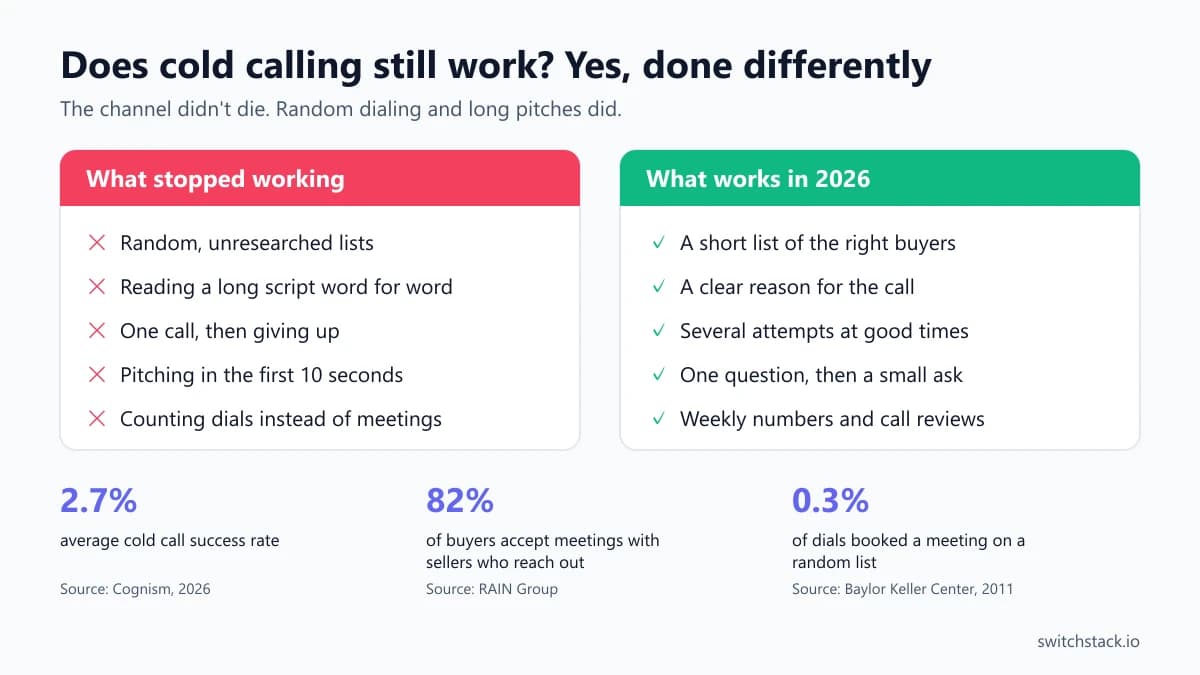
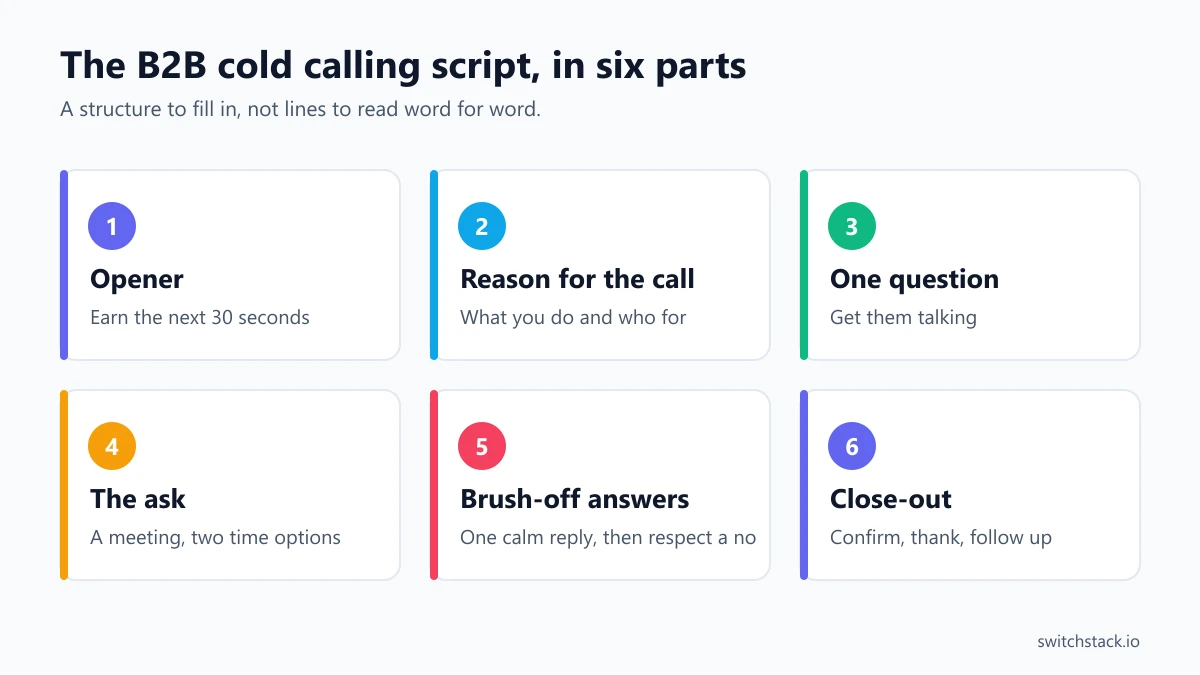
- It isn't reading a script word for word. Good setters follow a script, but they listen and adapt to what the prospect says.
Why a Booked Meeting Is Worth Paying For
Buyers spend very little time with sellers. Gartner's research on the B2B buying journey found that B2B buyers spend only about 17% of their buying time meeting potential suppliers. When they compare several suppliers, each one gets a small slice of that 17%.
So a meeting with the right person is scarce. Getting one takes many calls, a clear reason to talk and someone who keeps going after a no. That's why many companies treat B2B appointment setting as its own job, instead of asking their best seller to make the cold calls as well.
It also explains why B2B appointment setting is so often priced per meeting. The meeting is the hard part.
How B2B Appointment Setting Works, Step by Step
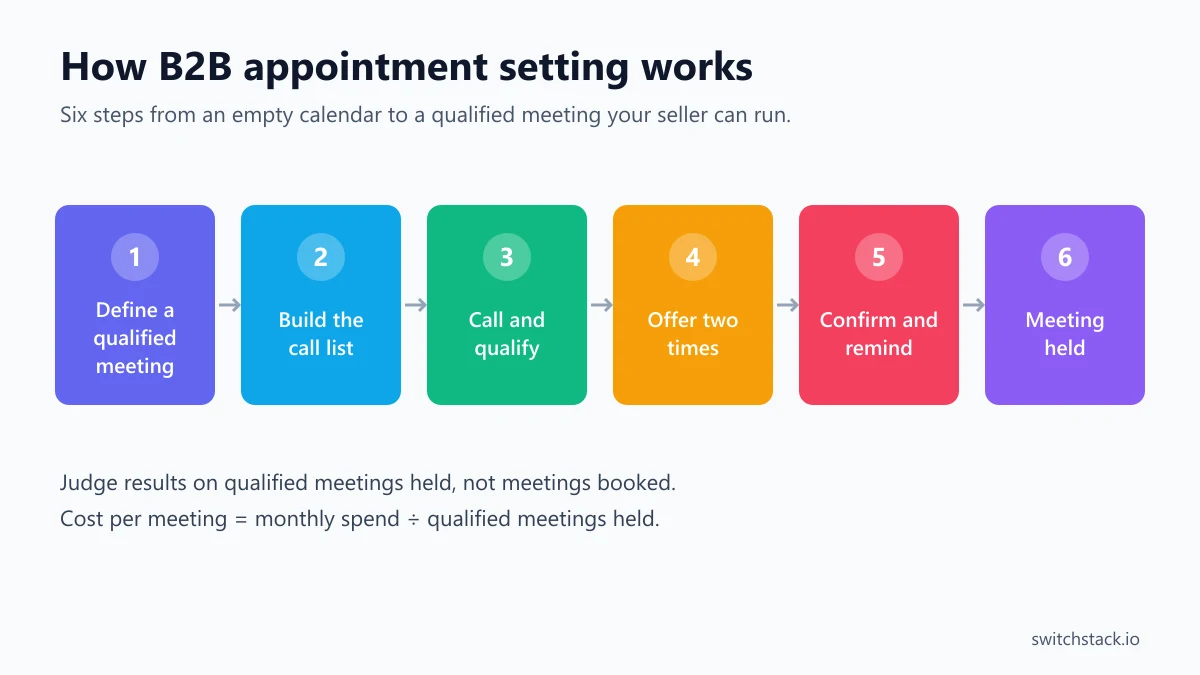
Whether you do it yourself or pay someone, the process has the same six steps.
1. Define a Qualified Meeting
Write down who you want to meet and what must be true before a meeting counts. The next section shows how. Skip this step and you'll argue about every meeting later.
2. Build the Call List
Pick companies that match your ideal customer, then the right person at each one: their name, title and phone number. A small, accurate list beats a large, out-of-date one. Check the calling rules in your target market before you start. Our page on cold calling laws by country covers 18 markets.
3. Call and Qualify
A booking script is short. It needs an opener, a reason for the call, one or two questions to check fit, and the ask. Our B2B cold calling script template has a fill-in version, and these cold calling openers cover the first ten seconds.
Call during your prospects' business hours. People answer the phone at work, during their working day. If your prospects are in London and your setter is in Manila, the setter works London hours. Calling at the wrong time is one of the most common reasons a good list produces few conversations.
4. Offer Two Times
When the prospect is interested and fits, the setter offers two specific times: "Would Tuesday at 10 or Wednesday at 2 work better?" Two options get a faster answer than "When are you free?"
The setter sends the calendar invite straight away, ideally while the prospect is still on the line. Then they write a short handover note for the seller: who they spoke to, what the prospect said, and why they agreed to meet.
5. Confirm and Remind
Send a confirmation email right after the call and a reminder the day before the meeting. Both are short. They remind the prospect why they said yes.
6. Meeting Held
A meeting only counts when it happens. If the prospect doesn't show up, the setter calls to rebook. After the meeting, the seller tells the setter whether it was a good fit, so the next bookings get better.
What a Good Booking Call Sounds Like
Here is a short example of B2B appointment setting on the phone. The setter works for a managed IT provider and is calling the operations manager at an accounting firm. The names are placeholders.
Setter: Hi Sarah, it's Ana from [Company]. I know I'm calling out of the blue. Can I take 30 seconds to tell you why, and you tell me if it's worth a longer chat?
Prospect: Go on.
Setter: We look after IT support for accounting firms with 20 to 100 staff. The firms we speak to often say the same thing: support tickets take days, and nobody really owns security. Is either of those true for you?
Prospect: The tickets part, yes. Our provider is slow.
Setter: How many people are in the office now?
Prospect: About 45.
Setter: That's right in the range we work with. Would a 20-minute call with our founder make sense, to see if we can fix the response times? Would Tuesday at 10 or Wednesday at 2 work better?
Prospect: Wednesday.
Setter: Great. I'm sending the invite now. Can you see it come through?
Why this call works:
- The opener asks for permission. It admits the call is unexpected and asks for 30 seconds, which lowers the prospect's guard.
- The reason is a problem, not a pitch. The setter names two common problems and lets the prospect pick one.
- There is one qualifying question. Office size checks fit without turning the call into a survey.
- The ask offers two times. It's easier to choose between two options than to think of a time.
- The invite goes out on the call. The prospect accepts it before they hang up, so the meeting is real.
After the call, Ana writes the handover note for the founder:
Sarah, operations manager, accounting firm, about 45 staff. Unhappy with how slowly the firm's current IT provider answers tickets ("it takes days"). Didn't mention security. Contract end date unknown. Agreed to a 20-minute call on Wednesday at 2pm about response times.
The founder now knows who they're meeting, what the prospect cares about and what the prospect hasn't said yet.
Agree on What a Qualified Meeting Is
The most important document in B2B appointment setting is one paragraph long: your definition of a qualified meeting. It decides what the setter aims for, what you pay for and how you judge results.
A good definition covers four checks:
| Check | Example |
|---|---|
| Right company | A B2B company with 20 to 500 employees in the US or Canada |
| Right person | Head of sales, sales director or founder |
| Real reason to talk | They have the problem you solve, or they're open to hearing how others solve it |
| Meeting held | The prospect joins the meeting at the agreed time |
Keep it simple enough that a setter can check it on a five-minute call. Ask your seller to flag any meeting that didn't meet the definition, so the setter learns what a good one looks like.
Then track three numbers separately:
- Meetings booked: the prospect said yes and accepted the invite.
- Meetings held: the prospect turned up.
- Qualified meetings held: the prospect turned up and met your definition.
Judge results on the third number. Our guide to how many cold calls it takes to book a meeting shows how to track every step, from dials to meetings held.
B2B Appointment Setting Cost: The 4 Pricing Models
Providers charge in four main ways. A quoted price means little until you know which model it is and what counts as a billable meeting.
| Model | What you pay for | Works well when | Watch out for |
|---|---|---|---|
| Pay per appointment | Each meeting booked or held | You want cost tied directly to results | Pressure to book anyone who says yes; extra fees for lists or setup |
| Monthly retainer | A team's time and effort, whatever the result | You want a provider to run the whole program | Paying for slow months; long minimum terms |
| Hybrid | A lower monthly base plus a fee per meeting | You want to share the risk | Two sets of terms to check |
| Dedicated caller | One full-time caller working only for you, for a flat monthly fee | You want control, steady effort and the same voice on every call | You need a clear script and someone to review results |
Published prices vary widely. A 2026 appointment setting pricing guide from Prospeo lists pay-per-appointment at $150 to $400 per meeting, fully verified meetings at $400 to $750, and agency retainers at $3,000 to $8,000 a month. Expect higher prices when you target senior people at large companies, because they're harder to reach.
Before you compare quotes, ask every provider four questions:
- Do you charge for meetings booked, or only for meetings held?
- Who decides whether a meeting was qualified?
- Is there a setup fee, a list or data fee, or a minimum term?
- Is the caller dedicated to me, or shared across several clients?
For a wider look at how cold calling is priced, including hourly rates, see our cold calling pricing guide.
How to Work Out Your Real Cost per Meeting
In B2B appointment setting, the headline price isn't your cost. Your real cost is:
Cost per qualified meeting = total spend in a month ÷ qualified meetings held that month
Here is an example with made-up numbers. It isn't a forecast. It only shows how the math works.
Option A: pay per appointment at $300 per booked meeting. The provider books 20 meetings, so you pay $6,000. Four prospects don't show up and three aren't a good fit. That leaves 13 qualified meetings held, so each one cost you about $462, not $300.
Option B: a flat $3,000 a month. The caller books 15 meetings. Three don't show up and two aren't a good fit, which leaves 10 qualified meetings held at $300 each. In a slow month with only 5 qualified meetings, each one costs $600.
What the example shows:
- With pay per appointment, no-shows and poor-fit meetings raise your real cost, unless the contract only charges for qualified meetings held.
- With a flat fee, your cost per meeting falls as the caller gets better at your offer, and rises in a slow month.
- Neither number means much after one week. Agree on a test period of at least a month before you judge any option.
Track your own numbers for a month, then compare options on cost per qualified meeting held, not on the price list.
In-House or Outsourced?
You can run B2B appointment setting with your own team or pay someone else to do it. Here is the short version:
- Do it in-house if calling is a core, long-term part of how you grow and someone on your team can coach a caller every day.
- Outsource it if you need meetings soon, nobody has time to manage a caller, or you want to test a new market before you hire.
- Use a dedicated outsourced caller if you want the control of your own hire without the recruiting, payroll and replacement risk.
We compare all three on cost, control, ramp time and risk in our guide to in-house SDR vs outsourced cold calling.
How to Choose a B2B Appointment Setting Provider
If you outsource, these seven checks separate good providers from the rest:
- Who makes the calls? Ask whether you get a dedicated caller or a share of a pool. A dedicated caller learns your offer faster and sounds the same on every call.
- Can you hear the calls? Ask for sample recordings before you sign, and recordings of your own calls every week after that.
- Is "qualified" in the contract? It should be your definition, not theirs.
- Do they call during your prospects' hours? A caller in another country should work your market's business day.
- Do they know the local rules? They differ by country. In the UK, numbers are screened against the TPS and CTPS registers. Germany needs at least presumed consent for B2B calls. The UAE limits calls to 9am to 6pm.
- What happens if it isn't working? Check the notice period, any minimum term and whether they replace a caller who isn't a good fit.
- Who owns the data? You should keep the call recordings, notes and contact history if you leave.
Take our 12 questions to ask a cold calling agency into every sales call with a provider.
7 Common Mistakes to Avoid
These mistakes are easy to make in any B2B appointment setting program, in-house or outsourced:
- Paying for meetings booked instead of held. It rewards volume, not quality.
- Booking anyone who says yes. A meeting with the wrong person wastes your seller's time and makes the numbers look better than they are.
- No handover note. Your seller should know why the prospect agreed to meet before the meeting starts.
- Skipping the confirmation and reminder. Two short emails help prospects remember the meeting and why they agreed to it.
- Calling outside your prospects' working hours. Fewer people answer, so the same list produces fewer conversations.
- Judging after one week. One week is too small a sample. Agree on a test period and the numbers you'll check at the end.
- No script, or a script read word for word. The first sounds unprepared. The second sounds like a recording. Use the script as a guide and practice it out loud.
How Switchstack Fits
Switchstack is a B2B cold calling company, and booking qualified meetings is what our done-for-you service is built for. Callers work from the Philippines, India, South Africa or Latin America, matched to your market, and call during your prospects' business hours.
- We Call for You: we supply, train and manage a dedicated caller who books meetings straight onto your calendar, from $2,199 a month per caller. You get a recording of every call and a weekly report on calls made, conversations and meetings booked.
- Hire a Caller: a vetted, full-time appointment setter who joins your team, works your list and reports to you, from $1,499 a month per caller. We handle contracts, payments and equipment. If you want a setter in the Philippines, see Filipino appointment setters.
Both run month to month with 30 days' notice, with no setup fee and a free replacement in the first 30 days. Calls start in about two weeks, and every new client gets 20% off the first 2 months. Not sure which country fits your market? Our country matcher recommends one in four questions, and full prices are on the pricing page.
Frequently Asked Questions
What is B2B appointment setting?
How much does B2B appointment setting cost?
What is the difference between appointment setting and lead generation?
How many meetings should an appointment setter book per month?
Is B2B appointment setting done by phone or by email?
Written by
Switchstack Team
Switchstack
Guides on cold calling and hiring callers from the Switchstack team.
Newsletter
Tactics worth your inbox.
Outbound tactics and product updates — only when we have something genuinely worth sharing.