Cold Calling for IT Service Providers and MSPs
Who to call, when to call, what to say and how to handle "we have an IT guy" when you sell managed IT services to small businesses.
Cold calling for MSPs works best when you call the owner or office manager of a small business at a moment when IT is on their mind: an office move, a hiring push, a new location or a contract renewal. Open with a reason for calling that fits their business, ask a few plain questions, and aim for a short meeting, not a sale. Then track dials, conversations and meetings so you know what is working.
This guide covers who to call, what makes a call timely, a sample opener, the objections you will hear most, and how to measure your results.
Table of Contents
- Why MSP Cold Calling Is Different
- Who to Call at a Small Business
- Triggers That Make a Call Timely
- A Sample Opener for MSP Cold Calls
- Qualification Questions to Ask
- Handling Common Objections
- How to Measure Results
- A Note on Calling Rules
- Getting the Calls Made
Why MSP Cold Calling Is Different
Selling managed IT to a 15-person accounting firm is not like selling to an enterprise. A few things stand out:
- There is usually no IT buyer. Nobody at a small business has "IT" in their title. The decision sits with the owner, or with whoever keeps the office running.
- Almost everyone already has "someone." It might be another MSP, a freelancer, or the owner's nephew. You are rarely filling an empty seat. You are offering a better option for later.
- Pain is invisible until it isn't. Owners don't think about backups or email security until a laptop dies or an invoice scam lands. Your call needs a reason that makes sense today.
- Trust matters more than features. A small business is handing you the keys to its files and accounts. A calm, plain-spoken caller earns more meetings than a slick one.
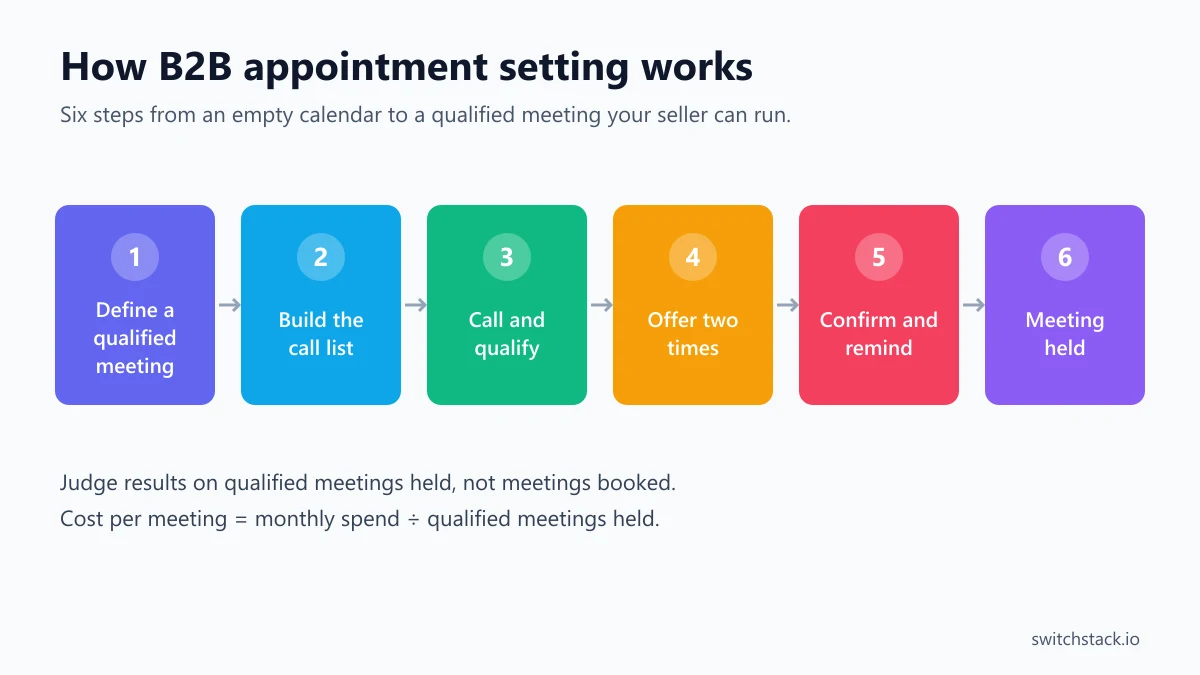
So the goal of the first call is modest: find out how they handle IT today, when that might change, and whether a 20-minute conversation is worth their time.
Who to Call at a Small Business
Your best contact depends on company size.
| Company size | Who usually decides | Who is easiest to reach |
|---|---|---|
| Under 10 people | Owner | Owner (often answers the phone) |
| 10 to 50 people | Owner, with input from the office manager | Office manager |
| 50 to 200 people | Operations lead, COO or controller | Operations lead or office manager |
A few practical notes:
- The office manager is not a gatekeeper to get past. In many small firms, they are the person who calls the IT provider, chases tickets and feels every outage. Treat them as a buyer. They often set up the meeting with the owner for you.
- Ask who handles IT. When someone answers, a simple "Who looks after computers and IT there?" gets you a name. Write it down and use it.
- Call one vertical at a time. Dental offices, law firms and accounting practices each have their own worries. Focusing on one lets your caller learn the language fast.
Triggers That Make a Call Timely
A call lands better with a reason behind it. These triggers are easy to spot, and each one puts IT on the owner's mind. A new owner or new office manager is another good signal, since new people often review vendors.
Office moves and renovations
Moving means new internet service, cabling, Wi-Fi and moving servers or printers. Watch local business news and "we're moving" posts. Call before the move, not after.
Hiring
A business hiring several people needs new laptops, new accounts and a smooth first day. Job posts on their website or job boards are an easy signal. A line like "I saw you're hiring three people this month" is specific and true.
Opening a new location
A second office means connecting two sites, sharing files and keeping both secure. Watch for grand opening notices, new addresses on websites and local press.
Contract renewals
MSP agreements often run for a fixed term. You can't see the renewal date from outside, so ask for it on the first call and record it. A business that says "we're happy, but our contract ends in March" is a warm lead for January.
A Sample Opener for MSP Cold Calls
Here is an example opener for an office manager at a growing firm. Adjust it to your business and keep it honest. For more on openers, see our post on cold calling openers that actually work.
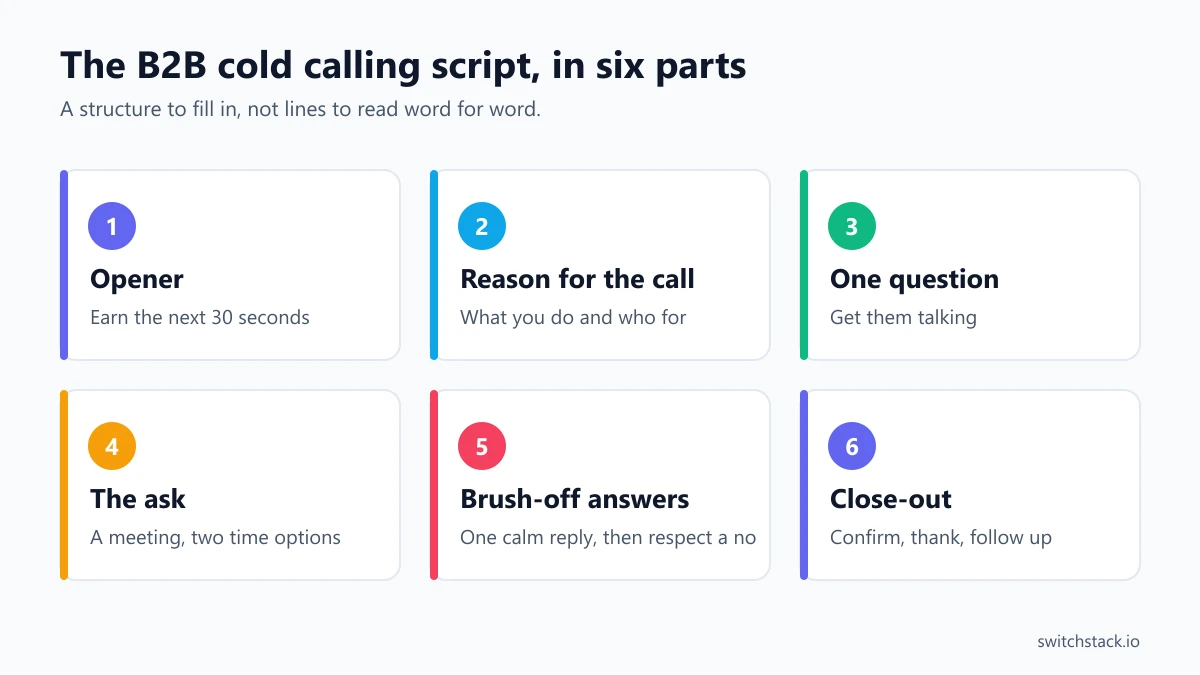
"Hi Maria, this is Sam with [Company]. We look after IT for small accounting firms here in [city]. I'm calling out of the blue, so can I take 30 seconds to say why, and you decide if it's worth continuing?"
(Yes)
"I saw you're hiring two staff accountants. When firms your size add people, the setup work usually lands on whoever runs the office: laptops, email accounts, access to client files. I'm curious how that's handled at your firm today?"
If they answer, listen. Don't pitch your whole service. Ask one or two follow-up questions, then ask for a short meeting with two specific times: "Would Tuesday at 10 or Thursday at 2 work for a 20-minute call?"
Qualification Questions to Ask
You don't need all of these on the first call. Pick two or three that fit the conversation.
- "Who looks after your IT today: an outside company, a freelancer, or someone in-house?"
- "How long have you worked with them, and is that on a contract?"
- "When does that agreement come up for renewal?"
- "When something breaks, how quickly does it usually get fixed?"
- "How many people and locations do you have now, and is that changing this year?"
- "If you lost access to your files for a day, what would that cost the business?"
- "Besides you, who else would weigh in on a change like this?"
Write the answers down. The renewal date and the name of the current provider are worth recording even if the answer today is "not interested."
Handling Common Objections
Objections from small businesses are usually honest. Answer them plainly and don't argue.
"We have an IT guy."
This is the most common answer, and it is not a no. Try:
"That's great, most firms we talk to do. Is that someone on your team, or an outside person? ... And how is it going when something urgent comes up, like a laptop dying the morning of a client meeting?"
If they're happy, ask: "Would it be okay if I checked back in six months?"
"We're under contract."
"Makes sense. When does that come up for renewal? Most owners like to compare options a couple of months before, so they're not deciding in a rush. Could we put a short call on the calendar ahead of that?"
Record the date. A renewal date is one of the most useful things a cold call can uncover.
"Send me some information."
"Happy to. So I send something useful rather than a generic brochure, what's the one IT issue that bugs you most right now?"
Then send something short that addresses that one issue, and suggest a meeting time in the same email.
"We're too small to need managed IT."
"That's fair. Plenty of small firms feel that way until they have a bad day, like a ransom email or a lost laptop. Can I ask how backups are handled now?"
If they truly have no need, thank them and move on. Not every business is a fit.
How to Measure Results
Cold calling for MSPs is a numbers game with long cycles, so measure the steps, not just closed deals. Track these weekly in a simple spreadsheet:
| Metric | What it tells you |
|---|---|
| Dials | Effort. Is the caller putting in the hours? |
| Conversations (reached a real person) | List quality and calling times |
| Conversations with a decision maker | Whether you're reaching the right role |
| Meetings booked | Opener and offer strength |
| Meetings held | Quality of the booking and reminders |
| Renewal dates captured | Future pipeline you're building |
| Proposals and closed deals | Revenue, measured over months |
How to use the numbers:
- Run two to four weeks before judging. One good or bad day tells you little. Look at ratios, such as conversations per 100 dials and meetings per 10 conversations.
- Change one thing at a time. If you change the opener, keep the list and calling times the same so you know what made the difference.
- Listen to recordings every week. Numbers tell you where calls stall. Recordings tell you why.
- Count renewal dates as an outcome. In this market, a captured renewal date is often the real win of a first call. Set a reminder to call back two to three months before it.
A Note on Calling Rules
The US Federal Trade Commission says that "most phone calls between a telemarketer and a business are exempt" from the Telemarketing Sales Rule, with some exceptions (FTC, Complying with the Telemarketing Sales Rule). That does not cover every situation. Many small business owners list a personal cell phone, and some states have their own rules. Check the rules for where you call, honor every "don't call me again," and keep your own do-not-call list. This is not legal advice.
For a full call structure you can adapt to your services, see the B2B cold calling script template, and track results with how many cold calls it takes to book a meeting.
Getting the Calls Made
Most MSP owners know they should be calling more, but client work always comes first. If you want consistent calling without taking time away from your techs, Switchstack offers two options:
- We Call for You, $2,499/month per caller. We supply, train and manage a dedicated Filipino caller who calls your prospects and books meetings on your calendar. Includes a script written with you, daily management and quality checks, call recordings and a weekly report.
- Hire a Caller, $1,799/month per caller. A vetted, full-time Filipino caller (40 hours a week, US business hours) joins your team, works your list and reports to you. We handle payroll, HR and equipment.
Both have no setup fee, run month-to-month with 30 days' notice, include a free replacement in the first 30 days, and start in about two weeks. Every caller is tested on role-play calls before you meet them. If you'd rather vet callers yourself, our guide on how to evaluate Filipino sales reps walks through what to check. See full details on our pricing page.
Frequently Asked Questions
Is cold calling still worth it for MSPs?
Who should an MSP ask for when cold calling a small business?
How many calls does it take to book a meeting with a small business?
Should MSPs call businesses that already have an IT provider?
Written by
Switchstack Team
Switchstack
Guides on cold calling and hiring callers from the Switchstack team.
Newsletter
Tactics worth your inbox.
Outbound tactics and product updates — only when we have something genuinely worth sharing.