B2B Cold Calling Script Template (With 2 Examples)
A fill-in-the-blanks B2B cold calling script with brush-off answers, gatekeeper and voicemail lines, and two worked examples you can adapt.
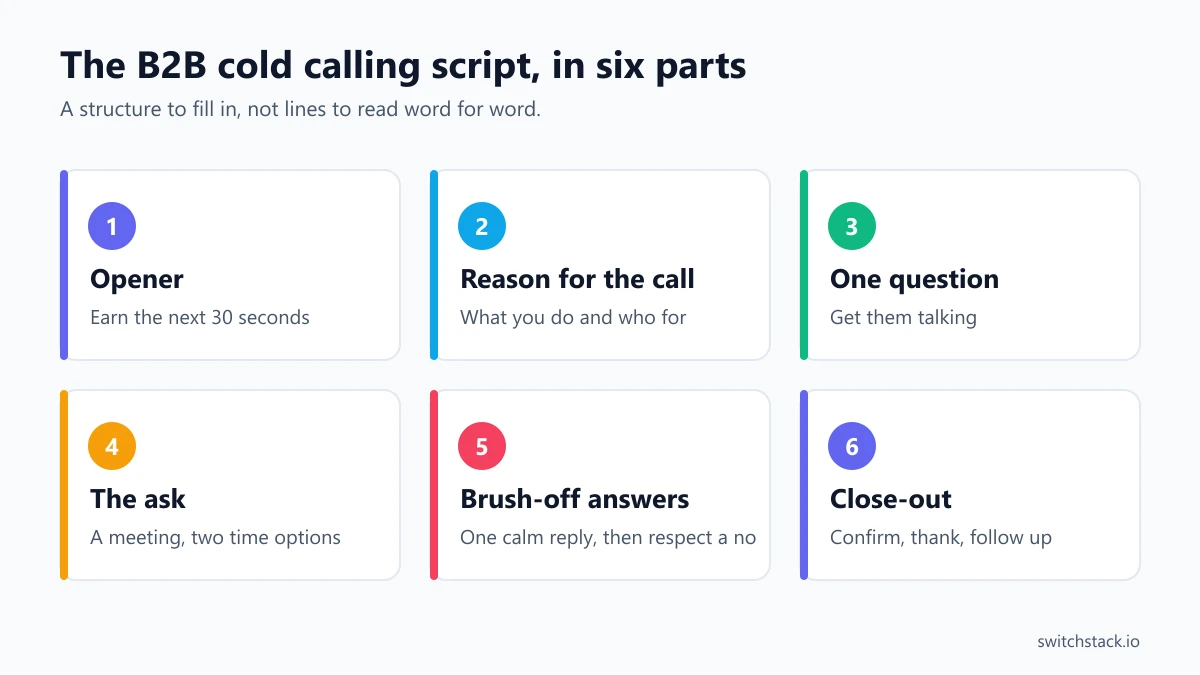
A B2B cold calling script works best as a short, fill-in-the-blanks template with five parts: an opener, one sentence on why you called, one question, a clear ask for a meeting, and ready answers to the brush-offs you hear every day. You fill in the blanks for your offer and your buyer, then practise until it sounds like you talking. Below is the template, gatekeeper and voicemail lines, and two worked examples for different B2B offers.
Table of Contents
- The B2B Cold Calling Script Template
- How to Fill In Each Part
- Handling the 5 Most Common Brush-Offs
- Gatekeeper Lines
- Voicemail Script
- Worked Example 1: Bookkeeping for Construction Firms
- Worked Example 2: Commercial Cleaning for Office Managers
- How to Test and Improve Your Script
- Need Someone to Make the Calls?
The B2B Cold Calling Script Template
Copy this and fill in the parts in brackets. If the call goes well, you reach the ask in about two minutes.
- Opener: "Hi [first name], this is [your name] from [company]. [Your opener line.]"
- Reason for the call: "The reason I'm calling is that we help [type of company or role] with [specific problem], mainly by [what you do, in plain words]."
- One question: "Can I ask, how are you handling [problem] right now?"
- The ask: "It might be worth a [15]-minute call to see if this fits. Would [day] at [time] or [day] at [time] work better?"
- Brush-off answers: one short line ready for each of the five common brush-offs (see below).
- Close-out: "Great. I'll send an invite to [email] for [day and time]. Is there anyone else who should join?"
Here is what each part is for:
| Part | Goal | Rough length |
|---|---|---|
| Opener | Earn the next 30 seconds | About 10 seconds |
| Reason for the call | Say what you do and who you do it for | About 15 seconds |
| One question | Get them talking about their situation | As long as they talk |
| The ask | Get a meeting on the calendar | About 10 seconds |
Learn the order and the key lines, then say them the way you normally speak.
How to Fill In Each Part
The opener
We cover openers in detail in 3 cold calling openers that actually work: the specific observation, the permission-based open and the plain problem statement. Pick one, and don't pitch in it. Its only job is to keep them on the line long enough to hear why you called.
The reason for the call
This is one sentence. It answers three things: who you help, what problem you solve, and what changes for them.
- Weak: "We're a full-service solutions provider helping organisations optimise their operations."
- Better: "We do the books for small construction firms, so owners can see which jobs made money each month."
If a friend outside your industry can't repeat it back, it is too vague. Leave out any claim you can't back up.
The one question
Plan one open question about how they handle the problem today. Then stop and listen. Good follow-ups come from what they say, not from your script. "How's that working?" and "What happens when it goes wrong?" are often all you need.
If they don't have the problem, thank them and move on. You have saved you both time.
The ask
Ask for a meeting, not a sale. Say how long it will take and offer two specific times. "Tuesday at 10 or Wednesday at 2?" is easier to answer than "When are you free?" If they hesitate, offer to send a short email first and agree a day you will call back.
Handling the 5 Most Common Brush-Offs
Most brush-offs are reflexes, not decisions. The pattern for each answer is the same: agree with them, give one short reply, then ask a question. Don't argue. If they say no a second time, respect it.
1. "I'm not interested."
"That's fair, I did call out of the blue. So I know whether to follow up or not, is [problem] something you deal with at all?"
2. "Just send me an email."
"Happy to. So I send something useful, is [option A] or [option B] the bigger issue for you right now?" Then: "I'll send it today and call you on [day] to see if it's worth a chat. Is morning or afternoon better?"
3. "We already have someone for that."
"Makes sense. I'm not asking you to switch today. If there were one thing you'd change about how it works now, what would it be?"
4. "We don't have the budget."
"Understood, and I'm not asking you to buy anything on this call. When do you usually set budgets for [area]? A short call now would give you something to compare when that time comes."
5. "I'm busy right now."
"No problem. Is later today or tomorrow morning better?" Then book the callback like a real meeting, with a set time, and call exactly when you said you would.
If you hear the same brush-off again and again, that is a signal. It usually means the reason for the call isn't clear, or you are calling the wrong people.
Gatekeeper Lines
Receptionists and assistants are doing their job. Be polite, be direct and never pretend you have a relationship you don't have.
- When you know the name: "Hi, this is [your name] from [company]. Could you put me through to [first and last name], please?"
- When asked what it's about: "I'm calling about [problem area] for [their team]. It's a short call to see if it's relevant. Is [first name] the right person for that, or is it someone else?"
- When you don't know the name: "I'm hoping you can help me. Who looks after [area] there?"
- When they won't put you through: "Understood. When is the best time to reach [first name] directly? Or is there an email address I should use?"
Write down what the gatekeeper tells you: their name, the best time to call and who really decides.
Voicemail Script
Keep it under 30 seconds. Use one reason, one action and your number said twice.
"Hi [first name], it's [your name] from [company]. I'm calling because we help [type of company] with [problem]. I'll also send you a short email today with the subject line '[subject]'. You can reach me on [number]. Again, that's [number]. Thanks."
A few tips:
- Say your number slowly, both times.
- Send the email you promised, with the same subject line.
- Don't pitch. The voicemail only needs to make your name familiar for the next call.
Worked Example 1: Bookkeeping for Construction Firms
This is a fictional example. A bookkeeping firm calls owners of small construction companies with 10 to 50 staff.
- Opener: "Hi Dana, this is Sam from Ledgerline Bookkeeping. I saw on your website that you've taken on three new commercial jobs this year. Can I take 30 seconds to tell you why I called?"
- Reason for the call: "We do the books for construction firms your size, mainly job costing, so you can see which jobs actually made money each month."
- One question: "How are you tracking profit on each job right now?"
- The ask: "If it's useful, I can show you a sample monthly job report in 15 minutes. Would Tuesday at 10 or Wednesday at 3 work better?"
- Likely brush-off: "Our accountant handles that."
- Reply: "Makes sense. Plenty of owners have an accountant for year-end taxes. Do they also give you job-by-job numbers each month, or mostly at year-end?"
Worked Example 2: Commercial Cleaning for Office Managers
Also fictional. A commercial cleaning company calls office managers at offices with 30 to 150 people.
- Opener: "Hi Priya, it's Jordan from BrightDesk Cleaning. I know I'm calling out of the blue. Can I take 30 seconds to tell you why, and you decide if it's worth continuing?"
- Reason for the call: "We clean offices of 30 to 150 people after hours, and we send you a short checklist every morning so you can see what was done."
- One question: "When your current cleaners miss something, how do you find out, and how quickly does it get fixed?"
- The ask: "Would a 20-minute walk-through and a written quote help? I could come by Thursday at 9 or Friday at 2."
- Likely brush-off: "We're locked into a contract."
- Reply: "Good to know. When does it come up for renewal? I'll call a couple of months before, so you have a quote to compare."
The structure is the same in both. Only the blanks change.
How to Test and Improve Your Script
A script improves through real calls, not desk edits. A simple routine:
- Read it aloud. Cut any line that doesn't sound like something a person would say.
- Role-play it. Have a colleague play a busy, slightly annoyed buyer. The role-play calls in our guide on how to evaluate Filipino sales reps work just as well for testing a script as for testing a caller.
- Record and listen. Where the law allows, and with any consent required, record calls and review a few each week. Note where prospects go quiet or cut you off.
- Count a few things. Track conversations, meetings booked and which brush-off came up on each call. A simple tally sheet is enough.
- Change one part at a time. If you change the opener and the ask in the same week, you won't know which change helped. Give each version a fair number of conversations before you judge it.
Once your script is running, use how many cold calls it takes to book a meeting to measure whether it is working.
Need Someone to Make the Calls?
A good script still needs someone to make the calls every day. Switchstack offers two ways to do that:
- We Call for You ($2,499/month per caller): we supply, train and manage a dedicated Filipino caller who calls your prospects and books meetings on your calendar. We write the script with you, run daily quality checks, and send call recordings and a weekly report.
- Hire a Caller ($1,799/month per caller): a vetted, full-time Filipino caller works 40 hours a week in US business hours, works your list and reports to you. We handle payroll, HR and equipment.
Both have no setup fee, run month-to-month with 30 days' notice, include a free replacement in the first 30 days and start in about two weeks. Every caller is tested on role-play calls before you meet them. See pricing for the details.
Frequently Asked Questions
How long should a B2B cold calling script be?
Should callers read the script word for word?
What is the goal of a B2B cold call?
What should I do if a prospect says no twice?
Written by
Switchstack Team
Switchstack
Guides on cold calling and hiring callers from the Switchstack team.
Newsletter
Tactics worth your inbox.
Outbound tactics and product updates — only when we have something genuinely worth sharing.