Cold Calling Openers That Actually Work (With Examples)
Seven B2B cold calling openers matched to real situations, the line to say right after each one, and what to do when they say no in ten seconds.
The best cold calling openers are short, honest and specific. They tell the prospect who you are, give one real reason for the call, and end with a question that is easy to answer. A good opener doesn't sell anything. It buys you thirty more seconds. Below are seven openers matched to different situations, the line to say right after each one, and a simple way to test them.
Table of Contents
- Why the First Ten Seconds Matter
- 1. The Specific Observation
- 2. The Permission-Based Open
- 3. The Plain Problem Statement
- 4. The Referral Opener
- 5. The Trigger Event Opener
- 6. The Call After an Email
- 7. The Old Lead Callback
- Which Opener to Use When
- When They Say No in the First 10 Seconds
- Common Opener Mistakes
- After the Opener
- How to Practice and Test Openers Week by Week
- Want Someone Else to Make the Calls?
Why the First Ten Seconds Matter
Most cold calls are lost in the first ten seconds. The person you called doesn't know who you are, and they're deciding whether to hang up.
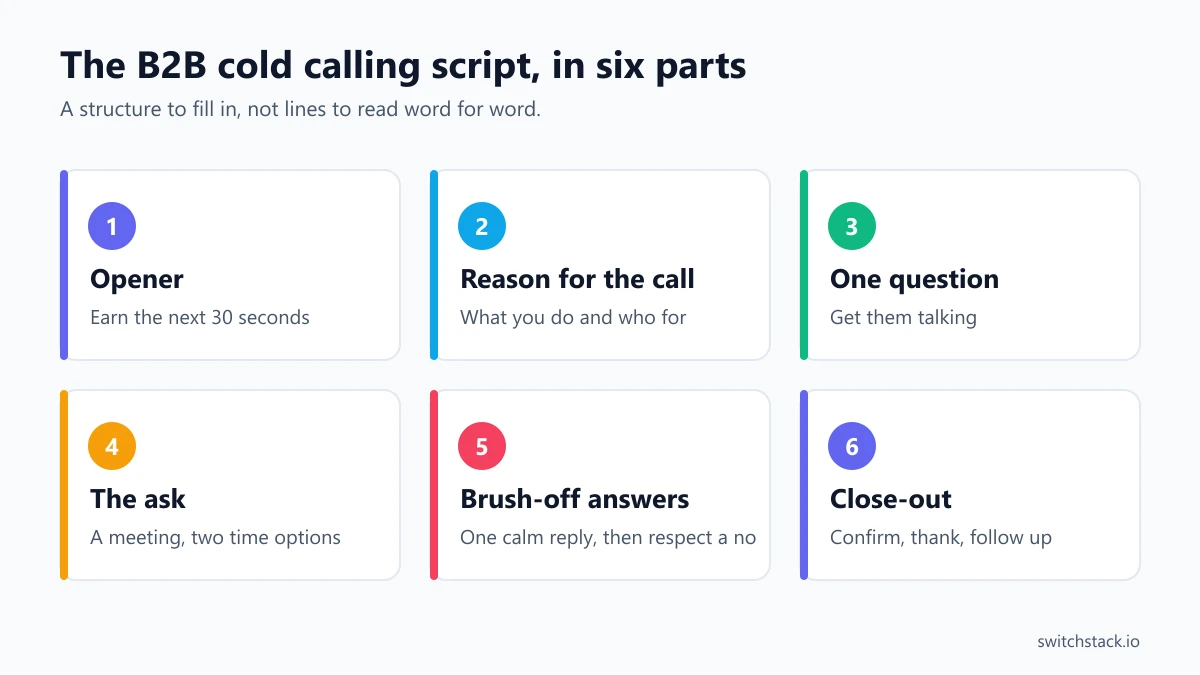
So the opener has one job: make it easy to keep talking. Every opener below follows the same pattern. Say your name and company, give one reason for the call, and ask a question. If you want the rest of the call laid out, use our B2B cold calling script template and drop your chosen opener into it.
1. The Specific Observation
Start with something true and specific about their company or role.
"Hi Maria, it's Sam from [company]. I saw you're hiring two account executives. Are they going to make their own calls, or will someone fill their calendars for them?"
This shows you did your homework, and it turns "Who is this?" into a real question they want to answer. It only works if the observation is real, so spend two minutes on their website or LinkedIn before you call.
Follow-up line: "The reason I ask is that we help teams keep new reps busy from week one. How are you planning to do that now?"
2. The Permission-Based Open
"I know I'm calling out of the blue. Can I take 30 seconds to tell you why I called, and then you decide if it's worth continuing?"
The ask is small and honest, so many people say yes. Once they've agreed, they listen. Then keep your word: say why you called in 30 seconds or less, and stop.
Follow-up line: After your 30 seconds, hand control back. "That's it. Does that sound like something you deal with, or am I off base?"
3. The Plain Problem Statement
Name a problem people in their role often have, in plain words, and ask if it's true for them.
"Most founders I speak with know they should be making more sales calls, but nobody has the time. Is that true for you too?"
If they say yes, you have a conversation. If they say no, you've learned something, and you can thank them and move on. Avoid big claims and made-up numbers. People can tell.
Follow-up line: "What usually gets in the way? Is it time, or finding the right people to call?"
4. The Referral Opener
Use this only if it is true. If someone actually suggested you call, say so. Never imply a connection you don't have. The prospect may check, and a fake name-drop ends the call and the relationship.
"Hi David, it's Sam from [company]. Priya at [their partner firm] suggested I give you a call. She mentioned you're trying to get more meetings with property managers. Is that still on your list?"
Follow-up line: "What did Priya tell you about that, or should I give you the short version?"
5. The Trigger Event Opener
A trigger event is something that just changed at their company: a new office, a funding round, a new head of sales, a product launch or a big hire. Changes create new problems, and people are more open to talking about them.
"Hi Alex, it's Sam from [company]. Congrats on opening the Dallas office. When teams expand into a new city, finding the first few customers there is usually the hard part. How are you handling that?"
Keep the congratulations short. One line, then the question.
Follow-up line: "Who on your team is responsible for getting that pipeline going?"
6. The Call After an Email
If you emailed first, the call is warmer, but don't assume they read it. Most people won't remember.
"Hi Jordan, it's Sam from [company]. I sent you a short email on Tuesday about booking more sales calls. I'm guessing it got buried, so I thought I'd call. Do you have a minute?"
Saying "it probably got buried" takes the pressure off. They don't have to admit they ignored you.
Follow-up line: "In short, the email asked one thing: [your question]. How are you handling that today?"
7. The Old Lead Callback
Old leads are people who showed interest months ago and then went quiet. They already know your name, so be direct about the history.
"Hi Chris, it's Sam from [company]. We spoke back in March about adding a caller to your team, and you said the timing wasn't right. I wanted to check if anything has changed since then."
Check your notes first so you can mention what they told you last time.
Follow-up line: "Last time you mentioned [their reason]. Is that still the main thing, or has something else come up?"
Which Opener to Use When
| Situation | Opener to try | What makes it work |
|---|---|---|
| No prior contact, you found something specific | Specific observation | Shows you did research |
| No prior contact, nothing specific found | Permission-based or plain problem | Honest, low-pressure ask |
| Someone really referred you | Referral | Borrowed trust, if it's true |
| Something just changed at their company | Trigger event | New changes create new problems |
| You emailed first | Call after an email | Warmer, but don't assume they read it |
| They showed interest months ago | Old lead callback | Honest about the history |
When They Say No in the First 10 Seconds
A fast "not interested" is usually a reflex, not a decision. They haven't heard enough to decide. You get one calm, short reply. If they say no again, respect it.
Try one of these:
- "Not interested." "Fair enough. Can I ask, is that because you've got this covered, or because it's just not a priority right now?"
- "I'm busy." "Understood. Is there a better time this week, or should I just send a two-line email?"
- "Send me an email." "Happy to. So I send something useful, what's the one thing you'd want to know?"
Don't argue and don't repeat your pitch louder. If they say no a second time, say "Thanks for your time, have a good day," and end the call. A polite exit keeps the door open for a later call. The script template has answers for more brush-offs.
Common Opener Mistakes
- Asking "How are you today?" It delays the reason for your call and signals a sales script.
- Talking for 30 seconds before asking anything. End the opener with a question within ten seconds.
- Pitching features in the first line. They don't care yet. Ask about their situation first.
- Fake familiarity. "We spoke last month" when you didn't, or a name-drop that isn't real.
- Made-up numbers. "We help companies grow 300%" sounds like every other call they ignore.
- Reading word for word. Learn the structure, then say it in your own words.
After the Opener
Ask one question about their situation, then listen. Don't pitch until you understand what they need. If there's a fit, ask for a short meeting and offer two specific times, such as "Tuesday at 10 or Wednesday at 2?" A clear choice is easier to say yes to than "When are you free?"
How to Practice and Test Openers Week by Week
Test openers on real calls, not on paper. Here's a simple plan.
Week 1: Practice out loud. Pick two openers that fit your list. Say each one out loud 20 times. Role-play with a colleague who plays a busy, slightly annoyed prospect. Record yourself and listen back. Cut any word you stumble on.
Week 2: Use opener A on every call. Track two numbers for every call where you reach a person: did they stay past 30 seconds, and did the call end with a meeting booked? A simple tally sheet is enough.
Week 3: Use opener B on every call. Same list type, same times of day, same tally. Changing only the opener makes the comparison fair.
Week 4: Compare and keep the winner. Look at the share of calls that got past 30 seconds. Keep the better opener, then test a new challenger against it next month. To plan how many calls that means for your goals, see how many cold calls it takes to book a meeting.
Listen to a few recorded calls each week too. You'll often hear the real problem, like a rushed first line or a question that's too broad, faster than the numbers show it.
Want Someone Else to Make the Calls?
If you don't have time to make these calls yourself, Switchstack offers two options. With We Call for You, we supply, train and manage a dedicated Filipino caller who calls your prospects and books meetings on your calendar, for $2,499 per month per caller. With Hire a Caller, you get a vetted, full-time Filipino caller who joins your team and works your list, for $1,799 per month. Both have no setup fee, run month-to-month, and every call is recorded. If you're comparing providers, here are the questions to ask a cold calling agency.
Frequently Asked Questions
How long should a cold calling opener be?
Should I ask 'How are you today?' on a cold call?
Can I use the same opener for every call?
How do I know if an opener is working?
Written by
Switchstack Team
Switchstack
Guides on cold calling and hiring callers from the Switchstack team.
Newsletter
Tactics worth your inbox.
Outbound tactics and product updates — only when we have something genuinely worth sharing.