In-House SDR vs Outsourced Cold Calling: How to Decide
Hire an SDR, hire an offshore caller yourself, or outsource to an agency? A plain guide to cost, control, ramp time, risk and which one fits your team.
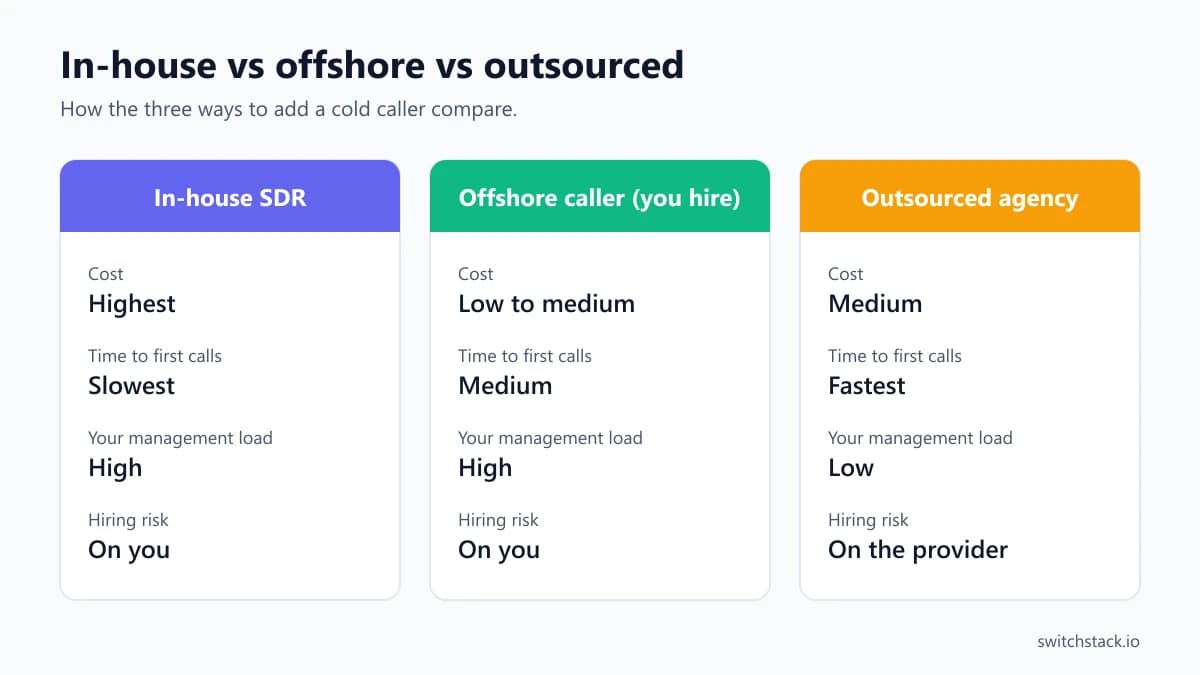
In-house vs outsourced SDR comes down to two questions: how much control you need, and how much management time you have. Hire an in-house SDR if calling is core to your growth and you have someone who can coach daily. Outsource cold calling if you want meetings booked soon without building a team. Hiring an offshore caller yourself sits in the middle: lower cost than a local hire, but you still do the managing.
This guide compares all three options on cost, control, ramp time, management load, risk and knowledge retention. It ends with clear "choose this if" advice.
Table of Contents
- The Three Options Explained
- What an In-House SDR Really Costs
- Side-by-Side Comparison
- The Six Trade-Offs That Matter
- Which Option Should You Choose
- Common Mistakes to Avoid
- How Switchstack Fits
The Three Options Explained
Before comparing, it helps to be precise about what each option means.
1. In-house SDR. You hire a sales development rep as your own employee, usually in your own country. They sit on your team, learn your product and report to you or a sales lead. You handle recruiting, pay, benefits and training.
2. Offshore caller you hire yourself. You find and hire a caller in another country, often the Philippines, as a contractor or employee. They work your hours and your list. You still recruit, test, pay and manage them. The main difference from option 1 is cost and location.
3. Outsourced cold calling (agency). You pay a company to make the calls for you. The agency hires, trains and manages the callers. You agree on the target market, the script and what counts as a booked meeting. You get meetings and reports, not an employee.
Some providers blend options 2 and 3. For example, a company may supply a dedicated offshore caller who works only for you but handle the payroll and HR. Ask any provider exactly who manages the caller day to day, because that decides how much of your time it takes.
What an In-House SDR Really Costs
Most founders compare an agency fee with an SDR's salary. That is the wrong comparison. The salary is only part of the cost.
Here is what the numbers look like using public data:
- Base pay. Payscale lists the average base salary for a Sales Development Representative in the US at $43,709 in 2026, with total pay (including commission) ranging from about $36k to $77k. Pay in your city may be higher or lower.
- Benefits. In the US Bureau of Labor Statistics' June 2026 employer cost release, private employers paid $32.82 per hour in wages and $14.07 per hour in benefits. Benefits made up 30.0 percent of total compensation. Put another way, that is roughly 43 cents in benefits for every dollar of wages.
A quick example, using those averages:
| Cost item | Rough yearly amount |
|---|---|
| Base salary (Payscale average) | $43,709 |
| Benefits (about 43% of wages, based on BLS averages) | about $18,700 |
| Subtotal before commission | about $62,400 |
That subtotal still leaves out commission, recruiting costs, a laptop and phone line, and the hours you or a manager spend hiring, training and coaching. Your own numbers will differ, so plug in your local salary and your real benefits cost.
For offshore pay, see our Philippines SDR salary benchmark. For how agencies price their work (per hour, per meeting or per month), see our cold calling pricing guide.
Side-by-Side Comparison
| Factor | In-house SDR | Offshore caller (you hire) | Outsourced agency |
|---|---|---|---|
| Cost | Highest | Low to medium | Medium |
| Control over calls | Full | Full | Shared |
| Time to first calls | Slowest (recruit, onboard) | Medium (recruit, set up) | Fastest |
| Your management load | High | High | Low |
| Hiring risk | On you | On you | On the provider |
| Knowledge retention | Strong while they stay | Strong while they stay | Weak unless you own the data |
| Easy to scale up or down | Hard | Medium | Easy |
No column wins every row. The right choice depends on which rows matter most to you right now.
The Six Trade-Offs That Matter
1. Cost
An in-house SDR is a fixed yearly cost, paid whether the role works or not. An offshore hire costs less per month but still carries recruiting time and setup costs. An agency is usually a monthly fee you can stop. Compare the full first-year cost of each, including the months before the caller is fully productive.
2. Control
With your own hire, you choose every word of the script, every list and every follow-up. With an agency, you share control. Good agencies let you approve the script and listen to calls. Weak ones send you a meeting count and little else. Always ask to hear recordings before you sign.
3. Ramp Time
Ramp time is how long it takes before a caller books meetings at a steady rate. An in-house hire needs recruiting time, then onboarding, then practice. An agency should start faster because it has already hired and trained callers. Do not trust anyone's ramp claims, including your own guess. Track three dates: first call, first booked meeting, and the first week the caller hits your weekly target.
4. Management Load
This is the factor most teams underestimate. A new caller needs daily feedback: listening to calls, fixing the opener, tightening objection answers. If nobody on your team has an hour a day for that, an in-house or offshore hire will drift. An agency takes on most of this work, but you still need to review results weekly.
5. Risk
Hiring is a bet. If your SDR leaves after a few months, you pay to recruit again and lose the time they spent learning. With your own hires, that risk is yours. With an agency, it shifts to the provider, who must replace the caller. Read the contract: check the notice period, any minimum term and what happens if a caller is not working out.
6. Knowledge Retention
Every call teaches you something: which titles answer, which objections come up, which opener works. With your own team, that learning stays inside your company, as long as the person stays. With an agency, it can walk away when the contract ends. Fix this by making sure you own the call recordings, call notes and contact data, whatever option you pick.
Which Option Should You Choose
Choose an in-house SDR if...
- Outbound calling is a core, long-term part of how you grow.
- You have a sales lead who can coach daily.
- Your product is complex and needs deep knowledge to pitch.
- You plan to promote SDRs into closing roles later.
- You can afford a fixed cost for several months before results show.
Choose an offshore caller you hire yourself if...
- You want full control at a lower cost than a local hire.
- You or a manager can coach daily, during the caller's shift.
- You are comfortable running interviews and live tests. Our guide on how to evaluate Filipino sales reps shows how.
- You can handle payroll, contracts and equipment across borders, or you use a provider that does it for you.
Choose an outsourced agency if...
- You need meetings soon and cannot wait months to hire.
- Nobody on your team has time to manage a caller.
- You want to test a new market, offer or script before hiring.
- You want to scale calling up or down month to month.
- You are happy to share control in exchange for less work.
If you match two columns, start with the option that has lower risk and less management load. You can always bring calling in-house once you know what works.
Common Mistakes to Avoid
- Hiring before you have a script. A caller cannot fix an unclear offer. Write and test a first script, even a rough one. Our cold calling scripts guide has examples you can adapt.
- Judging too early. One or two weeks is rarely enough to judge any option. Agree on a test period and the numbers you will check at the end.
- Measuring dials instead of meetings. Track booked meetings, meetings held and meetings that turn into real opportunities.
- Not owning the data. Whoever makes the calls, keep the recordings, notes and contact history in your own hands.
- Hiring a closer to prospect. Booking meetings and closing deals are different jobs. Hire for the job you need done.
If you decide to outsource, take these questions to ask a cold calling agency into every sales call.
How Switchstack Fits
Switchstack offers two services that map to the options above. We Call for You is the done-for-you route: we supply, train and manage a dedicated Filipino caller who books meetings on your calendar, for $2,499 per month per caller. Hire a Caller gives you a vetted, full-time Filipino caller who works your list and reports to you, for $1,799 per month, with payroll, HR and equipment handled by us.
Both have no setup fee, run month to month with 30 days' notice, include a free replacement in the first 30 days and start in about two weeks. See full details on our pricing page.
Frequently Asked Questions
Is it cheaper to outsource cold calling than to hire an in-house SDR?
Can I switch from outsourced cold calling to an in-house team later?
How long does it take for a new SDR to start booking meetings?
What is the biggest risk with hiring an offshore caller directly?
Written by
Switchstack Team
Switchstack
Guides on cold calling and hiring callers from the Switchstack team.
Newsletter
Tactics worth your inbox.
Outbound tactics and product updates — only when we have something genuinely worth sharing.