Cold calling laws by country · Reviewed October 2026
Call Recording Laws by Country
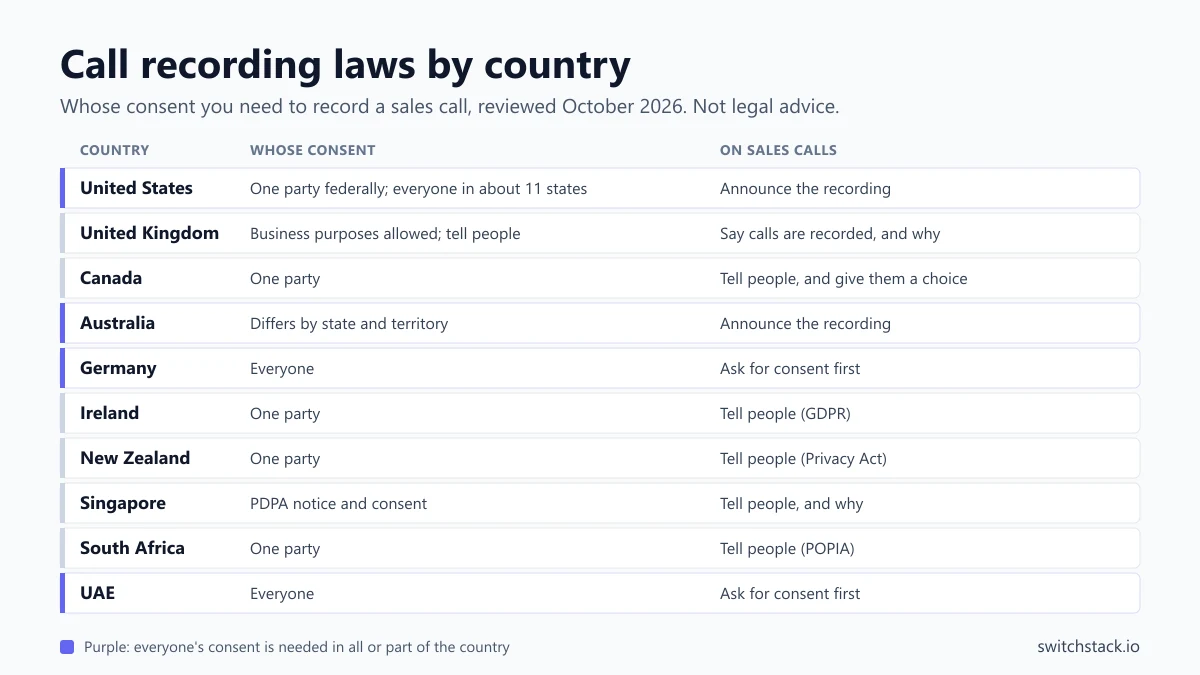
Recording a sales call is legal in most countries, but the consent rules differ. US federal law needs one party's consent, while about 11 states, including California, Florida and Washington, need everyone's. Germany and the UAE treat recording without consent as a crime. Canada, Ireland, New Zealand and South Africa let a participant record, but privacy laws expect you to tell people. The safest habit is to say at the start of every call that it's recorded, and to ask first where everyone must agree.
A plain summary for recording business sales calls, not legal advice. Each country lists the law or regulator guidance we checked.
Call recording laws by country at a glance
| Country | Whose consent | On sales calls |
|---|---|---|
| United States | One party under federal law; everyone in about 11 states | Announce the recording at the start of every call |
| United Kingdom | Businesses may record for business purposes; tell people | Say at the start that calls are recorded, and why |
| Canada | One party (Criminal Code) | Tell people the call is recorded and why, and give them a choice |
| Australia | Differs by state and territory | Announce the recording at the start of every call |
| Germany | Everyone: unauthorised recording is a crime | Ask for consent before you record |
| Ireland | One party | Tell people the call is recorded, as GDPR requires |
| New Zealand | One party: a participant may record | Tell people the call is recorded, under the Privacy Act |
| Singapore | The PDPA's notice and consent rules apply | Tell people the call is recorded and why |
| South Africa | One party (RICA s. 4) | Tell people the call is recorded, under POPIA |
| United Arab Emirates | Everyone: recording without consent is a crime | Get consent before you record |
Use this chart on your site
Call Recording Laws in the United States
One party under federal law; everyone in about 11 states
- Federal law lets a person record a call they're part of, or one where a party has consented (18 U.S.C. 2511(2)(d)).
- About 11 states mainly require the consent of everyone on the call: California, Delaware, Florida, Illinois, Maryland, Massachusetts, Michigan (at least for third parties), Montana, New Hampshire, Pennsylvania and Washington, according to the Reporters Committee for Freedom of the Press.
- California fines can reach $2,500 per violation (Penal Code § 632). Florida allows recording when all parties have given prior consent (s. 934.03), and Washington requires the consent of all participants (RCW 9.73.030).
- When a call crosses state lines and anyone on it is in an all-party state, the safe approach is to get everyone's consent.
Source: 18 U.S.C. 2511 (federal rule) · RCFP: Reporter's Recording Guide · California Penal Code § 632 · Florida Statutes s. 934.03 · RCW 9.73.030 (Washington) · Cold calling laws in the US
Call Recording Laws in the United Kingdom
Businesses may record for business purposes; tell people
- The Investigatory Powers (Interception by Businesses etc.) Regulations 2018 let a business record calls on its own system to establish facts, show it follows regulatory rules, or check the standards its staff meet.
- The business must make all reasonable efforts to inform everyone who uses its phone system that calls may be recorded.
- A recording of a named person is personal data under UK GDPR, so tell the person you're calling that the call is recorded and why, and cover it in your privacy notice.
Source: SI 2018/356, regulations 3 and 4 · Cold calling laws in the UK
Call Recording Laws in Canada
One party (Criminal Code)
- The Criminal Code's interception offence doesn't apply when the person recording has the consent of the person making the call or the person it's meant for (s. 184(2)(a)), so a participant can record.
- The Office of the Privacy Commissioner says PIPEDA applies to recorded calls, no matter who started the call. Businesses must tell people they're recording, clearly state the purpose and give them a choice about being recorded.
Source: Criminal Code s. 184 · Office of the Privacy Commissioner: guidance on recording customer calls · Office of the Privacy Commissioner: 2026 update on call recording · Cold calling laws in Canada
Call Recording Laws in Australia
Differs by state and territory
- Each state and territory sets its own rules in its surveillance devices law. In Victoria, Queensland and the Northern Territory, a party to the call can record it. New South Wales, Tasmania and the ACT allow it only in limited cases, such as to protect your lawful interests. South Australia and Western Australia generally need everyone's consent.
- Where the rules differ, follow the stricter one. Announcing the recording at the start of each call is the practical way to call across Australia. This summary rests on law-firm guidance rather than the text of each state's Act.
Source: Sydney Criminal Lawyers: Is it legal to record a phone call in Australia? · Cold calling laws in Australia
Call Recording Laws in Germany
Everyone: unauthorised recording is a crime
- Under section 201 of the Criminal Code (StGB), recording another person's private spoken words without authorisation can be punished with up to three years in prison or a fine.
- Ask the person at the start of the call whether they agree to the recording, and don't record if they say no.
Call Recording Laws in Ireland
One party
- Recording a call isn't “interception” under Irish law when either the caller or the person called has consented (Postal and Telecommunications Services Act 1983, s. 98, as amended in 1993).
- GDPR still applies to the recording, so tell the person that the call is recorded and why.
Source: Interception of Postal Packets and Telecommunications Messages (Regulation) Act 1993, s. 13 · Cold calling laws in Ireland
Call Recording Laws in New Zealand
One party: a participant may record
- Intercepting a private communication with a device can bring up to two years in prison, but the offence doesn't apply when the person recording is a party to the communication (Crimes Act 1961, s. 216B).
- A recording of a named person is personal information under the Privacy Act 2020, so tell people that you're recording and why.
Source: Crimes Act 1961, s. 216B · Cold calling laws in New Zealand
Call Recording Laws in Singapore
The PDPA's notice and consent rules apply
- Recording a call with a named person collects personal data. The PDPA's core rules are to tell people the purpose and get their consent, so say at the start that the call is recorded and why.
- We haven't found PDPC guidance written specifically for call recording, so this applies the PDPA's general rules.
Source: PDPC: Advisory Guidelines on Key Concepts (PDF) · Cold calling laws in Singapore
Call Recording Laws in South Africa
One party (RICA s. 4)
- Anyone may intercept a communication they're a party to, unless they do it to commit an offence (Regulation of Interception of Communications Act, s. 4(1)).
- A recording of a named person is personal information under POPIA, so tell people that the call is recorded and why.
Source: RICA (Act 70 of 2002), s. 4 (PDF) · Cold calling laws in South Africa
Call Recording Laws in the United Arab Emirates
Everyone: recording without consent is a crime
- Under Article 44 of Federal Decree-Law No. 34 of 2021, using technology to record, broadcast or disclose conversations or calls without consent can bring at least six months in prison, a fine of AED 150,000 to AED 500,000, or both, according to the UAE Public Prosecution.
- Ask for consent at the start of the call, and don't record if the person says no.
Source: WAM: Public Prosecution explains penalties for privacy infringement · Cold calling laws in the UAE
How to Record Sales Calls Safely
If you call several countries, these five habits meet the strictest rules on this page:
- Say at the start of every call that it's recorded, and why: for example, “This call is recorded for quality and training.”
- Where everyone's consent is needed (Germany, the UAE and all-party US states), ask and wait for a yes before recording.
- If someone objects, stop recording or offer another way to talk.
- Mention call recording in your privacy notice.
- Keep recordings secure, limit who can listen, and delete them when you no longer need them.
For the US, see the state-by-state rules in cold calling laws by state.
Want to hear every call?
Our callers record every call, so you can hear exactly what your prospects hear. See our B2B appointment setting services or hire a caller.
Call Recording Laws: FAQs
The questions people ask most about recording sales calls.
Is it legal to record sales calls?
Do I need consent to record a phone call?
Which US states require all-party consent to record calls?
Is it legal to record calls in the UK?
Can I record calls in Germany?
What should I say at the start of a recorded sales call?
Sources
Checked October 2026. For Australia, Singapore and the UAE, we used law-firm, regulator or government summaries rather than the text of the law itself. We review these rules every month.
- 18 U.S.C. 2511 (federal rule)
- RCFP: Reporter's Recording Guide
- California Penal Code § 632
- Florida Statutes s. 934.03
- RCW 9.73.030 (Washington)
- SI 2018/356, regulations 3 and 4
- Criminal Code s. 184
- Office of the Privacy Commissioner: guidance on recording customer calls
- Office of the Privacy Commissioner: 2026 update on call recording
- Sydney Criminal Lawyers: Is it legal to record a phone call in Australia?
- StGB § 201 (German)
- Interception of Postal Packets and Telecommunications Messages (Regulation) Act 1993, s. 13
- Crimes Act 1961, s. 216B
- PDPC: Advisory Guidelines on Key Concepts (PDF)
- RICA (Act 70 of 2002), s. 4 (PDF)
- WAM: Public Prosecution explains penalties for privacy infringement
Cite this page
Switchstack. “Call Recording Laws by Country.” Reviewed October 2026. https://switchstack.io/call-recording-laws
Calls Recorded, Rules Followed
Tell us who you want to reach and where. We'll recommend a caller country and explain how your campaign would work.
- A recording of every call
- Local calling rules followed
- Month-to-month
Prefer email? [email protected]
Book a Call