Cold calling laws by country · Reviewed October 2026
Cold Calling Laws in New Zealand
Yes. Cold calling is legal in New Zealand, including calls to businesses. There's no government do-not-call register: the Marketing Association runs a voluntary Do Not Call service for personal numbers only. General law applies instead: the Privacy Act 2020 for contact details, the Fair Trading Act for honest selling, and extra rules when you sell to consumers by phone.
A plain summary for business-to-business calls, not legal advice. The official and legal sources are listed at the end.
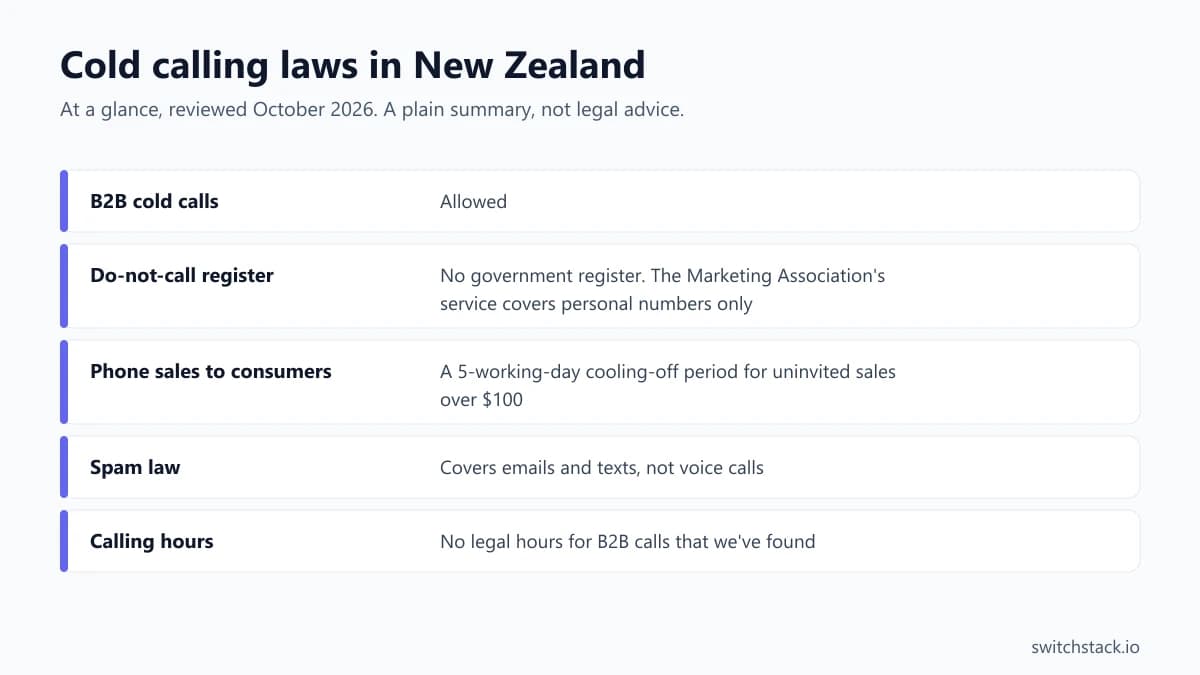
Cold calling laws in New Zealand at a glance
| B2B cold calls | Allowed |
|---|---|
| Do-not-call register | No government register. The Marketing Association's service covers personal numbers only |
| Phone sales to consumers | A 5-working-day cooling-off period for uninvited sales over $100 |
| Spam law | Covers emails and texts, not voice calls |
| Calling hours | No legal hours for B2B calls that we've found |
| Regulators | Commerce Commission (Fair Trading Act) and the Privacy Commissioner |
Use this chart on your site
Which laws cover cold calling in New Zealand?
- The Privacy Act 2020, which covers how you collect, use and store a contact's details.
- The Fair Trading Act 1986, which bans misleading conduct in trade and adds rules for uninvited direct sales to consumers.
- The Unsolicited Electronic Messages Act 2007, which covers marketing emails and texts. Its Schedule excludes voice calls, including recorded ones.
- The Marketing Association's Do Not Call service, a voluntary industry register rather than a law.
Is B2B cold calling legal in New Zealand?
Yes. The Do Not Call service doesn't extend to businesses, and the uninvited direct sales rules protect consumers, not companies buying for their business. What still applies to every call is the Fair Trading Act's ban on misleading claims, and the Privacy Act for the details you hold on named contacts.
Is there a do not call register in New Zealand?
Not a government one. The Marketing Association runs a free Do Not Call service where people can register a home or mobile number. It doesn't cover business numbers, and it's voluntary for marketers: not every company subscribes, and it can't stop calls from overseas.
Checking personal numbers against it is still good practice, because people on it have said clearly that they don't want sales calls.
Selling to consumers by phone
Under section 36K of the Fair Trading Act, a sale is an uninvited direct sale when it's negotiated by phone or at the consumer's home and the consumer didn't ask to be approached. For sales over $100, the consumer gets a 5-working-day cooling-off period, you must tell them about it out loud before they agree, and a summary of their cancellation rights must be on the front page of the agreement.
Consumer NZ puts the penalties for breaking these rules at up to $10,000 for an individual and $30,000 for a company.
The Privacy Act and your call list
A contact's name and direct number are personal information under the Privacy Act 2020. Collect only what you need for a clear purpose, tell people who you are and why you're contacting them, and keep the details secure. Whatever the law requires, stop calling anyone who asks you to.
Texts and emails after the call
If you follow up a call by email or text, the Unsolicited Electronic Messages Act 2007 applies: commercial emails and texts need the recipient's consent, accurate details of who sent them and a working way to unsubscribe.
Before you call New Zealand businesses: a checklist
- Call business numbers, and check any personal numbers against the Do Not Call service.
- Say who you are and who you're calling for at the start of the call.
- Keep every claim about price, terms and results accurate.
- If you sell to consumers by phone, explain the 5-working-day cooling-off period before they agree.
- Stop calling anyone who asks, and get consent before following up by email or text.
Can you call a lead in New Zealand who asked you to?
No legal register to check · Not applicable
- There's no government do-not-call register, and the Marketing Association's voluntary service covers personal numbers only.
- Keep your own do-not-call list, and stop calling anyone who asks.
Source: Marketing Association: Do Not Call · Do not call exemptions by country
Comparing registers? See the do not call registry in every country and how often to re-check your list.
Recording your calls? See whose consent you need in call recording laws by country.
Calling businesses in New Zealand?
We recommend a caller in the Philippines for New Zealand, from $2,199 a month. They call your prospects during their working day, follow the rules on this page and book meetings on your calendar. See cold calling services in New Zealand or our B2B telemarketing services.
Cold Calling in New Zealand: Legal FAQs
The questions people ask most about the rules.
Is cold calling legal in New Zealand?
Is there a do not call register in New Zealand?
Can I cold call businesses in New Zealand?
Does New Zealand's spam law cover phone calls?
What is the cooling-off period for phone sales in New Zealand?
Sources
Checked October 2026. We review these rules every month and log the changes on the laws by country page.
- Marketing Association: Do Not Call
- Consumer NZ: Uninvited direct sales
- Commerce Commission: warning letter citing section 36K
- Unsolicited Electronic Messages Act 2007, Schedule
Cite this page
Switchstack. “Cold Calling Laws in New Zealand.” Reviewed October 2026. https://switchstack.io/cold-calling-laws/new-zealand
Cold calling laws in other countries
Start Calling New Zealand
Tell us who you want to reach in New Zealand. We'll recommend a caller country and have someone on the phones in about 2 weeks.
- Local calling rules followed
- A recording of every call
- Month-to-month
Prefer email? [email protected]
Book a Call