Inbound lead follow-up · Reviewed October 2026
Speed to Lead: Lead Response Time Statistics
Speed to lead is how fast a company contacts a new lead after they ask to hear from it. The first minutes matter most: in the InsideSales.com and MIT study of more than 15,000 web leads, calling within 5 minutes instead of 30 made the odds of reaching the lead 100 times higher, and of qualifying them 21 times higher. Yet most companies are slow. In an audit of 2,241 US companies reported in Harvard Business Review, the average response took 42 hours, and 23% never responded.
Every figure links to the study it comes from. The two main studies are from 2007 and 2011, and newer tests of demo requests show companies are still slow.
Speed to lead statistics at a glance
| Finding | Result | Source |
|---|---|---|
| Calling within 5 minutes instead of 30 | Odds of reaching the lead 100 times higher, and of qualifying them 21 times higher | InsideSales.com and MIT |
| Waiting 10 minutes instead of 5 | Odds of reaching the lead 5 times lower, and of qualifying them 4 times lower | InsideSales.com and MIT |
| Waiting through the first hour | The odds of reaching the lead fall more than 10 times, and of qualifying them more than 6 times | InsideSales.com and MIT |
| Responding within an hour instead of an hour later | Nearly 7 times as likely to qualify the lead, across 1.25 million leads | SmartCompany |
| Responding within an hour instead of after 24 hours | More than 60 times as likely to qualify the lead | SmartCompany |
| Average response time | 42 hours, and 23% of 2,241 US companies never responded | SmartCompany |
| Calls to new demo requests | None of 114 B2B companies called within 5 minutes; the average first call took 14 hours 29 minutes | Workato |
| Replies to new demo requests | 7% replied within 60 seconds, and nearly 30% never replied | Chili Piper |
What Is Speed to Lead?
Speed to lead is the time between a lead asking to hear from you and your first contact with them. A lead might fill in a contact form, request a demo, ask for a quote or download a guide. The clock starts when they press send and stops when someone from your company calls or replies.
It matters because interest fades fast. Someone who asked for a demo a minute ago is still at their desk, thinking about the problem. A day later they're in meetings, and they may already be talking to a competitor who called first.
How Fast Should You Respond to a New Lead?
Within 5 minutes. In 2007, InsideSales.com and Professor James Oldroyd, then at MIT, studied three years of data from six companies: more than 15,000 web leads and more than 100,000 call attempts. Calling within 5 minutes instead of 30 made the odds of reaching the lead 100 times higher, and of qualifying them 21 times higher. Even the gap from 5 to 10 minutes cut the odds of reaching the lead by 5 times.
A larger study by Oldroyd and two co-authors, published in Harvard Business Review in 2011, looked at 1.25 million leads at 42 companies. Companies that responded within an hour were nearly 7 times as likely to qualify the lead as those that waited an hour longer, and more than 60 times as likely as those that waited 24 hours or more.
How Fast Do Companies Actually Respond?
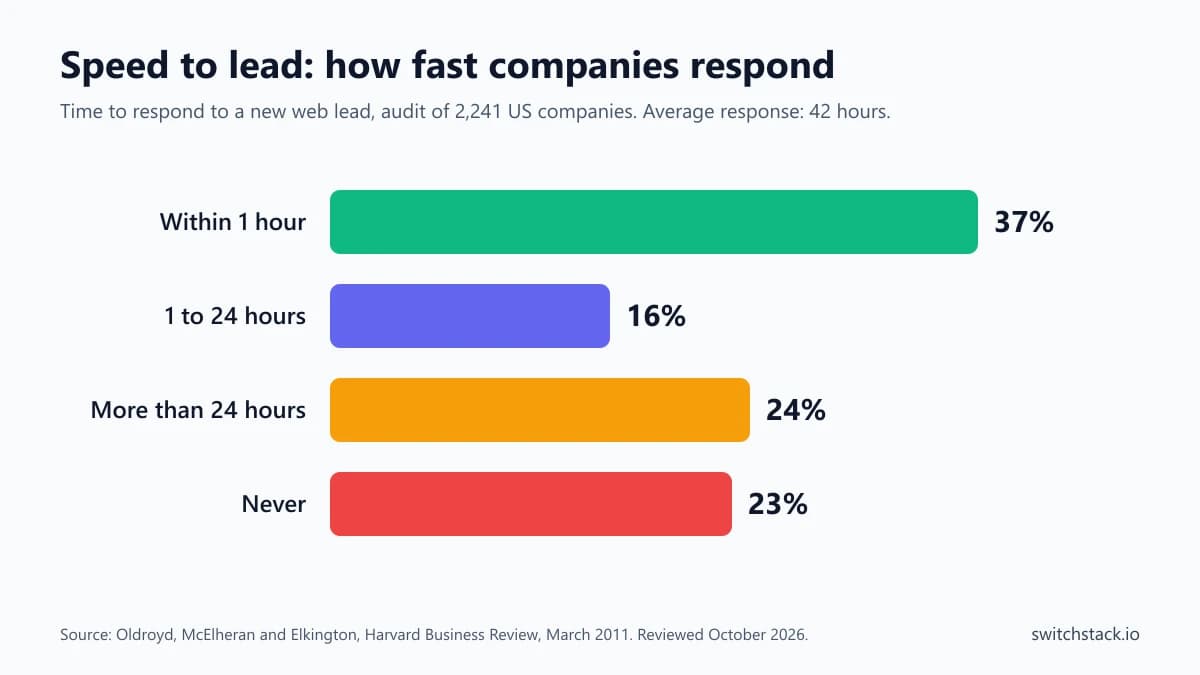
Much slower than that. The Harvard Business Review researchers sent a web lead to 2,241 US companies. 37% responded within an hour, 16% within 24 hours, 24% took longer than 24 hours, and 23% never responded. The companies that did respond within 30 days took 42 hours on average.
Use this chart on your site
Newer tests point the same way. When Workato sent demo requests to 114 B2B companies, none called within 5 minutes, only 31% called at all, and the average first call took 14 hours 29 minutes. Chili Piper's February 2022 test of demo requests found 7% of companies replied within 60 seconds and nearly 30% never replied.
When Is the Best Time to Call a New Lead?
As soon as it arrives: the response time mattered far more than the day or hour in the InsideSales.com and MIT study. Beyond that, the study found:
- 4 to 6pm was the best time to reach a lead, 114% better than 11am to noon.
- 8 to 9am and 4 to 5pm were the best times to qualify a lead. 8 to 9am was 164% better than 1 to 2pm.
- Wednesday and Thursday were the best days. Thursday was 49.7% better for reaching leads than Tuesday.
- After 20 hours, every extra call attempt hurt the chance of qualifying the lead.
These times come from US web leads at six companies in 2007, so treat them as a starting point and test your own.
How to Respond to Leads Faster
- 1.Send every new lead straight to the person who will call it, not to a shared inbox.
- 2.Call within 5 minutes during business hours, newest leads first.
- 3.If they don't answer, try again the same day. The research shows the value of a lead falls fastest in the first hours.
- 4.Follow the call with a short email, so they can reply in writing.
- 5.Measure the time from form to first call every week, and fix the slowest step.
The hardest part is having someone free to call the moment a lead arrives. Salespeople are usually in meetings or on other calls, which is why many companies give new leads to a dedicated caller.
Want every lead called fast?
A dedicated caller can work through your new leads during your business hours, newest first, and book the qualified ones on your calendar. See our inbound lead follow-up service, or read what appointment setting is.
- No setup fee
- No charge per lead or meeting
- Month-to-month
Speed to Lead: FAQs
The questions people ask most about lead response time.
What is speed to lead?
What is a good lead response time?
What is the average lead response time?
What is the 5-minute rule for leads?
When is the best time to call a new lead?
Sources
Checked October 2026. The Harvard Business Review article is behind a paywall, so its figures are cited from SmartCompany's report of the study.
- InsideSales.com and MIT: Lead Response Management Study (2007, PDF copy)
- Harvard Business Review: The Short Life of Online Sales Leads (March 2011)
- SmartCompany: report of the Harvard study's figures (July 2011)
- Workato: We tested 114 B2B companies' lead response times
- Chili Piper: Average B2B vendor response times (February 2022)
Cite this page
Switchstack. “Speed to Lead: Lead Response Time Statistics.” Reviewed October 2026. https://switchstack.io/speed-to-lead
Every New Lead, Called Fast
Tell us how many leads you get and when they arrive. We'll recommend a caller and give you the monthly price.
- No setup fee
- No charge per lead
- Month-to-month
Prefer email? [email protected]
Book a Call