Cold calling laws by country · Reviewed October 2026
Do Not Call Registry by Country
Most do-not-call registers protect personal numbers, so in the US, Canada, Australia, Singapore, Sweden, Norway and Finland, B2B calls are exempt or business numbers can't be registered. The UK is the big exception: companies register on the Corporate TPS, so B2B lists must be screened against both the TPS and CTPS at least every 28 days. Ireland's opt-out covers business landlines, Denmark's Robinson list covers sole traders, Switzerland's directory asterisk doesn't exempt businesses, the UAE's may cover business numbers, and Germany has no register but requires consent.
A plain summary for business-to-business calls, not legal advice. Each country lists the law or regulator guidance we checked.
Do not call registry by country at a glance
| Country | Register | Business numbers | Re-check before calling |
|---|---|---|---|
| United Kingdom | TPS and Corporate TPS (CTPS) | Covered: companies register on the CTPS, sole traders on the TPS | At least every 28 days |
| United States | National Do Not Call Registry (FTC) | Exempt: calls to businesses are outside the registry rules | Use a copy no more than 31 days old |
| Canada | National Do Not Call List (CRTC) | Exempt, but you must still register with the operator | Use a copy no more than 31 days old |
| Australia | Do Not Call Register (ACMA) | Not covered: business numbers can't be registered | Wash your list within 30 days before calling |
| Ireland | National Directory Database (NDD) opt-out | Covered: business landlines can opt out | Before each campaign (no set interval we've found) |
| Singapore | Do Not Call Registry (PDPC) | Not covered when you call an organisation about its own business | Within 21 days before calling |
| United Arab Emirates | Do Not Call Registry (TDRA) | Unsettled: the safe course is to check business numbers too | No set interval we've found |
| South Africa | National Opt-Out Registry (NCC) | Consent comes first under POPIA, for businesses too | Blocking starts in May 2027 |
| Sweden | NIX-Telefon | Not covered: company numbers can be called about the company's business | A check is valid for 2 months |
| Norway | Reservasjonsregisteret (Brønnøysund Register Centre) | Not covered: the register protects consumers | Before the first call and in every month you call |
| Denmark | Robinson list (CPR) | Covers sole traders. Companies opt out through CVR advertising protection | The CPR updates the list every quarter |
| Finland | Telephone Robinson (ASML, self-regulation) | Not covered: it's for consumers | Less than a month before calling (industry code) |
| Switzerland | Asterisk (*) in the phone directory | No business exemption: check company numbers too | Check the directory before calling |
| New Zealand | No government register | Not covered: the voluntary service is for personal numbers | Voluntary |
| Germany | No register: consent rules instead | Presumed consent needed for every B2B sales call | Not applicable |
| Japan | No register | Not covered: the telemarketing rules exclude purchases for business | Not applicable |
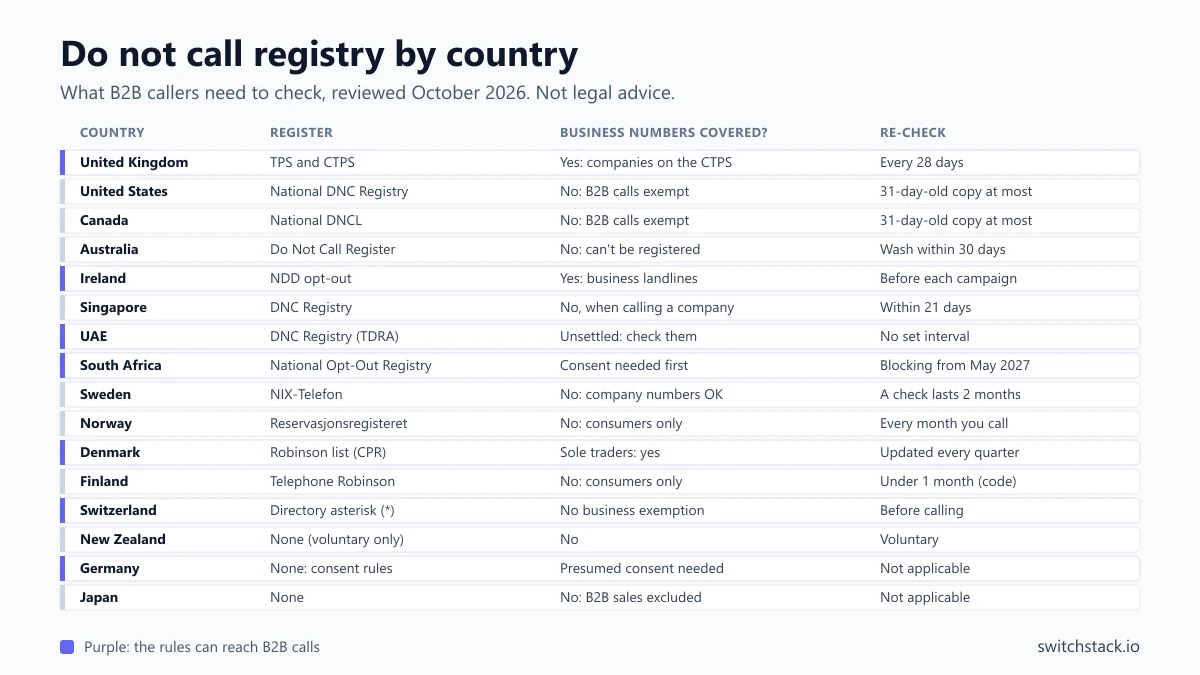
Use this chart on your site
Do Not Call Registry in the UK
TPS and Corporate TPS (CTPS) · Covered: companies register on the CTPS, sole traders on the TPS
- The Telephone Preference Service (TPS) lists individuals, including sole traders and some partnerships. The Corporate TPS (CTPS) lists companies and other corporate bodies. The ICO says to screen B2B call lists against both.
- A number counts once it has been on the register for 28 days (PECR, regulation 21(3)), so screen your list again at least every 28 days.
- Since 5 February 2026, the maximum fine for breaking PECR is £17.5 million or 4% of global turnover.
Source: ICO: Business-to-business marketing · PECR, regulation 21 · ICO: Statement on the commencement of the DUAA · Cold calling laws in the UK
Do Not Call Registry in the US
National Do Not Call Registry (FTC) · Exempt: calls to businesses are outside the registry rules
- The registry is for personal numbers, and calls between a telemarketer and a business are exempt from its rules. Check any contact who may be on a personal or mobile number.
- Callers covered by the rules must use a version of the registry obtained no more than 31 days before the call (16 CFR 310.4(b)(3)(iv)).
- Access costs $85 a year per area code, up to a maximum of $23,425, and the first five area codes are free (16 CFR 310.8).
Source: 16 CFR 310.6 (TSR exemptions) · 16 CFR 310.4 (Do Not Call safe harbor) · 16 CFR 310.8 (registry fees, eCFR) · Cold calling laws in the US
Do Not Call Registry in Canada
National Do Not Call List (CRTC) · Exempt, but you must still register with the operator
- Business-to-business calls are exempt from the National DNCL Rules. But every telemarketer, and every client that has calls made for it, must register with the National DNCL operator, even for B2B calls only. Registration is free.
- Telemarketers and their clients must use a version of the list obtained no more than 31 days before each call.
- Keep your own internal do-not-call list, and keep each request for 3 years and 14 days.
Source: CRTC: Unsolicited Telecommunications Rules · National DNCL: Exemptions · Cold calling laws in Canada
Do Not Call Registry in Australia
Do Not Call Register (ACMA) · Not covered: business numbers can't be registered
- Business phone numbers aren't eligible for the register, so business lines don't need washing. Personal and mobile numbers do.
- If you washed your list in the 30 days before a call and the register didn't flag the number, the ACMA says you're not in breach.
- The Industry Standard's calling hours and rules still apply to every telemarketing call, business numbers included.
Source: Do Not Call Register: Consumer overview · Do Not Call Register: Industry FAQs · ACMA Do Not Call Register: Industry standards · Cold calling laws in Australia
Do Not Call Registry in Ireland
National Directory Database (NDD) opt-out · Covered: business landlines can opt out
- You can't make a marketing call to a landline, business landlines included, if the number is marked in the NDD as opted out or the subscriber has told you not to call.
- Calls to mobiles need the subscriber's consent first.
- Each unlawful call is a separate offence. On indictment, a company can be fined up to €250,000 per offence.
Source: S.I. 336 of 2011, Regulation 13 · Data Protection Commission: NDD FAQs · Cold calling laws in Ireland
Do Not Call Registry in Singapore
Do Not Call Registry (PDPC) · Not covered when you call an organisation about its own business
- Messages to an organisation for its own purposes are excluded from the DNC rules. The PDPC's example: calling a company's HR manager on her business number to sell something for the company.
- Before a marketing call to a number used in a personal capacity, check the No Voice Call register within 21 days before the call, unless you have clear consent.
- Fines reach S$200,000 for an individual and S$1 million for an organisation.
Source: PDPC: Advisory Guidelines on the Do Not Call Provisions (PDF) · PDPC decision on the 21-day check (2023, PDF) · Allen & Gledhill: Increased PDPA penalties from 1 October 2022 · Cold calling laws in Singapore
Do Not Call Registry in the UAE
Do Not Call Registry (TDRA) · Unsettled: the safe course is to check business numbers too
- Since 27 August 2024, companies can't make marketing calls to numbers on the TDRA's Do Not Call Registry.
- The rules are written around calls to consumers, and how far they reach B2B calls isn't settled, so the safe course is to check business numbers too.
- Fines for calling registered numbers are AED 50,000 for a first violation, AED 75,000 for a second and AED 150,000 after that.
Source: Mondaq: New telemarketing regulations in the UAE · Clyde & Co: UAE tightens telemarketing regulations · Al Tamimi & Co: New UAE telemarketing regulations · Cold calling laws in the UAE
Do Not Call Registry in South Africa
National Opt-Out Registry (NCC) · Consent comes first under POPIA, for businesses too
- The National Consumer Commission launched the registry on 7 October 2026. Direct marketers must register by December 2026, and people can start blocking marketing from May 2027.
- The registry doesn't replace consent. Under POPIA section 69, a sales call to anyone who isn't already your customer needs their consent first, and POPIA protects companies as well as people.
- Fines reach R10 million under POPIA.
Source: Polity: NCC launches national opt-out registry · Information Regulator: Guidance Note on Direct Marketing (PDF) · POPIA section 109: administrative fines · Cold calling laws in South Africa
Do Not Call Registry in Sweden
NIX-Telefon · Not covered: company numbers can be called about the company's business
- Private individuals register their numbers on NIX-Telefon to opt out of sales, marketing and fundraising calls. Under the Marketing Act, you can't call someone who has clearly objected.
- Under the NIX rules, check a number before calling a private person, and call within two months of the check.
- If a company-owned number that's also used privately is on NIX, you can still call about the company's business during office hours. Active sole traders can be called about their business.
Source: NIX-Telefon: Rules for the register (Swedish) · Marketing Act (2008:486), sections 19 to 31 (Swedish) · Cold calling laws in Sweden
Do Not Call Registry in Norway
Reservasjonsregisteret (Brønnøysund Register Centre) · Not covered: the register protects consumers
- Consumers opt out of telephone marketing by registering in Reservasjonsregisteret. Calls to businesses aren't covered by the register rules.
- Lists must be updated against the register before the first contact and before contacting people in any month you market to them (Marketing Control Act, section 13 a).
- Anyone who opts out directly with your company, business contacts included, can't be called again (section 12).
Source: Marketing Control Act, sections 12 to 15, 42 and 48 (Norwegian) · Brønnøysund Register Centre: Reservasjonsregisteret (Norwegian) · Cold calling laws in Norway
Do Not Call Registry in Denmark
Robinson list (CPR) · Covers sole traders. Companies opt out through CVR advertising protection
- Calls to companies are lawful even without consent. But you can't call a sole trader whose business address is on the Robinson list, which the CPR register compiles every quarter, so check sole traders before calling.
- Companies can register advertising protection in the CVR register. The contact details they've registered there then can't be used for direct marketing.
- Sales calls to consumers are banned unless they asked for the call, whether or not they're on the Robinson list.
Source: Danish Consumer Ombudsman: Overview of the telephone sales rules (Danish, PDF) · Consumer Contracts Act, section 4 (Danish) · Cold calling laws in Denmark
Do Not Call Registry in Finland
Telephone Robinson (ASML, self-regulation) · Not covered: it's for consumers
- ASML, the Finnish marketing association, runs the Telephone Robinson service for consumers. Its code of conduct says member companies must use it.
- The code says a company's call list must have been updated against the service less than one month before a call.
- Companies can be called unless they've refused direct marketing, under section 202 of the Act on Electronic Communications Services.
Source: ASML: Telemarketing code of conduct (PDF) · Act on Electronic Communications Services (917/2014), sections 200 to 203 (Finnish) · Cold calling laws in Finland
Do Not Call Registry in Switzerland
Asterisk (*) in the phone directory · No business exemption: check company numbers too
- There's no separate register. Subscribers mark their directory entry with an asterisk instead, and advertising calls to those numbers are unfair competition (Unfair Competition Act, section 3(1)(u)).
- Since 1 January 2021, numbers that aren't in the directory at all are treated the same as asterisk numbers.
- The rule protects "customers" and doesn't exempt businesses. Existing business relationships are the exception.
Source: Unfair Competition Act, sections 3 and 23 (English, status 1 January 2025) · SECO: Unwanted advertising calls (German) · Cold calling laws in Switzerland
Do Not Call Registry in New Zealand
No government register · Not covered: the voluntary service is for personal numbers
- There's no government do-not-call register. The Marketing Association runs a free, voluntary Do Not Call service for home and mobile numbers, and it doesn't cover business numbers.
- Check any personal numbers against it, and keep your own do-not-call list.
Source: Marketing Association: Do Not Call · Cold calling laws in New Zealand
Do Not Call Registry in Germany
No register: consent rules instead · Presumed consent needed for every B2B sales call
- Germany has no do-not-call register. Instead, section 7 of the Act against Unfair Competition (UWG) requires at least presumed consent for a sales call to a business, and prior express consent for a call to a consumer.
- Calling consumers without consent can be fined up to €300,000.
Source: UWG § 7 (German) · UWG § 20 (German) · Cold calling laws in Germany
Do Not Call Registry in Japan
No register · Not covered: the telemarketing rules exclude purchases for business
- Japan has no do-not-call register. The Act on Specified Commercial Transactions only bans soliciting someone again after they've said no (section 17).
- Those telemarketing rules don't apply when the buyer purchases for business (section 26).
Source: Act on Specified Commercial Transactions (English, tentative translation) · Japan Federation of Bar Associations: opinion of 14 July 2022 (Japanese, PDF) · Cold calling laws in Japan
How to Screen a B2B Call List
If you call several countries, these five steps cover the strictest rules on this page:
- Find out which register applies in each country you call, and whether it covers business numbers.
- Screen every list before calls start, and again within the country's limit: 21 days in Singapore, 28 days in the UK, every calendar month in Norway, 30 days in Australia and 31 days in the US and Canada.
- Check any number that may be personal, such as a contact's mobile, even when you're calling them about work.
- Keep your own do-not-call list. Anyone who asks not to be called again goes on it, whether or not they're on a register.
- Keep records of each screening, so you can show when the list was checked.
Calling hours matter too: see the legal calling hours checker, and for recorded calls, call recording laws by country. Calling leads who asked to hear from you? See the do not call exemptions by country.
Want lists screened for you?
We check your list against the local rules before calls start. See our B2B appointment setting services or cold calling services by country.
Do Not Call Registry: FAQs
The questions people ask most about do-not-call registers and B2B calls.
Do B2B calls need to be checked against the do not call registry?
How often should I check my list against the do not call registry?
Can businesses register on the do not call list?
Does the UK TPS apply to business calls?
Which countries have no do not call register?
Sources
Checked October 2026. We review these rules every month and log changes on the laws by country page.
- United Kingdom: ICO: Business-to-business marketing
- United Kingdom: PECR, regulation 21
- United Kingdom: ICO: Statement on the commencement of the DUAA
- United States: 16 CFR 310.6 (TSR exemptions)
- United States: 16 CFR 310.4 (Do Not Call safe harbor)
- United States: 16 CFR 310.8 (registry fees, eCFR)
- Canada: CRTC: Unsolicited Telecommunications Rules
- Canada: National DNCL: Exemptions
- Australia: Do Not Call Register: Consumer overview
- Australia: Do Not Call Register: Industry FAQs
- Australia: ACMA Do Not Call Register: Industry standards
- Ireland: S.I. 336 of 2011, Regulation 13
- Ireland: Data Protection Commission: NDD FAQs
- Singapore: PDPC: Advisory Guidelines on the Do Not Call Provisions (PDF)
- Singapore: PDPC decision on the 21-day check (2023, PDF)
- Singapore: Allen & Gledhill: Increased PDPA penalties from 1 October 2022
- United Arab Emirates: Mondaq: New telemarketing regulations in the UAE
- United Arab Emirates: Clyde & Co: UAE tightens telemarketing regulations
- United Arab Emirates: Al Tamimi & Co: New UAE telemarketing regulations
- South Africa: Polity: NCC launches national opt-out registry
- South Africa: Information Regulator: Guidance Note on Direct Marketing (PDF)
- South Africa: POPIA section 109: administrative fines
- Sweden: NIX-Telefon: Rules for the register (Swedish)
- Sweden: Marketing Act (2008:486), sections 19 to 31 (Swedish)
- Norway: Marketing Control Act, sections 12 to 15, 42 and 48 (Norwegian)
- Norway: Brønnøysund Register Centre: Reservasjonsregisteret (Norwegian)
- Denmark: Danish Consumer Ombudsman: Overview of the telephone sales rules (Danish, PDF)
- Denmark: Consumer Contracts Act, section 4 (Danish)
- Finland: ASML: Telemarketing code of conduct (PDF)
- Finland: Act on Electronic Communications Services (917/2014), sections 200 to 203 (Finnish)
- Switzerland: Unfair Competition Act, sections 3 and 23 (English, status 1 January 2025)
- Switzerland: SECO: Unwanted advertising calls (German)
- New Zealand: Marketing Association: Do Not Call
- Germany: UWG § 7 (German)
- Germany: UWG § 20 (German)
- Japan: Act on Specified Commercial Transactions (English, tentative translation)
- Japan: Japan Federation of Bar Associations: opinion of 14 July 2022 (Japanese, PDF)
Cite this page
Switchstack. “Do Not Call Registry by Country.” Reviewed October 2026. https://switchstack.io/do-not-call-registry-by-country
Lists Screened Before Every Call
Tell us who you want to reach and where. We'll recommend a caller country and check your list against the local rules.
- Lists checked against local registers
- Local calling rules followed
- Month-to-month
Prefer email? [email protected]
Book a Call