SDR Salary in India: The 2026 Benchmark
What inside sales reps, business development executives and call centre agents earn in India in 2026, in rupees and dollars, plus the labour code rules and the full cost of hiring one yourself.
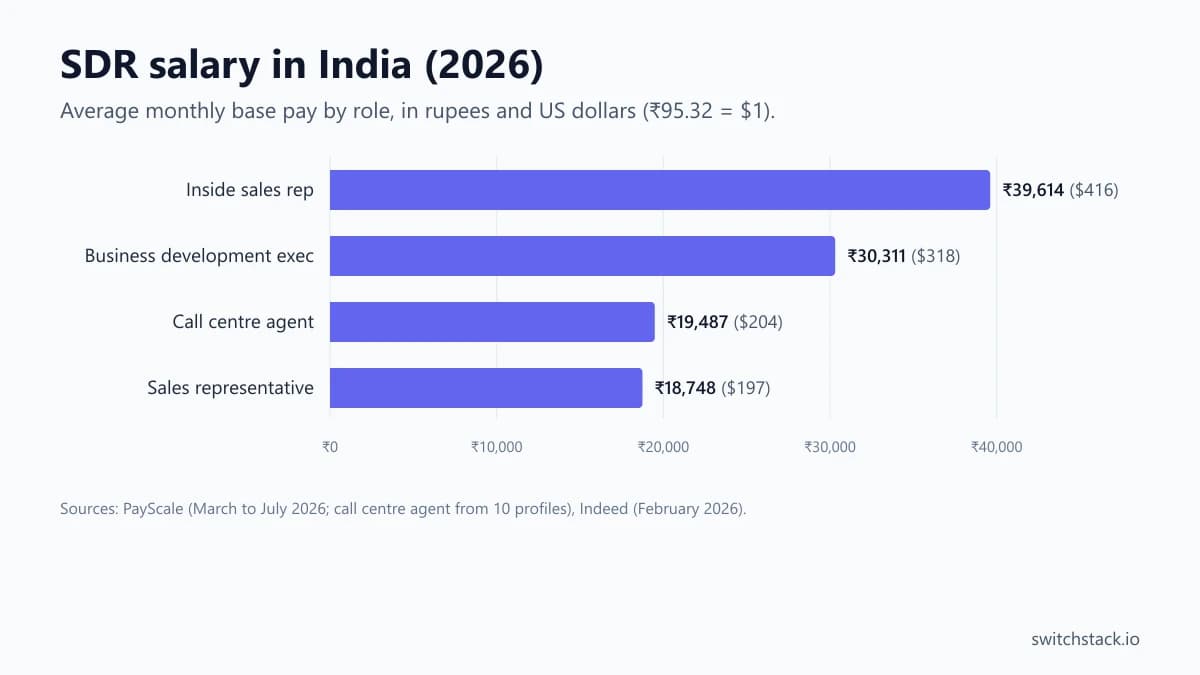
The average SDR salary in India in 2026 is about ₹30,300 to ₹39,600 a month in base pay, or roughly $320 to $420, based on PayScale's averages for business development executives and inside sales reps. Call centre agents and junior sales reps earn less, around ₹19,000 a month, while experienced reps earn well above the averages. On top of salary, budget for any labour code costs, night-shift transport for US hours, and the time it takes to hire and manage the rep yourself.
This guide gives the 2026 numbers for each role close to an SDR, explains how to read them, covers what India's new labour codes add, and works out the full monthly cost of hiring a rep directly.
Table of Contents
- SDR Salary in India at a Glance
- How to Read These Numbers
- Pay by Experience
- Pay by Role: What Each Job Does
- Incentives and Bonuses
- What India's Labour Codes Add
- Night Shifts for US Clients
- Shift Times by Client Market
- The Full Monthly Cost: A Worked Example
- How to Make a Fair Offer
- How to Hire From Outside India
- India vs the Philippines and South Africa
- Hiring on Your Own vs Using Switchstack
SDR Salary in India at a Glance
There's no single published figure for an SDR salary in India, because Indian employers use different titles for the same work. The closest are inside sales rep and business development executive. Here is what each role earns on average, with the source for every number:
| Role | Average pay | Per month | In US dollars | Source |
|---|---|---|---|---|
| Inside sales rep | ₹475,364 a year | ₹39,614 | $416 | PayScale, 135 profiles, March 2026 |
| Business development executive | ₹363,736 a year | ₹30,311 | $318 | PayScale, 284 profiles, June 2026 |
| Call centre agent | ₹233,846 a year | ₹19,487 | $204 | PayScale, 10 profiles, July 2026 |
| Sales representative | ₹18,748 a month | ₹18,748 | $197 | Indeed, 582 salaries, February 2026 |
Dollar figures use ₹95.32 to $1, the exchange rate on 14 October 2026. Monthly figures divide yearly pay by 12.
How to Read These Numbers
Treat these averages as a starting point for an SDR salary in India, not a price list. Keep four things in mind:
- They're self-reported. PayScale and Indeed collect pay from people who share it. That's useful, but it isn't an official survey.
- Some samples are small or old. The call centre figure rests on only 10 profiles. PayScale's page for business development representatives shows ₹696,343 a year, but from 16 profiles last updated in July 2025, so we've left it out of the table.
- Base pay isn't total pay. PayScale puts total pay for inside sales reps between ₹214,000 and ₹980,000 a year, including incentives.
- Your role may pay more. Reps who call international buyers in fluent English, on night shifts, may expect more than these averages. Check current job postings for the exact role you're hiring for before you make an offer.
Pay by Experience
Experience makes a big difference to an SDR salary in India. PayScale breaks down total pay, including bonus and other pay, by career stage:
| Role and experience | Average total pay a year | Per month |
|---|---|---|
| Inside sales rep, under 1 year | ₹249,943 | ₹20,829 |
| Business development executive, under 1 year | ₹291,105 | ₹24,259 |
| Business development executive, 1 to 4 years | ₹350,695 | ₹29,225 |
| Inside sales rep, 1 to 4 years | ₹401,686 | ₹33,474 |
Pay rises quickly in the first few years, especially for inside sales reps, whose average total pay goes up by about 60% between their first year and the one-to-four-year stage. The entry-level business development figure is the most reliable, with 172 salaries behind it.
Pay by Role: What Each Job Does
Much of the spread in pay comes down to the job title, which is why there's no single SDR salary in India. Match the role to the job you need done.
Call Centre Agent or Telecaller
Makes or takes calls at high volume, often from a script. Many work in customer service. "International voice process" roles serve overseas customers, usually on night shifts. Good agents can grow into cold calling, but they need training on research, objection handling and booking meetings.
Business Development Executive
A common Indian title for someone who finds new customers by phone, email and sometimes visits. Depending on the company, a business development executive may book meetings or close smaller deals themselves.
Inside Sales Rep or SDR
Finds and contacts new prospects, qualifies them and books meetings for a closer. This is the role most international companies mean when they hire an SDR. It pays more because it needs more judgment: researching accounts, handling brush-offs and deciding who's worth a meeting.
Incentives and Bonuses
Incentives can add a lot to an SDR salary in India, and many sales roles in India pay a monthly incentive on top of a fixed salary. Keep the plan simple and fair:
- A fixed salary the rep can live on without incentives.
- An incentive for each qualified meeting that actually happens, not for every meeting booked.
- A written definition of "qualified" that both of you agree on before the first call.
- A review after 90 days, once you know what a realistic monthly number is.
Paying only for booked meetings pushes reps to book anyone who says yes. Our guide to B2B appointment setting explains how to define a qualified meeting.
What India's Labour Codes Add
India's four labour codes came into force on 21 November 2025, replacing 29 older labor laws. The Labour Ministry's compliance handbook for employers sets out what they require. For a sales rep, the main points are:
- An appointment letter for every employee.
- Overtime at no less than twice the normal wage, for employees whose minimum wage is fixed under the Code on Wages.
- Final pay within two working days when an employee leaves.
- Provident fund for establishments with 20 or more employees. The employer pays 12% of wages, usually on a wage ceiling of ₹15,000 a month, so about ₹1,800. See EPFO for the current rates.
- Employees' State Insurance (ESI) for establishments with 10 or more employees. ESIC sets the employer's share at 3.25% of wages and the employee's at 0.75%, for employees earning up to ₹21,000 a month. Most SDRs earn more than that, so ESI often won't apply.
- Gratuity in establishments with 10 or more employees: 15 days' wages for each completed year of service, after five years, or after one year for fixed-term employees.
- Women on night shifts. Women can work before 6am or after 7pm if they consent and the employer follows the prescribed safety measures.
Minimum wages, leave and working hours also depend on the state the rep works in, so check the state's rules too. This is a plain summary, not legal advice. Confirm the details with an Indian payroll provider or labor lawyer before you hire.
Night Shifts for US Clients
Night shifts change the real cost of an SDR salary in India. India doesn't change its clocks, and it's 9.5 to 10.5 hours ahead of New York. A 9am to 5pm day on the US East Coast runs from 18:30 to 02:30 in India, or 19:30 to 03:30 when US clocks go back in November.
Indian outsourcing teams have worked US nights for years, so the shift itself isn't unusual. But it adds costs and duties:
- Transport. Many employers running night shifts provide a cab home. For women working after 7pm, safe transport is one of the required safety measures.
- An allowance. Many reps expect a night-shift allowance for US hours. Agree on the amount in writing.
- Consent. Women can only be asked to work before 6am or after 7pm with their consent.
UK hours are easier: a London business day is an afternoon and evening shift in India. It still runs past 7pm, though, so the rules for women working late apply.
Shift Times by Client Market
Here is a 9am to 5pm day in each market, shown in Indian time:
| Your prospects are in | Northern summer | Northern winter |
|---|---|---|
| Dubai | 10:30 to 18:30 | 10:30 to 18:30 |
| Riyadh | 11:30 to 19:30 | 11:30 to 19:30 |
| London | 13:30 to 21:30 | 14:30 to 22:30 |
| Singapore | 06:30 to 14:30 | 06:30 to 14:30 |
| Sydney | 04:30 to 12:30 | 03:30 to 11:30 |
| New York | 18:30 to 02:30 | 19:30 to 03:30 |
| Los Angeles | 21:30 to 05:30 | 22:30 to 06:30 |
The Gulf is a normal day shift, which is why India is our first choice for the UAE, Saudi Arabia and Qatar. Australia and the US are early-morning or overnight shifts, so the Philippines usually suits them better. Our cold calling laws by country page covers the calling rules in each of these markets.
The Full Monthly Cost: A Worked Example
Here is an example of what one SDR on US hours could cost each month, on a salary close to the average SDR salary in India. It assumes the rep is employed through an employer of record that's large enough for provident fund to apply. The allowance and cab figures are assumptions for illustration, not data.
| Cost | Per month |
|---|---|
| Fixed salary | ₹40,000 |
| Provident fund, employer's 12% on the ₹15,000 ceiling | ₹1,800 |
| Gratuity set aside (about 4.8% of a ₹20,000 basic wage) | ₹962 |
| Night-shift allowance (assumed) | ₹2,000 |
| Cab home after late shifts (assumed) | ₹3,000 |
| Total | ₹47,762, about $501 |
That total leaves out the employer of record's own fee, incentives, a laptop and headset, a phone line, the hours you spend recruiting and testing candidates, and the management time a new rep needs every day.
For a fair comparison with a local hire, work out the cost per meeting rather than the cost per month. Our guide to in-house SDR vs outsourced cold calling shows how.
How to Make a Fair Offer
A fair offer starts from the average SDR salary in India for the role. The rep should be able to live on the fixed salary without incentives, and you should be able to afford it if the first months are slow. Five steps get you there:
- Check live job postings for the same title, city and shift. Averages lag the market, and postings show what competing employers offer this month.
- Set the fixed salary from the tables above. Start near the business development executive average for a junior rep, and near the inside sales average for someone with outbound experience.
- Price the shift. If the rep works US hours, agree on the allowance and the cab before they start.
- Add a simple incentive for each qualified meeting that actually happens, capped so it can't swamp the fixed salary.
- Put it in writing, in the appointment letter, with a 90-day review date when you'll check the numbers together.
An example offer, with made-up numbers: a fixed salary of ₹40,000 a month, a ₹2,000 allowance for US hours, and a ₹500 incentive for each qualified meeting held, up to ₹8,000 a month. If the rep holds 12 qualified meetings in a month, they earn ₹48,000 before tax, and you know exactly what each meeting cost you in incentives.
How to Hire From Outside India
Whatever SDR salary in India you settle on, you need a legal way to pay it. If your company has no Indian entity, you can't simply put a rep on an Indian payroll. Most foreign companies choose one of three routes:
- An employer of record. A local company employs the rep for you, issues the appointment letter, runs payroll and handles provident fund, for a monthly fee on top of salary.
- An independent contractor. The rep invoices you directly. It's simpler, but the line between contractor and employee matters for tax and labor law, so get advice before you rely on it.
- A provider that places the caller for you. The provider recruits, contracts and pays the caller, and you get a dedicated rep working your list.
Whichever route you choose, test candidates on real role-play calls before you hire, and listen closely to how clearly they speak to your buyers. Our guide to evaluating sales reps with role-play scenarios works for Indian candidates too.
India vs the Philippines and South Africa
India has the lowest cost of the countries we recruit in, and it's often the best fit for some markets:
- Gulf hours on a day shift. Callers work normal hours for clients in the UAE, Saudi Arabia and Qatar.
- UK hours as an afternoon and evening shift, finishing well before midnight.
- One of the largest English-speaking workforces in the world, with a long history of outsourced calling.
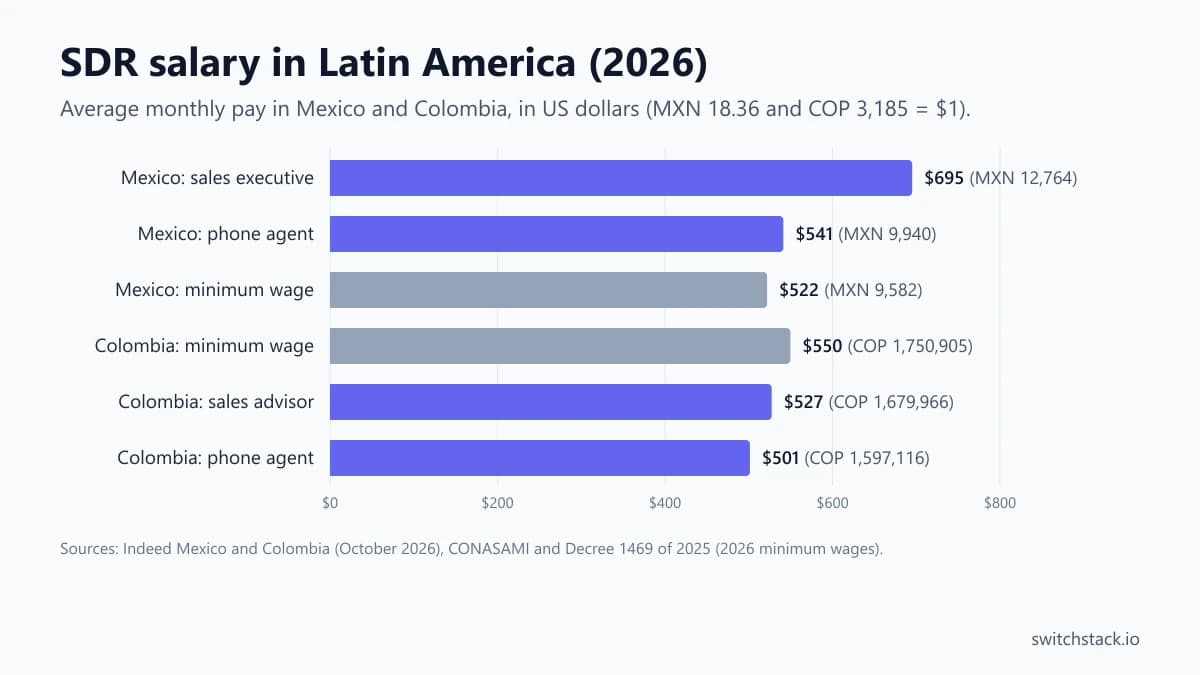
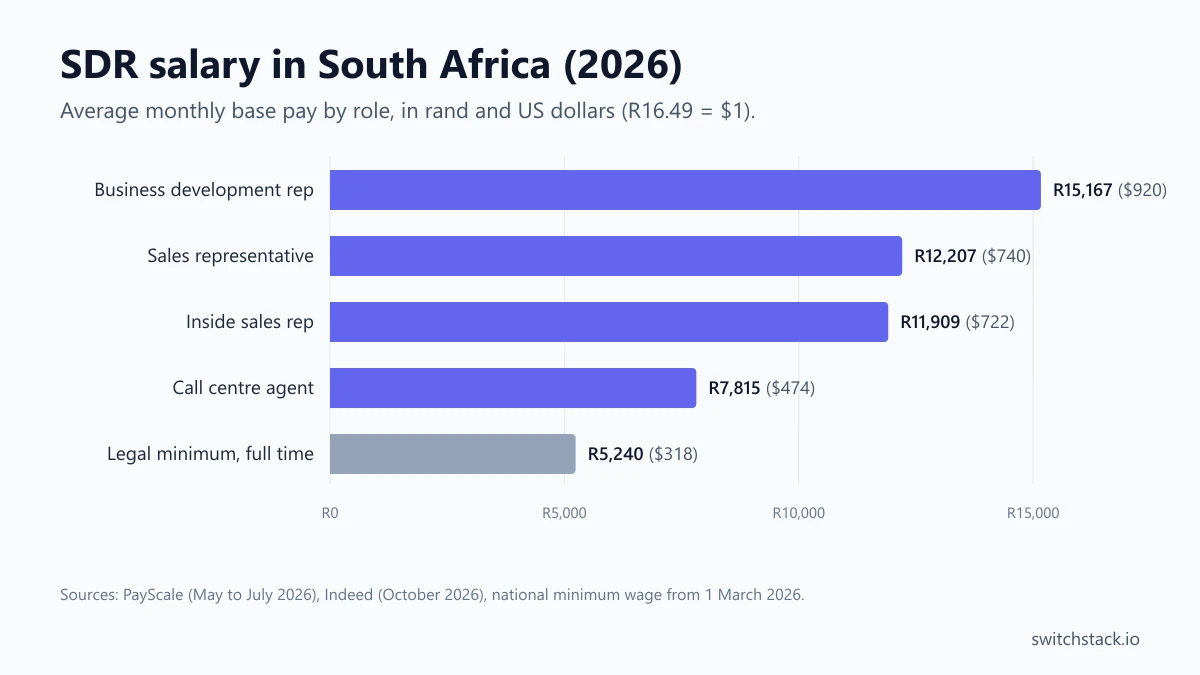
The trade-off is that English accents vary widely across India, so screening matters more. The Philippines suits North America and Asia-Pacific, and South Africa suits the UK and Europe. Compare pay in our Philippines SDR salary benchmark and our guides to SDR salary in South Africa and SDR salary in Latin America, or compare all four caller countries market by market on our best country to outsource cold calling page.
Hiring on Your Own vs Using Switchstack
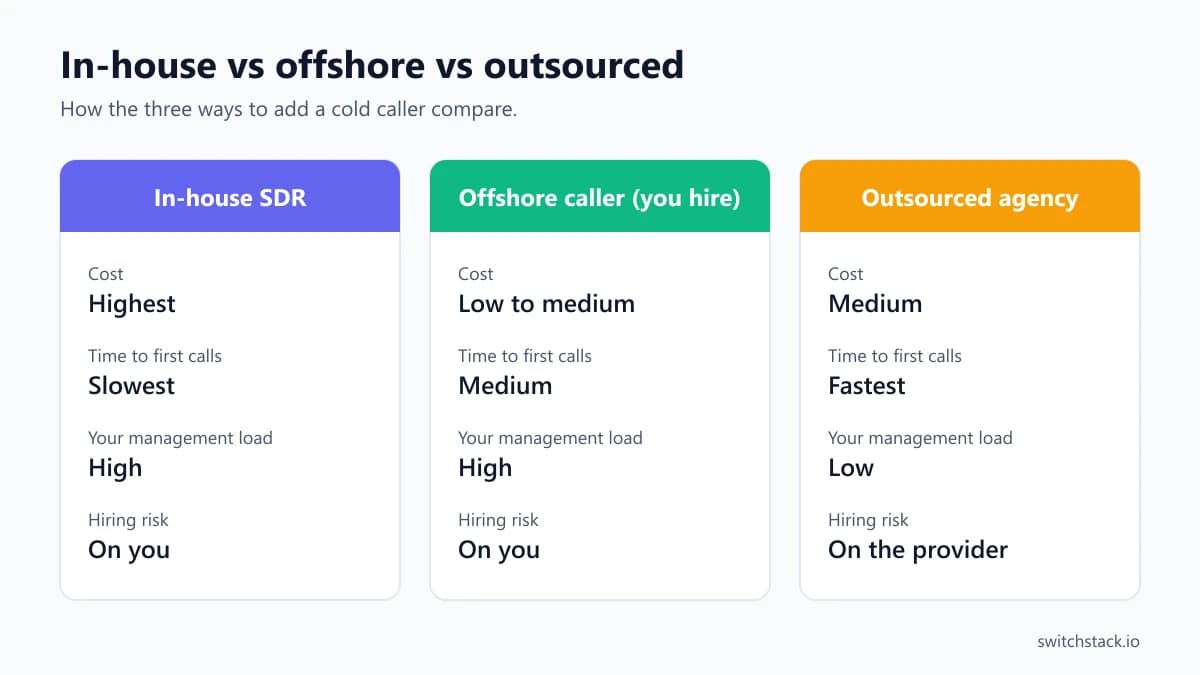
Paying an SDR salary in India directly is much cheaper on paper. Using Switchstack costs more each month, but you skip the recruiting, the contracts, the night-shift logistics and the risk of starting again if the first hire doesn't work out:
| Hiring on your own | Switchstack Hire a Caller | |
|---|---|---|
| Monthly cost | About $500 or more, plus any employer of record fee | $1,499 per caller |
| Finding and testing candidates | You | Us, with role-play calls on your offer, screened for clear English |
| Contracts and payments | You, or an employer of record | Us |
| If the hire doesn't work out | You start again | Free replacement in the first 30 days |
| Notice period | Set by the appointment letter and labor law | 30 days, month to month |
If you'd rather we run the calling too, We Call for You costs $2,199 a month with a caller in India, including the script, daily management and a weekly report. Both services have no setup fee, and every new client gets 20% off the first 2 months.
See how it works on our Indian cold callers page, or check the calling rules for the UAE if that's where your prospects are.
Frequently Asked Questions
How much does an SDR earn in India in 2026?
What does a call centre agent earn in India?
Do I have to pay provident fund for one employee in India?
Can women work night shifts in India?
Is it cheaper to hire a cold caller in India or the Philippines?
Want a caller like this on your team?
Tell us who you need to reach. We'll find and test a dedicated caller for you, or make the calls ourselves. Pick a time for a free 30-minute call below.
- Free 30-minute call, no obligation
- 20% off the first 2 months
- No setup fee, month-to-month
- Free replacement in the first 30 days
Prefer email? [email protected]
See all pricesWritten by
Switchstack Team
Switchstack
Guides on cold calling and hiring callers from the Switchstack team.
Newsletter
Tactics worth your inbox.
Outbound tactics and product updates — only when we have something genuinely worth sharing.