What Is Appointment Setting?
The meaning, what an appointment setter does, how the process works step by step, real call examples, the numbers to track and what it costs.
What Is Appointment Setting?
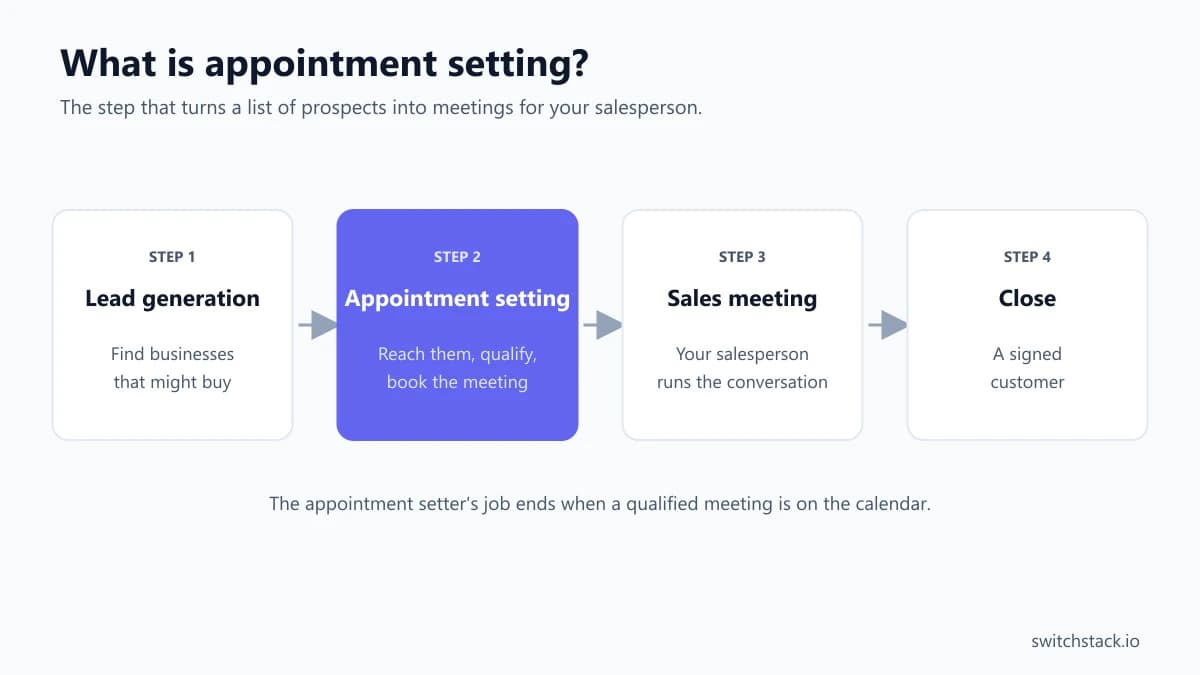
Appointment setting is the part of sales that turns a prospect into a booked meeting. An appointment setter contacts potential customers, usually by phone, checks that they fit, and books a meeting with a salesperson who runs the sales conversation. The setter doesn't try to close the deal: the job is done when a qualified meeting is on the calendar.
It exists because selling has two very different jobs. Finding and reaching the right people can take hundreds of calls a week. Running a good sales conversation takes skill and preparation. Appointment setting splits the two, so your best salesperson spends their time in meetings instead of on the phone trying to get them.
Where It Fits in the Sales Process
It sits between finding prospects and selling to them:
| Step | Who does it | What it produces |
|---|---|---|
| Lead generation | Marketing or a list provider | Names of businesses and people who might buy |
| Appointment setting | An appointment setter or SDR | A qualified meeting on the calendar |
| Sales meeting | An account executive or the founder | A proposal, a trial or a next step |
| Close | The same salesperson | A signed customer |
In a small company, one person may do every step. As a business grows, it's often the first job handed to someone else, because it takes the most time and the least deal knowledge.
What Does an Appointment Setter Do?
An appointment setter's day is mostly calls, with some preparation and follow-up around them:
- Works through a list of prospects, checking each company before calling
- Gets past the front desk, or asks who handles the area they're calling about
- Opens the call with a clear reason, then asks a few questions to check fit
- Books a meeting at a specific time and sends the invite straight away
- Handles common objections, such as "send me some information"
- Keeps notes on every call and confirms meetings the day before
The skills that matter most are a calm, confident voice, listening more than talking, and the persistence to make the next call after a run of noes. The same job is often called a sales development rep (SDR or BDR), and pay varies a lot by country: see our SDR salary by country benchmark.
How Does Appointment Setting Work?
- Define who to call. The industries, company sizes, locations and job titles that buy from you.
- Define a qualified meeting. What has to be true before a meeting counts: the right company, the right person, a real reason to talk, and a meeting that actually happens.
- Build the list and the script. A short opener, two or three questions and a clear ask.
- Make the calls. Usually in the prospects' business hours, often with follow-up emails.
- Book and confirm. A specific time on the salesperson's calendar, with a reminder before the meeting.
- Review and improve. Listen to calls, check which meetings were good, and change one thing at a time.
Appointment Setting Examples
A B2B call to book a meeting is short. Here's how a typical one goes:
Opener: "Hi Sarah, it's Daniel from Acme. I'll be brief: I'm calling because we help accounting firms cut the time they spend chasing late client paperwork."
Question: "How are you handling that at the moment, especially around tax season?"
Ask: "It sounds like it's worth 20 minutes with our founder to see if it fits. Would Tuesday at 10 or Wednesday at 2 work better?"
The setter doesn't pitch features or talk price. The aim is a good reason to meet and a specific time. A few more situations where it's common:
- A software company booking product demos with operations managers
- An IT support company booking IT reviews with small business owners (see MSP appointment setting)
- A marketing agency booking strategy calls with local business owners (see appointment setting for marketing agencies)
- A consultancy booking discovery calls with finance directors
- A recruitment agency booking calls with hiring managers
For full scripts, see our B2B cold calling script template.
Appointment Setting vs Cold Calling, Lead Generation and SDRs
These terms overlap, and people often use them to mean the same thing:
| Term | What it means | What it produces |
|---|---|---|
| Appointment setting | Contacting prospects to book qualified meetings for a salesperson | A meeting held |
| Cold calling | Phoning people who haven't heard from you before. It's the most common way to set appointments | A conversation |
| Lead generation | Finding businesses and people who might buy | A list of prospects |
| SDR (sales development rep) | A job title for someone who sets appointments, often by phone, email and LinkedIn | Qualified pipeline |
In short, lead generation finds people, cold calling reaches them, and appointment setting turns the right ones into meetings. See also what cold calling is and lead generation.
B2B vs B2C Appointment Setting
| B2B | B2C | |
|---|---|---|
| Who you call | Decision-makers at businesses | Consumers, often people who asked for a quote |
| Qualifying | Company size, role, need and timing | Interest, eligibility and budget |
| Meeting | A video call or office visit, often 20 to 30 minutes | A home visit or phone consultation |
| Rules | Usually lighter, but they vary by country | Stricter: do-not-call registers, consent and calling hours |
The calling rules differ by country, and they are usually stricter for calls to consumers. In the US, for example, the National Do Not Call Registry protects personal numbers. Compare the rules in cold calling laws by country.
How to Measure Results
Track these numbers every week, from the first call to the meeting:
| Metric | What it measures |
|---|---|
| Dials | Calls made |
| Connect rate | The share of dials where a person answers |
| Conversations | Calls where the setter speaks with the right person |
| Meetings booked | Meetings accepted by the prospect |
| Show rate | The share of booked meetings that actually take place |
| Meetings to opportunities | The share of held meetings that become real sales opportunities |
The ratios depend on your market and offer, so there's no honest universal benchmark. Measure your own for two to four weeks, then plan from them. Our guide on how many cold calls it takes to book a meeting shows how to work out your number.
In-House or Outsourced, and What It Costs
There are three common ways to get appointments set:
- Do it yourself. Free in cash, but it takes your best selling hours.
- Hire an in-house setter. A salary, plus your time to recruit, train and manage them.
- Outsource it. An agency or a dedicated outsourced caller, usually paid per appointment, per hour, or per month.
For typical prices under each model, see how much appointment setting costs.
Appointment setters also call inbound leads: people who filled in a form or asked for a demo. There, speed decides most of the outcome. See the speed to lead statistics and our inbound lead follow-up service.
Switchstack's B2B appointment setting services give you a dedicated caller for $2,199 to $3,099 a month, with no setup fee and no charge per meeting. Calls start in about 2 weeks. See how it works, or read our guide to in-house vs outsourced calling.
Appointment Setting: FAQs
Quick answers to the questions people ask most.
What is the meaning of appointment setting?
What does an appointment setter do?
Is appointment setting the same as cold calling?
What is B2B appointment setting?
How much does appointment setting cost?
How do you get more booked meetings to actually happen?
Want Meetings Booked for You?
A dedicated caller who books qualified meetings on your calendar, managed every day and recorded on every call.
- Start in about 2 weeks
- No setup fee, no per-meeting charges
- Free replacement in the first 30 days
- A recording of every call
Prefer email? [email protected]
Book a Call