Construction Cold Calling Script: Get on More Bid Lists
A construction cold calling script for subcontractors, suppliers and facility services companies: who to ask for at a general contractor, openers for each trigger, what prequalification asks for, where to find projects, objection answers and a voicemail.
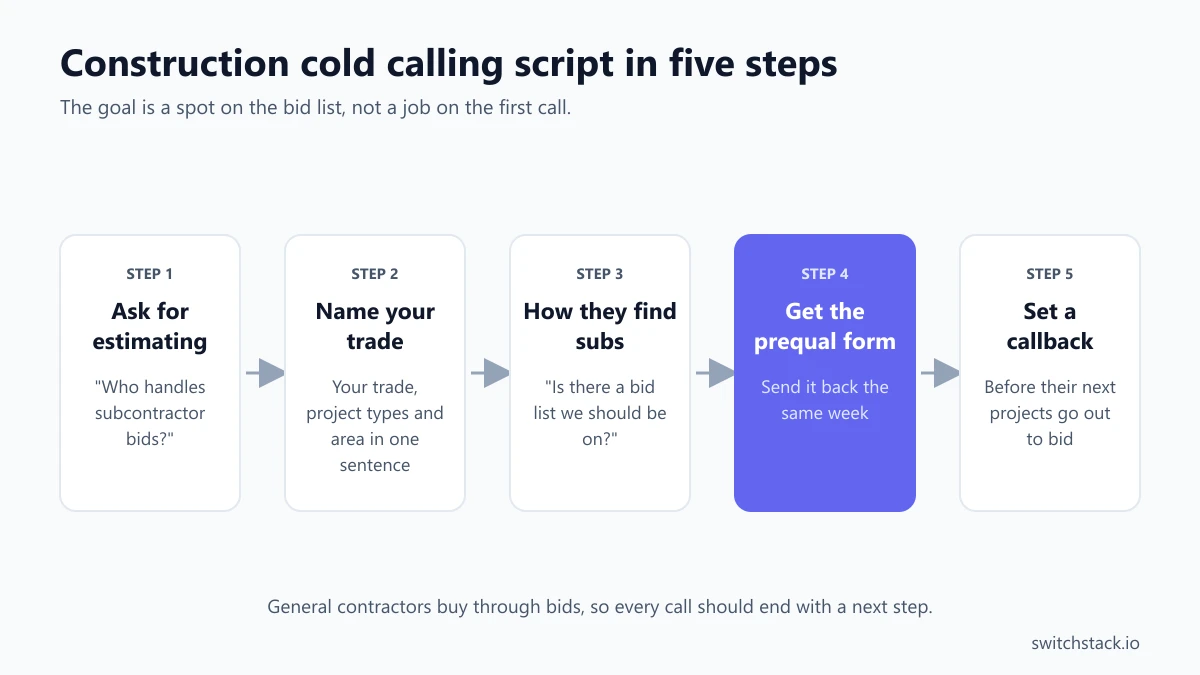
A construction cold calling script for subcontractors and suppliers works best when it asks for a spot on the bid list, not a job. Ask for the estimating or preconstruction team, name your trade and the area you cover, ask how they find subs for upcoming work, and close on a small next step: their prequalification form or an invitation to bid on a named project. Then call back before their next projects go out to bid.
This guide gives you the construction cold calling script word for word, who to ask for at a general contractor and seven openers for the triggers that make a call timely. It also covers what prequalification forms ask for, where to find projects and contractors to call, gatekeeper and voicemail lines, a follow-up email and answers to the objections you'll hear most. Jump straight to the script.
Rather have a caller do this for you? See How Switchstack Fits: a dedicated caller from $1,499 a month, with no setup fee. We call businesses only, never homeowners.
Table of Contents
- What Makes Construction Cold Calling Different?
- Who to Ask For at a General Contractor
- The Construction Cold Calling Script, Word for Word
- Openers for Each Trigger
- What Do General Contractors Ask For to Prequalify You?
- Where to Find Projects and Contractors to Call
- Gatekeeper Lines
- Construction Voicemail Script
- Follow-Up Email After the Call
- Answers to Construction Objections
- How to Measure Results
- What Calling Rules Apply?
- How Switchstack Fits
What Makes Construction Cold Calling Different?
Construction cold calling is different because general contractors buy through bids, not through sales meetings. They keep a list of subcontractors for each trade, invite several of them to price each project, and add new names when they need more coverage or a usual firm lets them down. So the first call has three realistic goals:
- Get on the bid list for your trade and region.
- Get prequalified, which usually means filling in their form before you can bid.
- Get invited to bid on a named project that's coming up.
A meeting with the estimator is a bonus. A promise to send the next invitation to bid in your trade is a win.
Who to Ask For at a General Contractor
At most general contractors, ask for the estimator or chief estimator, because they build the bid lists and send the invitations to bid. At a small contractor the owner often estimates too, and at a larger one a preconstruction manager prices projects before bids go out:
| Role | What they control | When to ask for them |
|---|---|---|
| Estimator or chief estimator | Bid lists and invitations to bid for each trade | First choice at most general contractors |
| Preconstruction manager | Early budgets, design-assist and who prices a project before bids go out | Larger contractors and negotiated work |
| Project manager | Subcontractors on projects already running, and change orders | When a project has started and a trade is behind or missing |
| Purchasing or procurement | Materials, equipment and some subcontracts | Suppliers selling materials or rentals |
| Owner | Everything | Small contractors, where the owner estimates too |
Selling facility maintenance or service contracts rather than project work? Call property managers and facility managers instead, and ask when the current service contract comes up for renewal.
The Construction Cold Calling Script, Word for Word
A construction cold calling script has five steps: ask for the estimating team, say your trade and area in one sentence, ask how they find subcontractors for upcoming work, ask for the prequalification form or a spot on the bid list, and set a date to call back. Fill in the brackets and learn the steps rather than reading them out.
1. Opener: "Hi [name], this is [your name] with [company]. We're a [trade] contractor working on [type of project, such as: commercial fit-outs and retail] around [area]. Have you got a minute?"
2. Reason for the call: "I'm calling because you're one of the contractors we'd like to bid for, and I wanted to find out how you pick [trade] subs for your projects."
3. The question: "How do you usually find [trade] subcontractors for new work? Is there a bid list we should be on?"
4. The next step: "Could you send me your prequalification form, or tell me who handles it? I'll get it back to you this week."
5. The callback: "What projects do you have coming up in the next few months that might need [trade]? When should I check back?"
Then close out: "What's the best email for bid invitations? And is there anyone else in estimating I should know?"
If they have no projects in your trade right now, ask what kind of work they're bidding next, and put a reminder in your calendar.
Openers for Each Trigger
A trigger gives you a reason to call this contractor this week. Swap step 2 of the construction cold calling script for the line that fits, including the last row if you sell materials or equipment rather than a trade:
| Trigger | Reason-for-the-call line |
|---|---|
| A new project announced | "I saw you're building [project] on [street]. Are the [trade] bids out yet, or still to come?" |
| A bid invitation in your trade | "I saw the [project] is out to bid. Are you taking [trade] numbers, and is there time to get us on the list?" |
| A contractor expanding into your area | "I noticed you've started work in [area]. We're local [trade], and I'd like to be on your list here." |
| A trade that's behind on a running project | "If you ever need [trade] on short notice, we have crews available in [month]. Who should I talk to?" |
| A service or maintenance contract renewal | "Your [service] contract may come up for renewal soon. When do you usually review it?" |
| A new property manager or owner | "I saw [name] took over [building]. New managers often review their service providers, so I wanted to introduce us early." |
| You supply materials or equipment | "I saw you're starting [project]. Who buys [material or equipment] for it, and are you open to another supplier quote?" |
What Do General Contractors Ask For to Prequalify You?
Most general contractors ask for the same kinds of information before you can bid, so have it ready before you start calling. The American Institute of Architects publishes a standard version, the A305 Contractor's Qualification Statement, which subcontractors and suppliers can use as well as contractors. Its exhibits cover:
| Section | What it asks for |
|---|---|
| General information | Your legal name, legal status and references |
| Financial and performance information | Financial information, and any disputes or disciplinary actions |
| Project-specific information | Insurance and bonds, safety program and records, key people and the work you do yourself |
| Past project experience | Projects you've completed |
On federal work, the Federal Acquisition Regulation says the Miller Act "requires performance and payment bonds for any construction contract exceeding $150,000." General contractors on that work often ask their subcontractors about bonding capacity too, so know yours before you call.
Where to Find Projects and Contractors to Call
Build your list from projects in your area, not from a generic database. Each one points to the contractors bidding it:
| Where to look | What it gives you |
|---|---|
| SAM.gov contract opportunities | Federal projects, and the contractors who win them |
| State and city procurement portals | Public projects out to bid, often with plan holders and bidders listed |
| Building permit records, where your city publishes them | Private projects about to start, and the contractor on the permit |
| General contractors' websites | Subcontractor registration pages and current projects |
| Local news and construction trade news | New projects, groundbreakings and contractors expanding into your area |
| Your own records | Contractors who invited you before, and the dates their next projects start |
Stick to the work you do best and the area you cover, so every call has a real reason behind it.
Gatekeeper Lines
At most general contractors, the person who answers is a receptionist or an office manager who usually knows who handles bids:
- Finding the right person: "Who handles [trade] subcontractor bids there?"
- If asked what it's about: "It's [your name] with [company]. We're [trade], and I'd like to get on your bid list."
- If they give you a bids email: "Thanks. Who reads it, so I can follow up by name?"
- If the estimator is out on site: "When is [name] usually in the office? I'll call back then."
Our guide on how to get past the gatekeeper has more lines for receptionists and phone menus.
Construction Voicemail Script
A construction voicemail should run under 20 seconds, name your trade and area, and say your number twice:
"Hi [name], it's [your name] with [company]. We're [trade] contractors working around [area], and I'd like to get on your bid list for [type of project]. Call me at [number], that's [number]. I'll also send our details by email."
Leave a voicemail on the first and third attempts, and call early in the morning or late in the afternoon, when estimators are more likely to be in the office.
Follow-Up Email After the Call
Send it the same day, with the documents they asked for:
Subject: [Trade] bids for [their company]: [your company]
Hi [name],
Thanks for your time today. As promised, here's our completed prequalification form and a one-page summary of our recent [trade] work.
We cover [area] and work on [type of project]. You mentioned [project or timing they gave you].
I'll check back in [month] before those bids go out.
[Your name] [Phone number]
Keep the attachments short: the form they asked for, your certificate of insurance if requested, and one page of recent projects.
Answers to Construction Objections
General contractors are busy and plain-spoken, so keep the answers in your construction cold calling script short and plain:
| They say | You say |
|---|---|
| "We've got our subs." | "That makes sense. Do you ever need a second number in [trade], or someone when your usual firm is booked?" |
| "Send it to our bids email." | "Will do. Who reads it, so I can make sure it reaches the right estimator?" |
| "Fill out our prequal first." | "Happy to. Where do I find the form, and who should it go back to?" |
| "You're too small for our work." | "Understood. What size of [trade] package do you usually let? We could start on a smaller one." |
| "It all comes down to price." | "Fair enough. That's why we'd like to be invited: so you have one more number to compare." |
| "Call back when we have a project." | "Will do. When do your next projects usually go out to bid?" |
For general brush-offs such as "not interested" and "I'm busy," see our 15 rebuttals to common cold calling objections.
How to Measure Results
In construction, the steps before a win take months, so measure each one every week:
| Metric | What it tells you |
|---|---|
| Calls and conversations | Effort and list quality |
| Bid lists joined | Whether contractors see you as a fit |
| Prequalification forms returned | Follow-through on your side |
| Invitations to bid | Whether you're on the lists that matter |
| Bids submitted | How many chances you're giving yourself |
| Jobs won | Revenue, measured over months |
A new spot on a bid list may not send an invitation until the contractor's next project in your trade, so judge the calling over months, not weeks.
What Calling Rules Apply?
The US Federal Trade Commission says that "most phone calls between a telemarketer and a business are exempt" from the Telemarketing Sales Rule, with some exceptions (FTC, Complying with the Telemarketing Sales Rule). Calling homeowners is different: consumer calls fall under much stricter rules, so keep construction cold calling to businesses. Honor every "don't call me again" and keep your own do-not-call list. This is not legal advice.
Calling outside the US? See cold calling laws in the US, in the UK and in every market we cover in cold calling laws by country.
How Switchstack Fits
Most contractors would rather their estimators price work than spend the day calling to get on bid lists. Switchstack supplies a dedicated, full-time caller who phones general contractors, property managers and developers with your construction cold calling script, gets you on bid lists and books meetings about upcoming projects. See cold calling for construction companies for how it works.
- Hire a Caller (from $1,499 a month per caller): when you hire cold callers through us, a vetted caller joins your team, works your list during your prospects' business hours and reports to you.
- We Call for You (from $2,199 a month per caller): with our cold calling services, we supply, train and manage the caller, write the script with you and send a recording of every call.
There's no setup fee and no charge per meeting, and it's month to month with 30 days' notice. See prices by caller country.
Want to test first? Our 60-day cold calling pilot costs 20% less and ends on its own unless you choose to continue. To talk it through, book a 30-minute call.
Frequently Asked Questions
What should a construction cold calling script include?
Who should a subcontractor ask for at a general contractor?
How do you get on a general contractor's bid list?
What is a prequalification form in construction?
Do subcontractors need bonds for federal projects?
Is it legal to cold call construction companies?
What should you say when a general contractor says they already have subs?
Want us to make these calls for you?
Tell us who you want to reach. We'll make the calls and book the meetings, or find you a caller of your own. Pick a time for a free 30-minute call below.
- Free 30-minute call, no obligation
- 20% off the first 2 months
- No setup fee, month-to-month
- Free replacement in the first 30 days
Prefer email? hello@switchstack.io
See all pricesWritten by
Switchstack Team
Switchstack
Guides on cold calling and hiring callers from the Switchstack team.
Newsletter
Tactics worth your inbox.
Outbound tactics and product updates — only when we have something genuinely worth sharing.