How to Get Past the Gatekeeper on B2B Cold Calls
How to get past the gatekeeper on B2B cold calls: seven steps, word-for-word scripts for receptionists, assistants and phone menus, answers to the usual objections, and what the law says you must tell whoever answers.
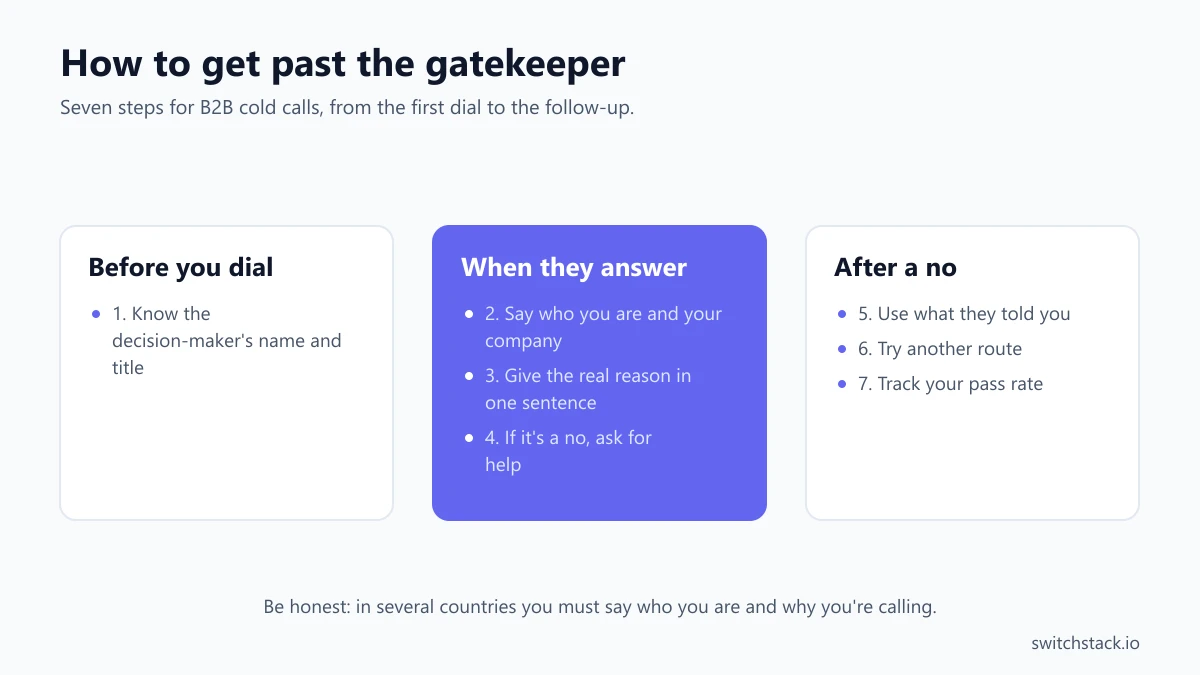
The way to get past the gatekeeper is to stop treating them as a barrier. Ask for the decision-maker by name, say who you are and why you're calling in one honest sentence, and when the answer is no, ask for help: who handles it, when to call, or a direct line. Receptionists and assistants are more likely to put through callers who sound clear and polite.
This guide covers how to get past the gatekeeper on B2B cold calls step by step, with word-for-word scripts for receptionists, executive assistants and phone menus, answers to the objections you'll hear, and what calling rules in six countries say you must tell whoever answers.
Table of Contents
- What Is a Gatekeeper in Sales?
- How to Get Past the Gatekeeper in 7 Steps
- What Should You Say to a Receptionist?
- How Do You Handle an Executive Assistant?
- Gatekeeper Cold Call Scripts
- How Do You Get Through a Phone Menu?
- How to Answer Gatekeeper Objections
- What Must You Tell a Gatekeeper by Law?
- Lines That Get You Blocked
- When Should You Stop Calling the Front Desk?
- When to Get Help
What Is a Gatekeeper in Sales?
A gatekeeper is anyone who answers the phone between you and the person you want to reach. Their job is to protect that person's time, so they screen calls that sound like sales pitches. They aren't all the same, and each needs a different approach.
| Gatekeeper | What they're there to do | What works |
|---|---|---|
| Receptionist or front desk | Route calls quickly and keep obvious pitches out | A name, a short reason and a polite ask |
| Executive assistant | Manage one person's calendar and inbox | The full reason, and a request for their advice |
| Colleague who picks up | Get back to their own work | Asking who handles the area |
| Phone menu or dial-by-name directory | Route callers without a person | Knowing the name and the department |
| Voicemail | Hold the message until the person has time | One reason, one action, your number twice |
The rest of this guide takes them one at a time. If you don't have a cold calling script yet, start with our B2B cold calling script template and come back.
How to Get Past the Gatekeeper in 7 Steps
- Know who you want. Find the decision-maker's full name and job title before you dial.
- Say who you are. Give your name and company at the start, in a normal voice.
- Give the real reason. One sentence about the problem you help with, for their team.
- Ask for help when the answer is no. Ask who handles it, when to call or which line to use.
- Use what they tell you. Write down their name, the best time and any new contact.
- Try another route. A direct line, an email or a different department.
- Track your pass rate. Count how often front-desk calls end with you speaking to the right person.
1. Know who you want
"Can I speak to whoever handles your marketing?" tells the gatekeeper this is a sales call before you've finished the sentence. "Could I speak to Priya Shah, please?" sounds like someone with a reason to call. Check the company's website, its LinkedIn page or a recent press release for the right name and title. If you can't find one, use the help request in step 4 instead of guessing.
2. Say who you are
Give your name and your company in the first sentence. Callers who hide their company sound like they have something to hide, and in several countries saying who you are is a legal requirement (see What Must You Tell a Gatekeeper by Law?). Speak at a normal pace. A rushed opener sounds like a script.
3. Give the real reason
When the gatekeeper asks what it's about, the answer that works is short, true and about their company: "It's about how your team books installer visits. I'd like to see if a short call makes sense." Don't pitch the product to the gatekeeper. They can't buy it, and a pitch is the clearest signal that the call should be screened out.
4. Ask for help when the answer is no
The first call through a front desk often doesn't reach the decision-maker. Good callers turn a no into information:
- "Who would be the right person for that?"
- "When is [first name] usually at their desk?"
- "Is there a direct line I should use, or is it best to go through you?"
- "Would an email be better? What's the right address?"
People like being asked for advice. Many receptionists will tell you exactly when to call back.
5. Use what they tell you
Write down the gatekeeper's name, what they said and when to call again. On the next call, say, "Hi Sam, it's [name] from [company] again. You said Tuesday mornings were best for Priya." That's a true reference to a real conversation, and it changes how the call sounds.
6. Try another route
If the front desk keeps saying no, try a direct line from the company's website or email signature, a short email to the decision-maker, or a call to a different department, such as sales, which is often quick to answer and may tell you who you need. Ask that department politely for the right person. Don't pretend to be a customer.
7. Track your pass rate
Count how many front-desk calls end with you speaking to the person you wanted, or with a named contact and a time to call back. Track it for a few weeks. If the number is low, change one thing at a time: the opener, the reason, or the time of day you call.
What Should You Say to a Receptionist?
Say your name and company, ask for the decision-maker by full name, and when the receptionist asks why, give one honest sentence and a question. Receptionists route a lot of calls, so make yours easy to put through.
You: Hi, this is Alex Morgan from Northline. Could you put me through to Priya Shah, please?
Receptionist: Can I ask what it's about?
You: Of course. It's about how your service team books installer visits. I'd like to see whether a short call with Priya makes sense, or whether someone else handles that.
Receptionist: She's in meetings all morning.
You: No problem. When's the best time to catch her? And is it better to call this number or a direct line?
Two things make this work. The reason is specific enough to sound real, and each reply ends with a question, so the receptionist can help you even if they won't connect you now.
How Do You Handle an Executive Assistant?
An executive assistant isn't a receptionist. They manage the decision-maker's calendar, read their email and often decide which meetings get booked. Treat them as the decision-maker's chief of staff.
You: Hi, is that Jordan? This is Alex Morgan from Northline. I'm calling for Priya Shah, and I'm guessing you manage her calendar.
Assistant: I do. What's it regarding?
You: We help service companies fill installer calendars. I'd like 20 minutes with Priya to see if it's relevant to her team. How does she prefer to hear about something like that?
Assistant: Send me an email and I'll pass it on.
You: I'll do that today. If she's interested, could you book the 20 minutes directly, or should I follow up with you on Thursday?
Give assistants more detail, not less. They can't judge whether to put you on the calendar without knowing what the meeting is for. Ask whether they can book it themselves. Many can.
Gatekeeper Cold Call Scripts
Fill in the brackets, then say each script out loud until it sounds like you.
The direct ask (you know the name): "Hi, this is [your name] from [company]. Could you put me through to [first and last name], please?"
The who-handles-it ask (you don't know the name): "Hi, this is [your name] from [company]. I'm hoping you can help me. Who looks after [area, such as fleet maintenance] there?"
The honest reason (when they ask what it's about): "It's about [problem area] for [their team]. I'd like to see if a short call makes sense. Is [first name] the right person for that, or is it someone else?"
The follow-up (after a real conversation): "Hi [gatekeeper's name], it's [your name] from [company] again. You mentioned [first name] is usually free [time]. Is now a good moment?"
The help request (after a no): "Understood. When is the best time to reach [first name]? Or is there an email address I should use instead?"
The voicemail (when you reach their line but not them): "Hi [first name], it's [your name] from [company]. I'm calling about [problem area] for your team. You can reach me on [number]. Again, that's [number]. I'll also send a short email today."
How Do You Get Through a Phone Menu?
To get through a phone menu, know the decision-maker's surname for the dial-by-name directory, or choose the option for reception and ask for them by name. Many companies answer with a menu instead of a person, and each kind needs a slightly different move.
- Dial-by-name directories usually ask for the first few letters of a surname. This is where knowing the decision-maker's name pays off.
- Menus often have an option for the operator or reception. Listen to the whole menu once, note the options and write them down for the next call.
- Sales lines are often answered quickly. If you choose that option, say straight away that you're not a customer and ask who handles your area. Don't pretend to be a buyer.
- Extension numbers are sometimes printed on websites or in email signatures. Save them in your notes.
When you reach a person through a menu, use the same direct ask and honest reason as with a receptionist.
How to Answer Gatekeeper Objections
| They say | You say |
|---|---|
| "What's it about?" | "It's about [problem area] for [team]. Is [first name] the right person for that?" |
| "Is this a sales call?" | "Yes, I'd like to see if a short call with [first name] makes sense. Is now a bad time?" |
| "Send an email." | "Happy to. What's the best address, and when should I follow up?" |
| "They're not interested." | "Understood. Is there someone else who looks after [area], or a better time next quarter?" |
| "They don't take sales calls." | "Thanks for telling me. How does [first name] prefer to hear from new suppliers?" |
| "We already have a supplier." | "That makes sense. Who would review that when the contract comes up?" |
| "Don't call again." | "Of course. I'll take the number off our list. Thanks for your time." |
Answer "Is this a sales call?" honestly. A yes with a clear, short reason keeps the conversation going. A dodge is the answer gatekeepers remember. For more brush-off answers, see the script template.
What Must You Tell a Gatekeeper by Law?
In several countries the calling rules say what a caller must disclose to whoever answers, receptionists included. These are the rules for business-to-business sales calls in six markets:
| Country | What the rules require | Full guide |
|---|---|---|
| UK | Say who's calling and who you're calling for, and show your number (ICO) | UK rules |
| US | B2B calls are exempt from most of the Telemarketing Sales Rule, but not from its ban on misrepresentation (16 CFR 310.6) | US rules |
| Canada | Give your name, the company you're calling for and a number where you can be reached (CRTC) | Canada rules |
| Australia | Say early in the call who you work for and why you're calling, and show your number (ACMA) | Australia rules |
| Netherlands | Give your name, your company and the sales purpose straight away, and show your number (Business.gov.nl) | Netherlands rules |
| India | Make sales calls from a 140-series number under a sender registered with a telecom operator (TRAI) | India rules |
So giving only your first name and never your company, a trick that still gets passed around, can put you in breach of the rules in the UK, Canada, Australia and the Netherlands. In the US, the Telemarketing Sales Rule's ban on false or misleading statements applies to B2B sales calls, so keep what you say to get transferred true. For every other market we cover, see cold calling laws by country.
This is a plain summary for business-to-business calls, not legal advice.
Lines That Get You Blocked
You'll still hear these tricks recommended. Each might work once, and then the gatekeeper remembers your number or your company.
- "It's a personal call." It isn't, and they'll find out within a minute.
- "I'm returning their call." Unless they called you, this is a lie the decision-maker will spot straight away.
- "They're expecting my call." Only say it when you've agreed on a time.
- Pretending to be a customer to get through the sales line or support desk.
- Hiding your company name, which several countries' rules require you to give.
- Pitching the gatekeeper for three minutes. They can't buy, and they will remember the call.
- Being rude when the answer is no. The receptionist will be there next month, and so will the assistant.
The honest version of each line works better over a few weeks of calls, because the gatekeeper remembers you as someone who was clear and polite.
When Should You Stop Calling the Front Desk?
Plan several attempts over two to three weeks, at different times of day, and mix calls with a short email. Our guide to how many cold calls it takes to book a meeting covers attempt counts and follow-up timing.
Change tactics when the front desk has given you the same answer three times. Try the direct line, the email or another department. Stop calling straight away when anyone asks you not to call again, and add the company to your do-not-call list. The rules in the UK, Canada and the Netherlands require it.
When to Get Help
Knowing how to get past the gatekeeper is a skill that comes from making a lot of calls, writing down what each front desk says and calling back at the right time. That's hard to do between meetings when you're also running sales.
If you'd rather not do the calling yourself, Switchstack can do it for you. With our cold calling services, we supply, train and manage a dedicated caller who handles the front desks, assistants and phone menus and books qualified meetings on your calendar. If you want to manage the caller yourself, you can hire cold callers through us: a vetted, full-time caller who works your list and reports to you. See our appointment setting services for how meetings are booked and confirmed, or book a call to talk it through.
Frequently Asked Questions
How do you get past the gatekeeper on a cold call?
What should I say to a receptionist on a cold call?
Is it OK to lie to a gatekeeper?
How do you handle an executive assistant?
What if the gatekeeper says to send an email?
Should I avoid the gatekeeper by calling early or late?
How many times should I call before giving up on a gatekeeper?
Want us to make these calls for you?
Tell us who you want to reach. We'll make the calls and book the meetings, or find you a caller of your own. Pick a time for a free 30-minute call below.
- Free 30-minute call, no obligation
- 20% off the first 2 months
- No setup fee, month-to-month
- Free replacement in the first 30 days
Prefer email? [email protected]
See all pricesWritten by
Switchstack Team
Switchstack
Guides on cold calling and hiring callers from the Switchstack team.
Newsletter
Tactics worth your inbox.
Outbound tactics and product updates — only when we have something genuinely worth sharing.