Cold calling laws by country · Reviewed November 2026
Cold Calling Laws in India
Is cold calling legal in India? Yes, if the call goes through TRAI's registration system. Under the TCCCPR 2018, that covers every sales call to an Indian number, business or personal. Promotional calls must come from 140-series numbers under a registered sender and respect people's Do Not Disturb (DND) preferences. Unregistered callers on ordinary 10-digit numbers face 15 days of barring, then a year's disconnection.
A plain summary for business-to-business calls, not legal advice. The official and legal sources are listed at the end.
Calling businesses in India?
We recommend a caller based in India, from $2,199 a month. Sales calls to Indian numbers have to go out under a sender registered with an Indian telecom operator, so we'll confirm whose registration your calls use before they start.
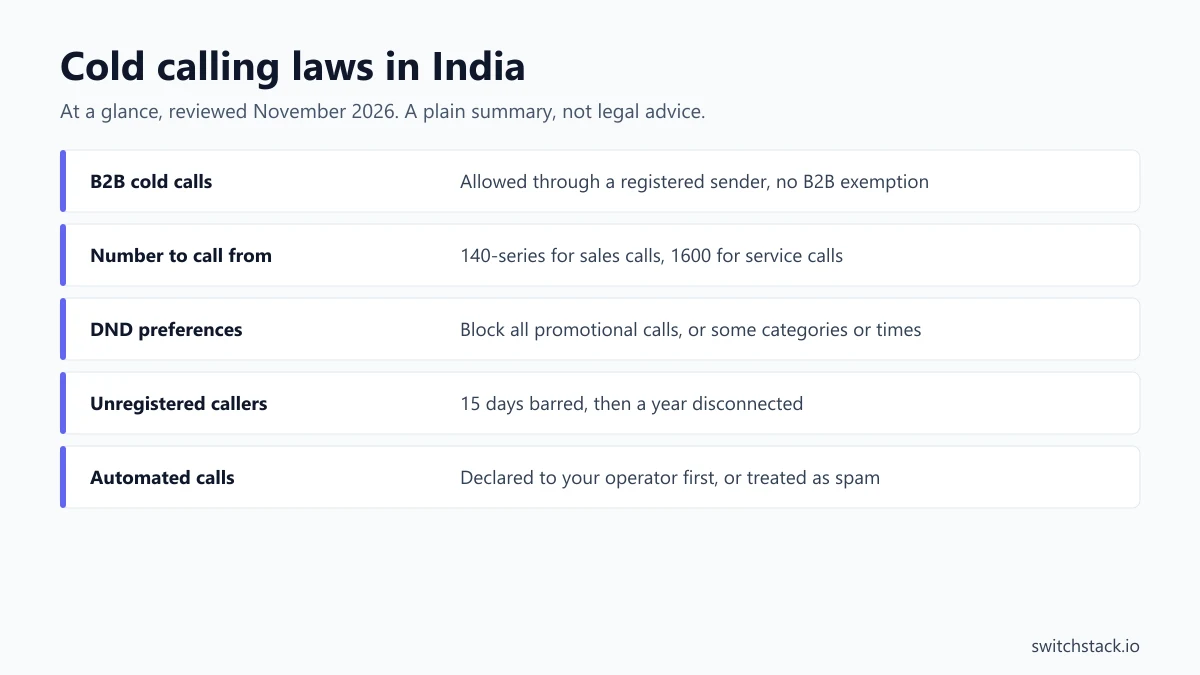
Cold calling laws in India at a glance
| B2B cold calls | Allowed through a registered sender, no B2B exemption |
|---|---|
| Number to call from | 140-series for promotional calls, 1600-series for service and transactional calls |
| DND preferences | Block all promotional calls, or only some categories, times or days |
| Unregistered callers | 15 days' barring, then a year's disconnection and blacklisting |
| Automated calls | Must be declared to your operator first, or they count as spam |
| Calling hours | None fixed by TRAI |
| Regulator | Telecom Regulatory Authority of India (TRAI) |
Use this chart on your site
Which laws cover cold calling in India?
The main law is the Telecom Commercial Communications Customer Preference Regulations, 2018 (TCCCPR), issued by the Telecom Regulatory Authority of India (TRAI). The rules were tightened in February 2025 by the Second Amendment and again on 18 September 2026 by the Third Amendment, which takes effect in stages, 30, 60 and 90 days after its publication in the Gazette.
Telecom operators enforce the rules day to day. They register the businesses that send commercial calls, apply each customer's preferences, handle complaints and bar or disconnect the lines of senders who break the rules. The Digital Personal Data Protection Act, 2023 separately covers the personal data in your call list.
Is cold calling legal in India for B2B calls?
Yes, on the same terms as any other sales call. The TCCCPR defines a commercial communication by its purpose: any call or message whose primary purpose is to inform about, advertise or solicit business for goods or services. It defines a customer as any telecom subscriber. A call that pitches your service to a company's purchasing manager is covered in the same way as a call to a consumer.
So B2B calling into India needs the same setup: a registered sender, the right number series and a list checked against DND preferences. Calling an Indian business from your own mobile number doesn't get around this.
Do you need to register to make sales calls in India?
Yes. A business that sends commercial calls registers with an Indian telecom operator, which records senders on its DLT (distributed ledger) platform. Anyone who sends commercial communications without registering is what TRAI calls an Unregistered Telemarketer (UTM). UTMs typically call from ordinary 10-digit mobile or landline numbers.
Since the 2025 amendment, promotional calls may only be made from 140-series numbers, and service and transactional calls from the 1600 series. The 2026 amendment stops operators' spam alerts and call management apps from blanket-flagging the 140xx, 1600xx and 1601xx series, so a registered call isn't automatically labeled as spam.
How do DND preferences work in India?
DND (Do Not Disturb) preferences are the choices each phone subscriber registers with their operator about which commercial calls they'll accept. A registered sender's promotional calls are checked against them.
- Each subscriber can block all commercial calls that need explicit consent, or block only promotional calls.
- Preferences can be narrower: by category of product, by mode (call or message), by time band and by type of day.
- A sender can reach a subscriber who blocked promotional calls only with that person's explicit consent, recorded through the operators' consent system.
- Subscribers can complain through the TRAI DND app, their operator's app or website, or by calling or texting 1909, within 7 days of the call.
- The 2026 amendment adds an appeal: a subscriber who disagrees with how a complaint was resolved can appeal within 15 days.
Can you call someone who enquired about your service?
Yes, for a limited time. Under the 2026 amendment, an enquiry about your goods or services creates a relationship for 7 days from the date of the enquiry, and an application for your product or service for 3 months. The enquiry has to be made in writing or by digital means, and you have to keep it in a form you can verify.
After that window, treat the lead like any other promotional call: a registered 140-series number and the person's DND preferences.
Are automated calls and robocalls allowed in India?
Only if you declare them first. Since the 2025 amendment, senders have had to tell their operator in advance that they use autodialers or robocalls.
The 2026 amendment defines an application-to-person (A2P) call as one started by software, an autodialer or a recorded or artificial voice, without a person dialing it. Every sender has to declare its A2P calls to its operator, with the number ranges it will use, and undeclared A2P calls are treated as unsolicited. These provisions start 60 days after the amendment's publication, in mid-November 2026.
Operators can also charge up to Rs 0.05 a minute to carry A2P calls, except calls from the 140xx, 1600xx and 1601xx series.
What are the penalties for unsolicited calls in India?
TRAI's penalties for senders work through their phone lines. When 5 or more different people complain about the same sender within 10 days, the operator suspends outgoing calls on all of that sender's lines and investigates. If it confirms the sender made unsolicited commercial calls, a first violation bars outgoing calls on every line the sender has, with every operator, for 15 days. A second violation disconnects all the sender's lines for one year, blacklists the sender and blocks the devices used for the calls.
The 2026 amendment adds AI-based detection. Operators flag numbers that are likely to be sending spam and share the list, and 5 or more flagged numbers from one sender within 10 days start graded action, from KYC re-verification to disconnection. Action can also start at 3 complaints in 10 days when the number is already flagged.
What does the DPDP Act mean for your call list?
A contact's name and number are personal data. Under section 4 of the Digital Personal Data Protection Act, 2023, you can process them only with the person's consent or for one of the legitimate uses listed in section 7. Marketing isn't on that list, though section 7 does cover data someone gave you voluntarily for a specific purpose, such as a request for a quote.
The Act doesn't apply to personal data that the person made publicly available themselves (section 3). The DPDP Rules were notified on 14 November 2025 with an 18-month phased timeline, so most duties apply from May 2027. The highest penalty is up to Rs 250 crore, for failing to keep personal data secure. The 2026 TRAI amendment adds that nothing in its regulations exempts a sender from the DPDP Act.
Are there legal calling hours in India?
TRAI's regulations don't set fixed calling hours. Instead, subscribers can block promotional calls in time bands and on days of their choosing, and a registered sender's calls are checked against those preferences. For B2B calls, the working day is the practical window.
Before you call Indian businesses: a checklist
- Register as a sender with an Indian telecom operator, or call through a registered telemarketer.
- Make promotional calls from 140-series numbers, never from ordinary 10-digit numbers.
- Check every number against DND preferences, unless you hold explicit consent.
- Keep written or digital proof of any enquiry, and call within 7 days of it.
- Declare any autodialer or recorded-voice calls to your operator before you use them.
- Record where each contact came from, and stop calling anyone who asks you to.
Calling businesses in India?
We recommend a caller based in India, from $2,199 a month. Sales calls to Indian numbers have to go out under a sender registered with an Indian telecom operator, so we'll confirm whose registration your calls use before they start. See Indian cold callers for US, UK and Gulf calls or our B2B telemarketing services.
Cold Calling in India: Legal FAQs
The questions people ask most about the rules.
Is cold calling legal in India?
Is B2B cold calling exempt from TRAI's rules?
What is a 140 number in India?
Can I cold call from my own mobile number in India?
Can I call a lead who enquired on my website?
Are there legal calling hours in India?
Who enforces the cold calling rules in India?
Sources
Checked November 2026. We review these rules every month and log the changes on the laws by country page.
- TRAI: Telecom Commercial Communications Customer Preference Regulations, 2018
- TRAI: TCCCPR (Second Amendment) Regulations, 2025
- TRAI: TCCCPR (Third Amendment) Regulations, 2026
- TRAI press release 119/2026 on the Third Amendment
- MeitY: Digital Personal Data Protection Act, 2023
- PIB: DPDP Rules, 2025 notified
Cite this page
Switchstack. “Cold Calling Laws in India.” Reviewed November 2026. https://switchstack.io/cold-calling-laws/india
Cold calling laws in other countries
Start Calling India
Tell us who you want to reach in India. We'll recommend a caller country and have someone on the phones in about 2 weeks.
- Local calling rules followed
- A recording of every call
- Month-to-month
Prefer email? [email protected]
Book a Call