Truck Dispatcher Cold Calling Script for Owner-Operators
A truck dispatcher cold calling script for signing owner-operators and small fleets: a safety check, openers for new and established authorities, answers to six brush-offs, a voicemail and what to qualify before the handoff.
A truck dispatcher cold calling script works best when it respects the driver's time and safety. Check that the driver is parked, say you're a dispatch service that works for carriers, give one reason tied to their truck or their new authority, ask how they find loads now, and ask for a short call to talk lanes and rates. Below is the full script, an opener for new authorities, answers to the six brush-offs owner-operators use most, a voicemail, what to qualify before the handoff and the calling rules to know. Rather have someone make these calls for you? Skip to Need Someone to Make the Calls?
Table of Contents
- Who Should a Truck Dispatcher Cold Call?
- Where Do Dispatchers Find Carriers to Call?
- The Truck Dispatcher Cold Calling Script
- An Opener for a New Authority
- Answers to the 6 Brush-Offs Owner-Operators Give
- Voicemail Script
- What to Qualify Before the Handoff
- When Should You Call Owner-Operators?
- Calling Rules for Truck Dispatchers
- Need Someone to Make the Calls?
Who Should a Truck Dispatcher Cold Call?
Call carriers that run their own authority but don't have a full-time person finding loads. That usually means owner-operators and fleets of up to about ten trucks. Each type needs a slightly different reason for the call:
| Carrier type | Why they may want a dispatcher | What to lead with |
|---|---|---|
| New authority | No broker setups yet, still learning the load boards | Help booking first loads and handling broker paperwork |
| Self-dispatching owner-operator | Hours on load boards and phone calls instead of driving or resting | Time back: you find and negotiate, they approve every load |
| Small fleet (2 to 10 trucks) | The owner dispatches while also driving or running the business | Steady loads for every truck so the owner can run the company |
| Already has a dispatcher | May be unhappy with rates, communication or being pushed into loads | A second opinion on rate per mile, with no forced dispatch |
Pick one equipment type at a time, such as dry van, reefer, flatbed, hotshot or power only. A caller who phones only reefer carriers for a week learns the lanes and the language fast, and it shows on the phone.
Where Do Dispatchers Find Carriers to Call?
A good free starting point is FMCSA's Company Census File, a public dataset on the US Department of Transportation's open data portal. Each record has the carrier's USDOT number, the date it was added, its phone and cell phone numbers and its number of power units. That's enough to build a focused list:
- Filter by power units to keep carriers with one to ten trucks.
- Sort by the date added to find carriers that registered recently.
- Keep one region or equipment type per list, so your caller can talk about real lanes.
Many paid trucking lead lists are built from the same FMCSA data, with extra filters. Whichever you use, read the calling rules below before you dial, because many of these numbers are personal cell phones.
The Truck Dispatcher Cold Calling Script
The script has five steps: a safety check, who you are, the reason for the call, one question about how they find loads, and the ask for a short call with your dispatcher. Fill in the parts in brackets. Learn the steps and say them in your own words: drivers hang up fast on someone reading a script.
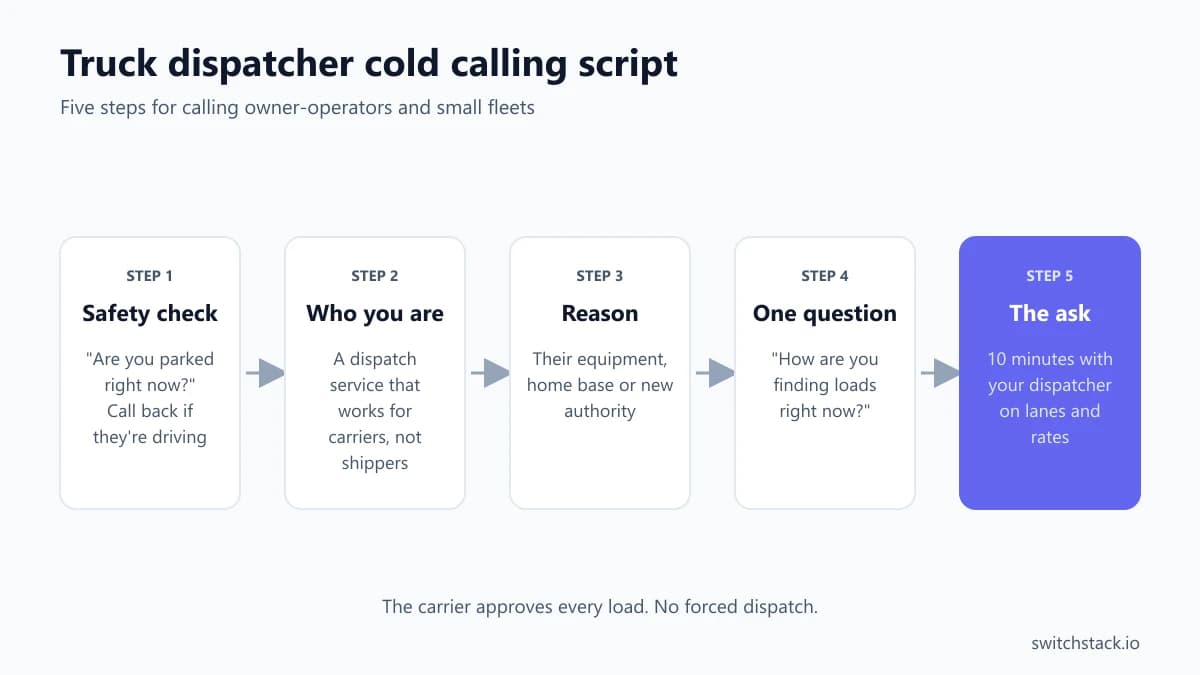
1. Safety check: "Hi, is this [name]? This is [your name] with [dispatch company]. Are you parked right now, or should I call you back?"
If they're driving, ask when they'll stop and call back then. It shows respect, and a driver who's parked can actually talk.
2. Who you are: "We're a dispatch service. We work for carriers, not shippers: we find loads, negotiate rates with brokers and handle the paperwork, and you approve every load."
3. Reason for the call: "I'm calling [equipment type] carriers based around [city or state]. I saw you run [one truck / a few trucks] under your own authority."
4. The question: "How are you finding loads right now? Are you on the load boards yourself, or does someone book them for you?"
Then listen. Follow up with one or two of these, depending on the answer:
- "What lanes do you like to run, and where's home?"
- "What rate per mile are you trying to stay above?"
- "How many hours a week go into finding and booking loads?"
5. The ask: "Would you be open to a 10-minute call with [dispatcher's name] to go through your lanes and the rates we're seeing on them? If it doesn't add up for you, no hard feelings."
Offer two times: "Is this evening around 7 better, or tomorrow morning before you roll?"
Then close out: "Great. What's the best number and email for you? I'll send a short note with our fee and what we'd need to get started."
An Opener for a New Authority
New carriers often have a truck, insurance and an authority, but no broker setups and no steady freight yet. Lead with that:
"Hi [name], [your name] with [dispatch company]. Are you parked? ... Great. I saw [company name] got set up recently, so congratulations. A lot of new carriers tell us the hardest part is getting the first loads and broker packets done. That's what we do for owner-operators. How's it going so far?"
Don't promise loads or rates you can't back up. Tell them what you'll do, and let them judge the numbers on the next call.
Answers to the 6 Brush-Offs Owner-Operators Give
The six brush-offs you'll hear most are "I find my own loads", "I already have a dispatcher", "What's your percentage?", "Do I have to take every load?", "Are you a broker?" and "I'm driving". Owner-operators are direct, so answer the same way: keep it short and don't argue.
1. "I find my own loads."
"That makes sense. A lot of good carriers do. How many hours a week does that take you? If we could take that off your plate and you still approve every load, would that be worth a 10-minute call?"
2. "I already have a dispatcher."
"Good, then you know how it works. Are you happy with the rates they're getting you on your main lanes? If you want a second opinion, we can compare one week of loads, no strings."
3. "What's your percentage?"
"We charge [your percentage] of the load's gross, and nothing if the truck doesn't move. The better question is what you'd net after our fee, so let's look at a real load on your lane."
4. "Do I have to take every load you find?"
"No. You approve every load before we book it. You decide your lanes, your home time and your minimum rate."
5. "Are you a broker?"
"No. We're a dispatch service working for carriers. We book your truck with brokers under your authority, and you're paid by the broker or your factoring company, not through us."
Only say this if it's true for your business. See the section on broker authority below.
6. "I'm driving" or "Call me later."
"No problem, drive safe. When are you stopping next? I'll call you then."
Write down the time and call back exactly then. Keeping that promise is how you earn the next conversation.
Voicemail Script
Keep it under 20 seconds:
"Hi [name], [your name] with [dispatch company]. We dispatch [equipment type] trucks out of [region] and we're taking on a few more carriers. If you'd like help finding loads at better rates, call me at [number]. That's [number] again. Drive safe."
Then send a short text or email only if the carrier has agreed to hear from you that way. Otherwise, call again on a different day and at a different time.
What to Qualify Before the Handoff
Before you book a call with your dispatcher, make sure the carrier is one you can actually help:
| Check | What to ask |
|---|---|
| Authority | MC and USDOT numbers, and how long the authority has been active |
| Equipment | Trailer type and size, and how many trucks |
| Lanes | Home base, preferred lanes, and states or regions they avoid |
| Rates | The minimum rate per mile they'll accept |
| Factoring | Whether they use a factoring company, and which one |
| Insurance | Whether cargo and liability coverage is in place |
| Decision | Who signs the dispatch agreement, if it's not the person on the phone |
After the call, most dispatch services send a sign-up packet: a dispatch agreement, a W-9, a copy of the operating authority, a certificate of insurance and, for factored carriers, a notice of assignment. Send yours the same day, while the call is fresh.
When Should You Call Owner-Operators?
Call when the truck is likely to be stopped, and always open with the safety check. Federal rules matter here. Under 49 CFR 392.82, a driver may not use a hand-held mobile phone while driving a commercial motor vehicle. 49 CFR 390.5 defines that as holding the phone to talk, dialing or answering by pressing more than one button, or reaching for it. The federal rule doesn't ban hands-free calls, but a driver in traffic isn't in a good place to talk business.
Times when trucks are more likely to be parked:
- Early morning, before the first pickup
- Around the mandatory break: 49 CFR 395.3 says a driver can't keep driving once 8 hours of driving have passed without a 30-minute break
- Evenings, once the driver has shut down for the day
- Home time, often on the weekend
Track which times of day get answers from your list, and move your calling hours toward them.
Calling Rules for Truck Dispatchers
Three rules matter most when you put a truck dispatcher cold calling script to work in the US. This is general information, not legal advice.
Dial by hand. Under the TCPA and the FCC's rules, calls to mobile phones made with an autodialer or a prerecorded voice need the person's prior express consent. A live call that a person dials isn't covered by that ban.
Treat cell numbers with care. The National Do Not Call Registry is for personal numbers, and calls to businesses are exempt from its rules. But many owner-operators list a personal cell phone, so check numbers that may be personal against the registry, and add anyone who asks not to be called to your own do-not-call list right away. Our guide to US cold calling laws covers the details, and the legal calling hours checker shows the 8am to 9pm window for residential numbers.
Know where dispatch ends and brokering begins. FMCSA's 2023 guidance on brokers and bona fide agents says a dispatch service may be classed as either one, depending on what it does. A dispatcher would generally be a bona fide agent, not needing broker authority, when it:
- has a written agreement appointing it as the carrier's agent
- arranges loads through brokers and doesn't solicit shippers for freight
- is paid by the carrier, not by the broker or a factoring company
- tells brokers it's a dispatch service working for that specific carrier
That has a direct effect on your cold calling. The same guidance lists dealing directly with shippers, and soliciting the open market of carriers to move a specific shipment, as signs that broker authority is needed. So call carriers, not shippers, and pitch your dispatch service, not a load: "I've got a load from Dallas to Atlanta, want it?" to a carrier you haven't signed is a broker's call. Check your own setup with a transportation attorney.
Need Someone to Make the Calls?
Signing carriers takes a lot of dials, and every hour your dispatchers spend cold calling is an hour they're not booking loads. Our cold calling for truck dispatchers gives dispatch services a dedicated caller who phones owner-operators and small fleets from your list, in English or Spanish. Two ways to work with us:
- Hire a Caller (from $1,499/month per caller): when you hire cold callers through us, a vetted, full-time caller phones owner-operators from your list, runs the truck dispatcher cold calling script above, qualifies carriers on the checklist and books calls with your dispatchers.
- We Call for You (from $2,199/month per caller): with our cold calling services, we supply, train and manage the caller, write the script with you, and send call recordings and a weekly report.
If many of the carriers you call speak Spanish, a caller from Latin America can run the same script in Spanish. Both services have no setup fee, run month to month and start in about two weeks. See prices by caller country.
Calling shippers as well? Our freight broker cold calling script covers that side, and the B2B cold calling script template gives you a general call structure to adapt.
Frequently Asked Questions
What should a truck dispatcher say on a cold call?
How do truck dispatchers find owner-operators to call?
Is it legal to cold call owner-operators?
Do truck dispatchers need broker authority?
When is the best time to call truck drivers?
Can I hire someone to cold call carriers for my dispatch company?
Want us to make these calls for you?
Tell us who you want to reach. We'll make the calls and book the meetings, or find you a caller of your own. Pick a time for a free 30-minute call below.
- Free 30-minute call, no obligation
- 20% off the first 2 months
- No setup fee, month-to-month
- Free replacement in the first 30 days
Prefer email? [email protected]
See all pricesWritten by
Switchstack Team
Switchstack
Guides on cold calling and hiring callers from the Switchstack team.
Newsletter
Tactics worth your inbox.
Outbound tactics and product updates — only when we have something genuinely worth sharing.