Logistics Cold Calling Script for 3PLs, Forwarders and Warehouses
A logistics cold calling script that wins shippers: who to ask for by service, the five-step call, openers for 3PLs, freight forwarders, warehouses, couriers and customs brokers, where to find importers to call, and answers to "we already have a 3PL".
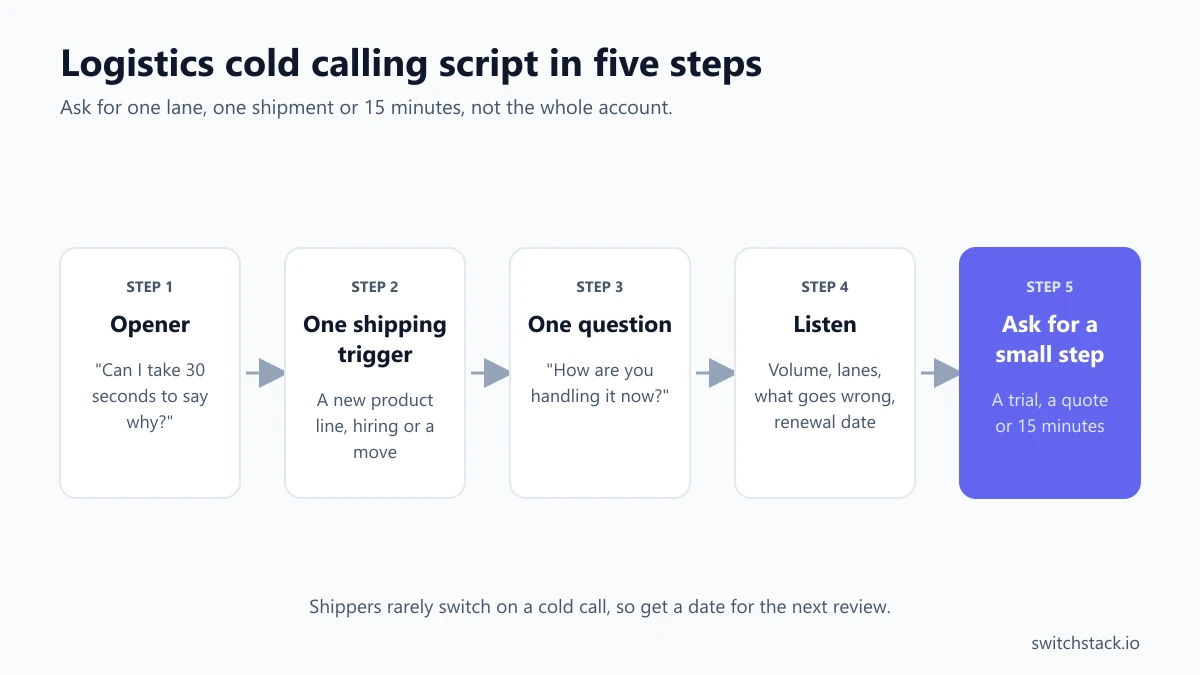
A logistics cold calling script works best when it asks for one small step, such as a quote on one lane, one trial shipment or a 15-minute call, rather than the whole account. Ask for the person who owns shipping or fulfillment and open with one reason that fits them, such as a new product line, a hiring push for warehouse staff or a new importer in shipping data. Then ask how they handle it today, listen, and ask for the small step with two specific times.
This guide gives you the full logistics cold calling script word for word. It has openers for 3PLs, freight forwarders, warehouses, couriers and customs brokers, and openers by trigger. It also covers where to find shippers and importers to call, gatekeeper and voicemail lines, a follow-up email and answers to the objections shippers raise most. Jump straight to the script.
Selling truckload capacity as a broker? Use our freight broker cold calling script instead.
Rather have a caller book these meetings for you? See How Switchstack Fits: a dedicated caller from $1,499 a month, with no setup fee.
Table of Contents
- What Makes a Logistics Cold Call Different?
- Who to Ask For, by What You Sell
- The Logistics Cold Calling Script, Word for Word
- Openers by Logistics Service
- Openers by Trigger
- Where to Find Shippers and Importers to Call
- Gatekeeper Lines
- Logistics Voicemail Script
- Follow-Up Email After the Call
- When to Call and How Often to Follow Up
- Answers to Logistics Objections
- What to Find Out Before You Quote
- What Calling Rules Apply?
- How Switchstack Fits
What Makes a Logistics Cold Call Different?
A logistics cold call is different from most B2B calls because almost every shipper already has a provider, and switching is risky for them. Moving stock to a new warehouse or a new forwarder can disrupt orders for weeks. That changes the job of the first call:
- Ask for a small first step. One lane, one container, one trial shipment or a quote to compare. A whole-account switch on a cold call gets "send me your rates."
- Know the mode before you call. A brand shipping parcels, an importer moving containers and a manufacturer moving pallets have different problems. Use the opener that fits.
- Find the review date. Most shippers review providers at a contract renewal, an annual bid or after a bad season. A date you write down is worth more than a pitch.
Who to Ask For, by What You Sell
When cold calling for logistics, ask for whoever owns shipping or fulfillment: the head of operations at an online brand, the import manager at an importer or the supply chain director at a distributor. Their title depends on what you sell:
| If you sell | Who to ask for | What to ask whoever answers |
|---|---|---|
| E-commerce fulfillment (3PL) | The founder or head of operations at an online brand | "Who runs your order fulfillment?" |
| Freight forwarding | The import or export manager, or the purchasing manager at a smaller importer | "Who books your shipments from overseas?" |
| Warehousing and distribution | The supply chain, logistics or operations director | "Who handles your warehouse space and distribution?" |
| Courier and last-mile delivery | The office manager or operations manager | "Who arranges your local deliveries and couriers?" |
| Customs brokerage | The import or compliance manager, or the owner at a small importer | "Who handles customs clearance for your imports?" |
| Cold chain | The operations or quality manager at a food or pharmaceutical company | "Who manages your temperature-controlled shipping?" |
You don't need the name before you call. Write down the name you're given and ask for that person by name on the next call.
The Logistics Cold Calling Script, Word for Word
A logistics cold calling script has five steps: a short opener, one reason that fits the shipper, one question about how they ship today, listening, and an ask for a small first step with two specific times. Fill in the brackets, then learn the steps rather than reading them out.
1. Opener: "Hi [name], this is [your name] from [company]. I know I'm calling out of the blue. Can I take 30 seconds to tell you why, and you decide if it's worth a conversation?"
2. Reason for the call (one trigger): "I saw you've started selling on [marketplace]. When order volume jumps like that, [the problem you solve, such as: packing orders in-house usually starts to slow shipping down]."
Selling forwarding, warehousing or courier services instead? Swap in the matching line from openers by logistics service.
3. The shipping question: "How are you handling fulfillment right now?"
4. Listen: Let them talk. Follow up with one or two of these:
- "Roughly how many orders, pallets or containers is that a month?"
- "What goes wrong most often: delays, damage or cost?"
- "When does your current agreement come up for review?"
5. The ask (a small first step, two times): "It sounds like it's worth 15 minutes with [name], who works with [type of shipper] like you. Would Tuesday at 10 or Thursday at 2 work? Or if it's easier, I can send a quote on [one lane, one product line or one month's orders] for you to compare."
Then close out: "Great. What's the best email for the invite? And is there anyone else who should be on the call?"
If they're not ready, end with a date: "No problem. When do you usually review providers? I'll call a few weeks before then."
Openers by Logistics Service
Each service solves a different problem for the same shipper. Swap step 2 of the logistics cold calling script for the line that fits what you sell:
| You sell | What to say |
|---|---|
| E-commerce fulfillment | "Online brands at your stage often find packing orders takes more of the team's week than selling. How are you handling fulfillment now?" |
| Ocean freight forwarding | "I work with importers bringing [product type] in from [country]. How are you booking your containers today, and how has transit time been?" |
| Air freight | "When a shipment can't wait for ocean, who do you call? I'd like to be the backup you keep on file." |
| Warehousing | "Companies near [area] often run short of space before peak season. How much room do you have for [season]?" |
| Courier and last-mile delivery | "We do same-day deliveries around [city] for businesses like yours. How are you getting urgent deliveries out today?" |
| Customs brokerage | "Customs rules for [product type] keep changing. Who's handling your clearance, and how have your recent entries gone?" |
Pick one service and one type of shipper to start, so your caller learns their language and their problems.
Openers by Trigger
A trigger gives you a true reason to call this shipper this week. Swap step 2 for the line that fits:
| Trigger | What to say |
|---|---|
| A new product line or marketplace | "I saw you've launched [product line or marketplace]. New lines often need different storage or shipping. Who's planning that?" |
| Job posts for warehouse staff | "I saw you're hiring warehouse staff. Is that because volume's growing faster than your space?" |
| A new importer in shipping data | "I saw you've started bringing in shipments from [country]. Who's handling the freight for those?" |
| A move to a new building | "I heard you're moving to [location]. Moves are a good time to look at how goods get in and out. Who's running that?" |
| A busy season coming | "Peak season is about [number] months out. Is your current setup ready for the volume, or is that still being worked out?" |
| Problems with a current provider | "A rough season is often when shippers start comparing providers. How did last [season] go for you?" |
| A renewal date from an earlier call | "Last time we spoke, you said your contract comes up in [month]. Is it worth comparing before you renew?" |
Only use a trigger that's true for that company. A made-up reason for the call ends the conversation the moment the shipper notices.
Where to Find Shippers and Importers to Call
In the US, information from inward vessel manifests can be copied and published under CBP rules, which is why commercial import databases can show who imports what by sea (19 CFR 103.31). Importers can ask for their names to be kept confidential, so the data won't show every company.
Other good sources:
- Job boards. A company hiring warehouse associates, a logistics coordinator or an import specialist is growing or reorganizing.
- Marketplace sellers. Brands selling on large marketplaces often outgrow their own packing setup.
- Trade show exhibitor lists. Exhibitors at industry shows list what they make and where they're based.
- Business parks and industrial estates. Companies near your warehouse or route are the easiest to serve well.
- Your own lost quotes. Shippers who chose someone else last year may be ready to compare again.
Start with one type of shipper in one region, so every call teaches your caller something about the next one.
Gatekeeper Lines
At a shipper, whoever answers the phone usually knows who handles shipping, so ask for that person by their role, not for "the decision-maker":
- "Hi, who handles your shipping and logistics there?"
- "Is [name] in today? It's about your [fulfillment, freight or deliveries], and it'll take two minutes."
- "What's the best time to reach [name]: early morning, before the trucks go out?"
- "Could you tell me [name]'s email, so I can send a short note first?"
Never pretend to be a current carrier or a customer. Warehouse and shipping teams talk to each other, and a misleading call gets around.
Logistics Voicemail Script
A logistics voicemail should run under 20 seconds, name what you move and say your number twice:
"Hi [name], this is [your name] from [company], [phone number]. We [your service, such as: handle fulfillment for online brands] around [region], and I had a quick question about how you're shipping [product type]. I'll call again on [day]. That's [phone number]."
Follow-Up Email After the Call
Send it the same day, while they still remember the call:
Subject: Your [fulfillment, freight or deliveries], as promised
"Hi [name],
Thanks for the time today. You mentioned [their problem in their words, such as: orders back up every time a container lands].
We [your service] for [type of shipper] around [region]. A 15-minute call with [name] would show how we'd handle [their problem], or I can send a quote on [one lane or product line] for you to compare.
Does [day and time] or [day and time] work?
[Your name] [Company] | [phone]"
When to Call and How Often to Follow Up
Call shipping and warehouse teams early in the morning, before the trucks go out, or in the middle of the afternoon, once the day's shipments are moving. One call rarely reaches the right person, so plan a short sequence:
| Day | What to do |
|---|---|
| 1 | Call, leave a voicemail and send the follow-up email |
| 3 | Call at a different time of day |
| 7 | Call and leave a second voicemail |
| 14 | Call, then email one question about their shipping |
| After that | Call back before the review date or busy season they gave you |
Stop as soon as someone asks you not to call again, and add the number to your do-not-call list.
Answers to Logistics Objections
Shippers hear from providers every week, so every logistics cold calling script needs answers ready for these objections. Agree first, then ask one question:
| Objection | Answer |
|---|---|
| "We already have a 3PL." | "Plenty of companies your size do. What would you change about them if you could? And when does that contract come up?" |
| "We do it ourselves." | "That works until volume jumps. How many orders a day before it starts to slow you down?" |
| "Just send me your rates." | "Happy to. So the quote is accurate, roughly how many orders, pallets or containers a month, and from where to where?" |
| "We're in a contract." | "Understood. When does it end? I'll call a couple of months before then, so you have a comparison ready." |
| "Moving warehouses is too much hassle." | "It is a big job. Would one product line or one region be a smaller way to compare?" |
| "We're too small for you." | "What volume are you at now? If you aren't a fit for us yet, I'll tell you straight away." |
| "Call me after peak." | "Will do. When does peak end for you? I'll put it in the calendar and call then." |
If they still say no, ask when they next review providers, and call back before then.
Selling ocean freight from the US? Expect to be asked "Are you licensed?" on the first call. No one in the US may act as an ocean transportation intermediary without a license from the Federal Maritime Commission (46 CFR 515.3), so keep your license number ready to give.
What to Find Out Before You Quote
A quote built on guesses loses to a quote built on the shipper's own numbers. Ask these before you book or quote, and pass the answers to whoever takes the meeting:
| Question | Why it matters |
|---|---|
| "What are you shipping, and how big or heavy is it?" | Fit with your warehouse, vehicles or modes |
| "Roughly how many orders, pallets or containers a month?" | Whether the account is worth a meeting |
| "From where to where?" | Lanes, countries and customs needs |
| "Who handles it now, and what would you change?" | What you're replacing and why |
| "When does your current agreement end?" | When to call back if not now |
| "Who else decides?" | Who should join the meeting |
Write the answers down on every call, even the ones that don't book. They become your call-back list.
What Calling Rules Apply?
The US Federal Trade Commission says that "most phone calls between a telemarketer and a business are exempt" from the Telemarketing Sales Rule, with some exceptions (FTC, Complying with the Telemarketing Sales Rule). Owners of small shippers often give a personal cell phone, so check the rules where you call, honor every "don't call me again" and keep your own do-not-call list. This is not legal advice.
Calling shippers outside the US? See our guides for the UK, Canada and Australia, or every market we cover in cold calling laws by country.
How Switchstack Fits
Most logistics companies would rather their sales team runs quotes and site visits than spends the day dialing to find them. Switchstack supplies a dedicated, full-time caller who works your list of shippers with your logistics cold calling script and books meetings on your calendar. See cold calling for logistics companies for how it works with 3PLs, forwarders and carriers.
- Hire a Caller (from $1,499 a month per caller): when you hire cold callers through us, a vetted caller joins your team, works your list during your prospects' business hours and reports to you.
- We Call for You (from $2,199 a month per caller): with our cold calling services, we supply, train and manage the caller, write the script with you and send a recording of every call.
There's no setup fee and no charge per meeting, and it's month to month with 30 days' notice. See prices by caller country.
Want to test first? Our 60-day cold calling pilot costs 20% less and ends on its own unless you choose to continue. To talk it through, book a 30-minute call.
Frequently Asked Questions
What should a logistics cold calling script include?
Who should you ask for when cold calling for logistics?
What is a good logistics sales pitch?
How do you answer "we already have a 3PL" on a cold call?
How do freight forwarders find importers to call?
What triggers make a logistics cold call timely?
Is it legal to cold call shippers and importers?
Want us to make these calls for you?
Tell us who you want to reach. We'll make the calls and book the meetings, or find you a caller of your own. Pick a time for a free 30-minute call below.
- Free 30-minute call, no obligation
- 20% off the first 2 months
- No setup fee, month-to-month
- Free replacement in the first 30 days
Prefer email? hello@switchstack.io
See all pricesWritten by
Switchstack Team
Switchstack
Guides on cold calling and hiring callers from the Switchstack team.
Newsletter
Tactics worth your inbox.
Outbound tactics and product updates — only when we have something genuinely worth sharing.