Cold Calling Objections: 15 Rebuttals That Keep the Call Going
The most common cold calling objections, what each one usually means, and a word-for-word rebuttal for 15 of them, from "send me an email" to "we already have a provider".
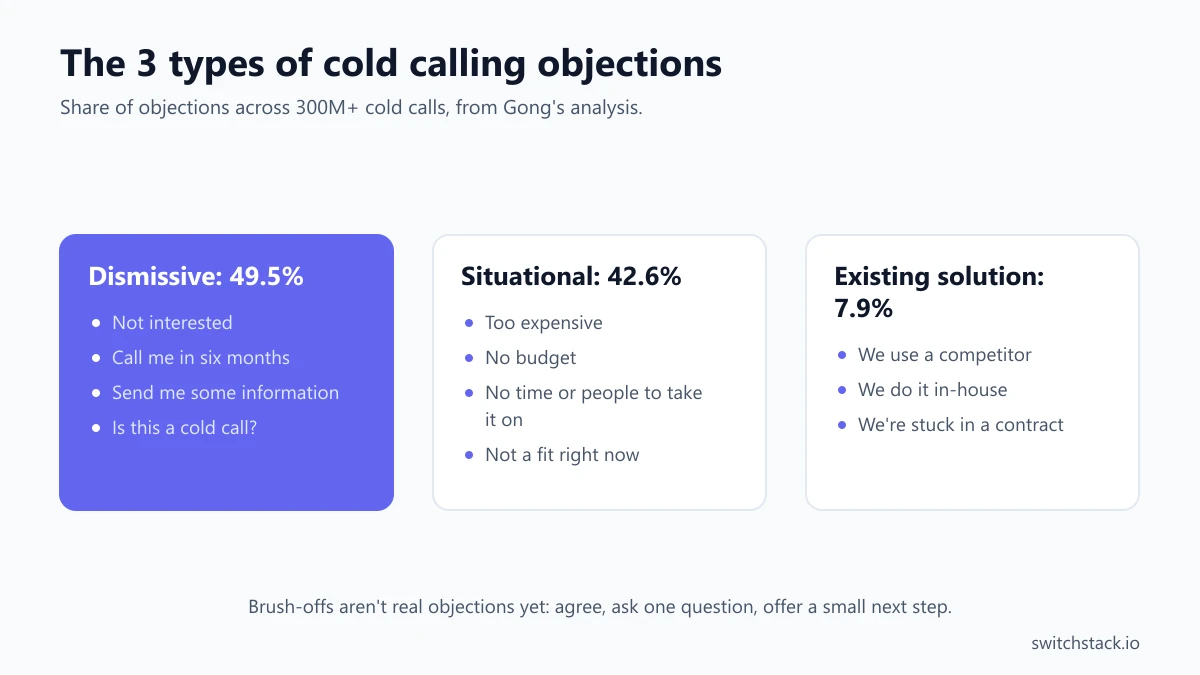
Cold calling objections are the reasons a prospect gives to end a call before agreeing to a meeting. Most aren't real objections at all: Gong's analysis of more than 300 million cold calls found that brush-offs such as "not interested" and "send me some information" make up 49.5% of them, and that the five most common objections account for 74%. Handle every objection the same way: agree, ask one question, and offer a small next step.
This guide covers the three types of cold calling objections, a three-step way to handle any of them, and word-for-word rebuttals for 15 objections you'll hear on B2B calls. Each one tells you what the objection usually means, so you can answer the reason, not just the words.
Table of Contents
- What Are the Most Common Cold Calling Objections?
- How Do You Handle Any Objection?
- Dismissive Objections and Rebuttals
- Situational Objections and Rebuttals
- Existing-Solution Objections and Rebuttals
- What About Objections From the Gatekeeper?
- When Should You Stop and End the Call?
- How to Practice Objection Handling
- How Switchstack Fits
What Are the Most Common Cold Calling Objections?
The most common cold calling objections fall into three types. Gong sorted the objections in more than 300 million cold calls recorded on its platform like this:
| Type | Share of objections | Examples | What it usually means |
|---|---|---|---|
| Dismissive | 49.5% | "Not interested", "call me in six months", "send me some information" | A reflex. They don't know enough yet to object |
| Situational | 42.6% | "Too expensive", "no budget", "no time to take this on" | A real reason, tied to their situation right now |
| Existing solution | 7.9% | "We use a competitor", "we do it in-house", "we're in a contract" | They solve the problem another way |
Source: Gong.
Two things follow from those numbers. First, half of what you hear is a brush-off, so the most useful skill is turning a reflex into a conversation. Second, "we already have someone" is rarer than most callers fear: fewer than one objection in ten.
How Do You Handle Any Objection?
Use the same three steps for every objection. They work because they keep you on the prospect's side instead of arguing with them.
- Agree. "Fair enough." "That makes sense." Arguing makes people defend their first answer. Agreeing lowers their guard.
- Ask one question. Find the reason behind the objection, or test whether the problem you solve exists for them. One question, then listen.
- Offer a small next step. Not the sale: a 15-minute call, a callback on a date they choose, or one useful email with a time to talk after it.
Slow down when you hear an objection. A calm, unhurried reply sounds confident, and a fast one sounds like a script.
Dismissive Objections and Rebuttals
Dismissive objections are reflexes. The prospect wants the call to end and hasn't heard enough to have a real reason. Your job is to turn the brush-off into a real answer with one question.
1. "I'm not interested."
What it usually means: "I don't know what you do yet, and I'm busy."
"Fair enough, most people I call aren't, until [problem] comes up. Quick question before I go: how are you handling [problem] today?"
If the answer shows the problem exists, ask for 15 minutes. If it doesn't, thank them and end the call.
2. "Send me an email."
What it usually means: a polite way to end the call. Sometimes they really do want to read first.
"Happy to. So I send something useful rather than a brochure, is it [problem A] or [problem B] that matters more to you right now?"
Then: "I'll send two lines on that. Can I call you Thursday afternoon once you've seen it?" An email with an agreed follow-up time is a next step. An email on its own is usually the end.
3. "Call me in six months."
What it usually means: "Not now," or "never, but politely."
"Will do. What's going to be different in six months, so I call at the right time?"
If they name a reason, such as a contract ending or a new budget, you have a real date and a reason to call. Put both in your notes.
4. "Is this a sales call?"
What it usually means: "Are you going to waste my time?"
"Yes, it is. I'll be quick: I'm calling because [one-line reason]. If it's not relevant, tell me and I'll let you go."
Honesty works here. A caller who dodges the question loses trust in the first ten seconds.
5. "I'm busy right now."
What it usually means: often true.
"Of course. Is later today or tomorrow morning better for a two-minute call?"
Offer two specific times. "When's good?" gets a vague answer; two options get a choice.
6. "How did you get my number?"
What it usually means: they're wary, or they want to know whether you're allowed to call.
"From [the source: your company website, a business directory, a referral]. If you'd rather I didn't call this number, I'll take it off our list."
Always tell the truth, and keep a record of where every number came from. In the EU, people have a right to ask where personal data about them came from, under Article 15(1)(g) of the GDPR. For the rules in each market, see our cold calling laws by country.
Situational Objections and Rebuttals
Situational objections are real reasons, so treat them with respect. Find out whether the reason is permanent or just about timing.
7. "We don't have the budget."
What it usually means: "Not this year," or "not for something I don't see value in yet."
"Understood. When do you usually set next year's budget? A short call now means you'll know whether it's worth including."
8. "It's too expensive."
What it usually means: they're comparing you with something, or with nothing.
"Compared with what you're doing now, or compared with doing nothing? I ask because it changes whether this is worth a call."
If they don't know your price yet, it's a brush-off in disguise. Say the price range plainly if it's published, then ask your question.
9. "I'm not the right person."
What it usually means: sometimes true. Sometimes "I don't want to deal with this."
"Thanks for telling me. Who would look after [area]? And would it be all right to mention you suggested I call?"
A name and permission to use their name is a good result. You call the next person with a warm introduction.
10. "We don't have time to take this on."
What it usually means: they think saying yes creates work for them.
"That's usually why people talk to us: so it doesn't land on your team. What does your team's week look like right now?"
11. "It's not a priority right now."
What it usually means: there's a priority, and it isn't you.
"Makes sense. What is the priority this quarter? If it's related, I'd rather know; if not, I'll call back when it is."
Existing-Solution Objections and Rebuttals
Existing-solution objections are the rarest type, at 7.9% of objections in Gong's data, and the most specific. Don't criticize the current provider. Ask how well it's working.
12. "We already work with someone."
What it usually means: the problem is solved, or they think it is.
"Good to hear. If you could change one thing about how it works now, what would it be?"
If the answer is "nothing", thank them and ask when the contract renews. If there's a gap, that's your meeting.
13. "We do it in-house."
What it usually means: they have people on it, and they're proud of them.
"That makes sense. A lot of teams keep it in-house and bring in outside help when there's more to do than people to do it. Is your team keeping up at the moment?"
14. "We're locked into a contract."
What it usually means: a real date. It's useful information.
"When does it come up for renewal? I'll call three months before, so you have a comparison in time to decide."
Put the renewal date in your notes and call back when you said you would. That call is one the prospect expects.
What About Objections From the Gatekeeper?
Gatekeepers object for a different reason: protecting someone else's time. The most common is the first question they ask.
15. "What's this regarding?"
"It's about [problem area] for [team]. Is [first name] the right person for that, or is someone else?"
Give the real reason in one sentence and end with a question. For receptionists, assistants and phone menus, see our full guide on how to get past the gatekeeper.
When Should You Stop and End the Call?
Stop after two objections, or as soon as someone asks not to be called again. Objection handling isn't about never accepting a no. End the call when:
- The prospect repeats a clear no. Handle one objection, and a second if it's a different one. After that, thank them and end the call. You can ask whether you may check back in a few months.
- They ask not to be called again. Add the number to your do-not-call list straight away and never call it again. See how do-not-call registers work in each market in our do-not-call registry guide.
- They're rude or upset. Apologize for the interruption and end the call politely. A calm exit protects your company's name.
A short, polite call that ends with "no" still leaves a better impression than a long one that ends the same way.
How to Practice Objection Handling
Practice objection handling by writing answers to your own five most common objections, role-playing them and reviewing recorded calls every week. Rebuttals only work when they sound natural:
- Write down your top five objections. Use your own calls, not a generic list. Your market has its own favorites.
- Write one answer for each, then say it out loud. If a line feels awkward to say, rewrite it until it doesn't.
- Role-play with a colleague. Have them use each objection twice, once politely and once abruptly.
- Record your calls and listen back weekly. Note which objection ended each call that didn't book a meeting.
- Change one line at a time. If you change the opener and three rebuttals at once, you won't know what worked.
The objections you hear also depend on the start of the call. Our guide to cold calling scripts that work covers openers, and the B2B cold calling script template shows where objection answers fit in a full script.
How Switchstack Fits
Switchstack supplies dedicated, full-time cold callers for B2B companies. Before your caller starts, we write the script with you, including answers to the objections your market uses, and test callers on role-play calls built around them. You hear the recordings and approve the caller.
- We Call for You: with our cold calling services, we supply, train and manage the caller, check call quality every day and send a recording of every call, from $2,199 a month per caller.
- Hire a Caller: when you hire cold callers through us, a vetted, full-time caller joins your team and works your script, from $1,499 a month.
There's no setup fee and no charge per meeting, and it's month to month with 30 days' notice. Want to test first? Our 60-day cold calling pilot costs 20% less and ends on its own unless you choose to continue. To talk it through, book a 30-minute call.
Frequently Asked Questions
What are the most common cold calling objections?
How do you respond to "send me an email"?
How do you respond to "not interested"?
How many objections should you handle before ending a cold call?
Should you read objection rebuttals word for word?
What is the difference between a brush-off and a real objection?
Want us to make these calls for you?
Tell us who you want to reach. We'll make the calls and book the meetings, or find you a caller of your own. Pick a time for a free 30-minute call below.
- Free 30-minute call, no obligation
- 20% off the first 2 months
- No setup fee, month-to-month
- Free replacement in the first 30 days
Prefer email? hello@switchstack.io
See all pricesWritten by
Switchstack Team
Switchstack
Guides on cold calling and hiring callers from the Switchstack team.
Newsletter
Tactics worth your inbox.
Outbound tactics and product updates — only when we have something genuinely worth sharing.