Cybersecurity Cold Calling Script: Book Meetings With IT and Security Leaders
A cybersecurity cold calling script for MSSPs, pen testing firms, compliance consultancies and security vendors: who to ask for, the five-step call, how not to sound like a vishing call, openers by deadline and by service, objection answers and a voicemail.
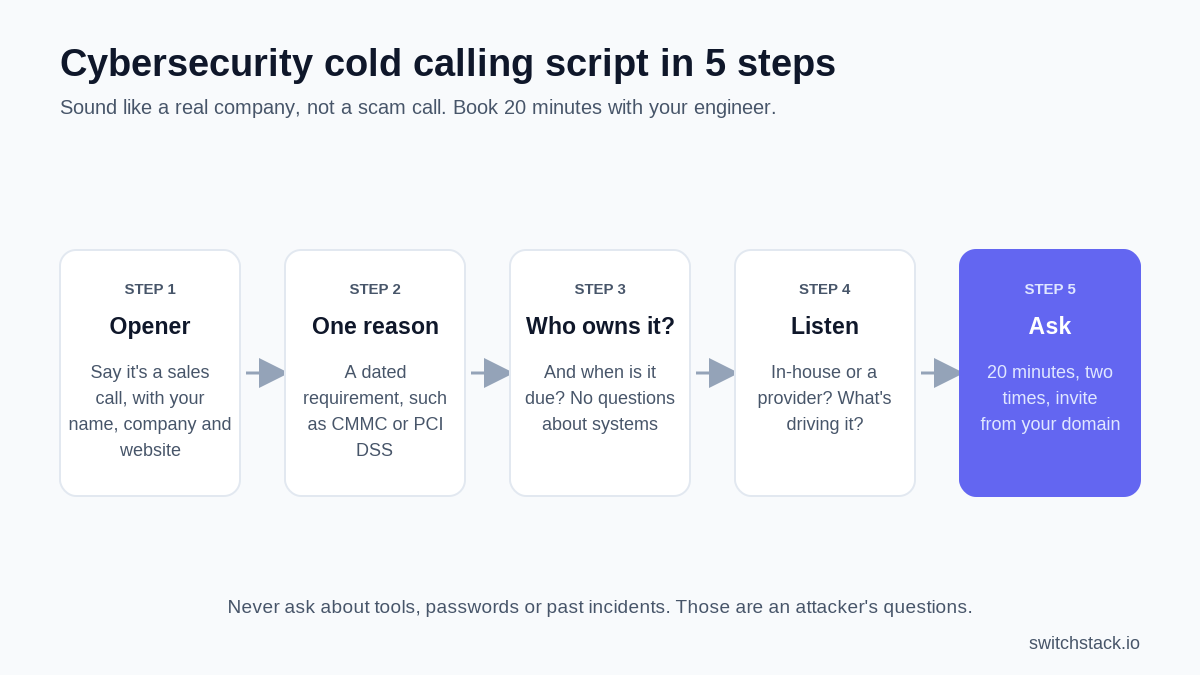
A cybersecurity cold calling script works when it sounds nothing like a scam call: say it's a sales call, give your company and a way to check you, and never ask about the prospect's systems. Ask for the IT or security lead, open with one dated reason that fits the company, such as a CMMC or PCI DSS requirement, and ask who owns it and when it's due. Then listen, and offer two times for a 20-minute call with your sales engineer.
This guide gives you the full cybersecurity cold calling script word for word. It covers who to ask for at each company size, how to stay clear of anything that sounds like vishing, openers by compliance deadline and by the service you sell, front desk lines, a voicemail and a follow-up email. It also has answers to the objections security buyers raise most, and what to keep off the call. Jump straight to the script.
Rather have a caller book these meetings for you? See How Switchstack Fits: a dedicated caller from $1,499 a month, with no setup fee.
Table of Contents
- Who to Ask For at Each Company Size
- Why Security Buyers Hang Up, and How to Sound Different
- The Cybersecurity Cold Calling Script, Word for Word
- Openers by Compliance Deadline
- Openers by What You Sell
- Other Reasons to Call This Week
- Front Desk Lines
- Cybersecurity Voicemail Script
- Follow-Up Email After the Call
- When to Call and How Often to Follow Up
- Answers to Cybersecurity Objections
- What to Keep Off the Call
- Questions to Qualify the Meeting
- What Calling Rules Apply?
- How Switchstack Fits
Who to Ask For at Each Company Size
Before you use a cybersecurity cold calling script, know who to ask for: whoever owns IT security, which changes with the size of the company. At small companies that's often the owner and an outside IT provider; at large ones it's the CISO's team:
| Company size | Who to ask for | Who usually signs |
|---|---|---|
| Under about 100 staff | The owner or office manager, and the name of their outside IT provider | The owner |
| About 100 to 1,000 staff | The IT director or head of IT | The IT director, often with the CFO |
| Over 1,000 staff | The CISO, the head of security operations or the governance, risk and compliance (GRC) lead | The CISO, with procurement |
Selling a compliance service such as SOC 2 or CMMC readiness? Ask for whoever answers customers' security questionnaires. At smaller companies that's often the COO or a compliance manager, not IT.
You don't need a name before you call. Ask whoever answers: "Who looks after IT security there, someone in-house or an outside provider?" Write the name down and ask for that person next time.
Why Security Buyers Hang Up, and How to Sound Different
Security buyers are trained to distrust unexpected callers. CISA warns that caller ID is easy to spoof, and advises people not to share details of their organization, including its structure or networks, unless they're sure the caller is entitled to them (CISA, Avoiding Social Engineering and Phishing Attacks). A good security cold call works with that instinct instead of against it:
- Say it's a sales call in your first sentence. Honesty is the fastest way to sound like a real company.
- Give your full name, company and website, and invite them to look you up or call your main number back.
- Never ask about their tools, versions, passwords, past incidents or who has admin access. Those are the questions an attacker asks.
- Never ask them to click a link, install anything or "verify" an account.
- Offer to email from your company domain before the meeting, so they can check the invite came from you.
Your caller will still hear "Is this a phishing test?" now and then. That's a good sign: they're listening. The answer is in the objections table.
The Cybersecurity Cold Calling Script, Word for Word
A cybersecurity cold calling script has five steps: an opener that says it's a sales call, one dated reason that fits the company, one question about who owns it, time to listen, and an ask for 20 minutes with two specific times. Fill in the brackets, then learn the steps rather than reading them out.
1. Opener (say it's a sales call): "Hi [name], this is [your name] from [company]. This is a sales call, and I won't ask about your systems. Do you have 30 seconds, or should I call back later?"
2. Reason for the call (one dated reason): "We work with [industry] companies of about your size on [service]. I'm calling because [a dated reason from the table below, such as: Defense Department contracts can now require a CMMC Level 2 assessment by a third-party assessor]."
3. The ownership question: "Who owns that at [company], and when does it next come up?"
4. Listen: Let them talk. Follow up with one or two of these:
- "Is that handled in-house, or by an outside provider?"
- "What's driving it: a customer, an auditor, your insurer or your own plan?"
- "When's the deadline, or your next review?"
5. The ask (two times): "Then it's worth 20 minutes with [name], our [sales engineer / lead assessor]. Would Tuesday at 11 or Wednesday at 3 work? I'll send the invite from our company email, so you can check it's us."
Then close out: "Great. Who else should join: your compliance lead, or your IT provider?"
If they're not ready, end with a date: "No problem. When's your next assessment or renewal? I'll call a few weeks before then."
Openers by Compliance Deadline
A compliance deadline gives your caller a true reason to call that isn't a scare story. Swap step 2 of the cybersecurity cold calling script for the line that fits the company:
| Requirement | Who it affects | What to say |
|---|---|---|
| CMMC Phase 2 | US defense contractors that handle controlled unclassified information | "Since 10 November, Defense Department contracts can require a CMMC Level 2 assessment by a third-party assessor. Is that on your plan for next year?" |
| PCI DSS v4.0 | Businesses that store, process or send card data | "The 51 PCI DSS requirements that were future-dated took effect in March 2025. How did your last assessment go with those?" |
| FTC Safeguards Rule breach notice | Non-bank financial institutions, including tax preparation firms | "Since May 2024, a breach involving 500 or more customers' unencrypted information has to be reported to the FTC within 30 days. Who would handle that for you?" |
| IRS written information security plan | Tax and accounting firms | "The IRS says tax and accounting firms are required by law to have a written information security plan. When did you last update yours?" |
| SEC cybersecurity incident disclosure | US public companies | "A material cybersecurity incident generally goes on a Form 8-K within four business days of being judged material. Who makes that call on your team?" |
The sources, each opened on 29 November 2026:
- CMMC: Phase 2 begins one calendar year after Phase 1 and adds Level 2 certification by a third-party assessor (C3PAO) for applicable contracts (32 CFR 170.3(e)). Phase 1 began when the Defense Department's acquisition rule took effect on 10 November 2025 (Federal Register, 10 September 2025).
- PCI DSS: of the 64 new requirements in v4.0, 51 were future-dated and took effect on 31 March 2025 (PCI Security Standards Council).
- FTC Safeguards Rule: covered institutions must notify the FTC no later than 30 days after discovering a breach involving at least 500 consumers' unencrypted information, a requirement in force since May 2024. The FTC lists tax preparation firms among the covered financial institutions (FTC).
- IRS: tax and accounting professionals count as financial institutions under federal law and must have a data security plan (IRS and Security Summit).
- SEC: an Item 1.05 Form 8-K is generally due four business days after a company determines an incident is material (SEC press release 2023-139).
Use the deadline as the reason for the call, not as a threat. Your caller says what the rule is and asks who owns it. The detail belongs to your team in the meeting.
Openers by What You Sell
In a cybersecurity cold calling script, the best opener asks about the problem your service solves, in the buyer's words. Use the question that fits what you sell:
| What you sell | Who to call | Opening question |
|---|---|---|
| Managed detection and response, or a SOC service | IT director at 100 to 1,000 staff | "Who watches your security alerts at 2 a.m. on a Sunday?" |
| Penetration testing | IT director or CISO | "When was your last outside test, and what prompted it?" |
| Compliance consulting (SOC 2, ISO 27001, CMMC) | CEO, COO or compliance lead | "Has a customer asked you for a SOC 2 report yet?" |
| Security awareness training | HR lead or IT manager | "How do new hires learn what a phishing email looks like?" |
| Virtual CISO | CEO or CFO at companies with no security lead | "Who makes the security decisions when there's no CISO?" |
| Security services sold through IT providers | Owner of a managed IT provider | "When a client asks for a security service you don't offer, what do you do?" |
Pick one service and one or two industries, and get good at them. A caller who knows what a SOC 2 audit involves sounds very different from one reading a general script.
Other Reasons to Call This Week
Not every company faces a deadline. These signals work just as well in step 2 of the cybersecurity cold calling script:
| What you noticed | What to say |
|---|---|
| A new IT or security leader | "Congratulations on the new role. New IT leaders often review their providers in the first few months. What's on your list?" |
| A job ad for a security analyst or engineer | "I saw you're hiring a security analyst. While that seat's open, who's watching the alerts?" |
| They sell to large companies | "When a big customer sends you a security questionnaire, who fills it in?" |
| A cyber insurance renewal coming up | "Who answers the security questions on your cyber insurance renewal?" |
| A move to new offices or a new cloud setup | "Moves like that often change who looks after what. Who's owning security through the change?" |
Leave other companies' breaches out of it. Calling because a competitor was hacked sounds like fear-based selling, and security buyers hang up on it.
Front Desk Lines
To get past the front desk at a company, say it's a sales call for whoever looks after IT security, and ask for a name, not a transfer to the help desk. Help desk staff are trained to be careful with unknown callers, so don't ask them anything technical:
- "Hi, this is [name] from [company]. It's a sales call for whoever looks after IT security. Who would that be?"
- "I don't need anything technical, just the right person's name."
- "Is [name] in today? It'll take two minutes."
- "Could you tell me [name]'s email? I'll send a short note first, so they know who I am."
Never pretend to be from their IT provider, a vendor they already use or their own IT team. That's exactly what a social engineer does, and it ends your chances with that company.
Cybersecurity Voicemail Script
The voicemail that goes with a cybersecurity cold calling script should run under 20 seconds, say it's a sales call and tell them how to check who you are:
"Hi [name], this is [your name] from [company], [phone number]. This is a sales call. We help [industry] companies with [service], and I had one question about [deadline or reason]. I'll email you today from [company domain], so you can check it's us. That's [phone number]."
Follow-Up Email After the Call
Send it the same day, from your company domain, with no attachments and no links except your own website:
Subject: [Their deadline or project], as promised
"Hi [name],
Thanks for the time today. You mentioned [their situation in their words, such as: a customer has asked for a SOC 2 report by the spring].
We help [industry] companies with [service]. A 20-minute call with [name], our [sales engineer], would show how we'd approach [their situation], and you can decide from there.
Does [day and time] or [day and time] work? There's no attachment here, so you can look us up at [website] first.
[Your name] [Company] | [phone]"
When to Call and How Often to Follow Up
Try early in the morning or late in the afternoon, around the meetings that fill IT leaders' days. One call rarely reaches them, so pair your cybersecurity cold calling script with a short sequence:
| Day | What to do |
|---|---|
| 1 | Call, leave a voicemail and send the follow-up email |
| 3 | Call at a different time of day |
| 8 | Call, and send a short LinkedIn note that mentions your voicemail |
| 15 | Call, then email one question about their deadline or project |
| After that | Call back on the review date they gave you, or every few months |
Stop as soon as someone asks you not to call again, and add the number to your do-not-call list.
Answers to Cybersecurity Objections
Security buyers hear plenty of pitches, so every cybersecurity cold calling script needs answers ready for these objections. Agree first, then ask one question:
| Objection | Answer |
|---|---|
| "Our IT provider handles security." | "Good. Does their contract cover [service], or mainly IT support? Plenty of companies use both. Would it help to have [name] and your provider on the same call?" |
| "We're covered. We have antivirus and a firewall." | "That's a good start. When a customer or your insurer asks how you'd spot someone already inside the network, what do you tell them?" |
| "We just had a pen test." | "Great, then you know where the gaps are. Who's working through the findings, and when's the retest?" |
| "There's no budget this year." | "Understood. When does next year's budget get set? I'd like [name] to talk with you before then." |
| "Just send me something." | "Happy to. Which matters more right now: [deadline], an audit or a customer asking? I'll send one page on that." |
| "How did you get my number?" | "From [the real source, such as your company website or a business directory]. If you'd rather I didn't call, I'll take you off our list now." |
| "Is this a phishing test?" | "No. I'm a salesperson at [company]. You can check us at [website] or call our main line, and I'll email you from our company domain." |
If they still say no, ask when their next review or renewal is, and call back before then.
What to Keep Off the Call
Security buyers judge you by what you ask, so a few things never belong in a cybersecurity cold calling script:
- No questions about systems. Tools, versions, vulnerabilities, passwords, admin accounts and past incidents stay out, even when the prospect offers them. Write down "wants to discuss their setup" and let your engineer ask in the meeting.
- No fear stories. No breach statistics, no "you're at risk" and no mention of another company's breach.
- No unauthorized testing. Never offer to scan or test anything until the right person at the company has signed an authorization.
- No client names unless you have their written permission.
Questions to Qualify the Meeting
Before you book, find out enough to tell whether the meeting is worth your engineer's time. Write these down for whoever takes it:
| Question | Why it matters |
|---|---|
| "Roughly how many staff, and which industry?" | Fit with the companies you serve best |
| "Who owns security: someone in-house, an outside provider or nobody yet?" | Who should be in the meeting |
| "What's driving it: a deadline, a customer, an audit or your insurer?" | How urgent it is |
| "Which framework applies: SOC 2, PCI DSS, CMMC, HIPAA or another?" | Whether it matches your expertise |
| "When does it need to be done?" | Timing of the deal |
| "Who else decides, and when?" | Who else to invite |
Before you hang up, agree on what happens next: the meeting time, who attends and what they'll bring, such as the customer's questionnaire or last year's report.
What Calling Rules Apply?
The US Federal Trade Commission says that "most phone calls between a telemarketer and a business are exempt" from the Telemarketing Sales Rule. The exceptions include calls selling nondurable office or cleaning supplies, and calls asking employees to buy for their own use (FTC, Complying with the Telemarketing Sales Rule). In the UK, companies can register with the Corporate Telephone Preference Service (CTPS), while sole traders and some partnerships register with the TPS, and the same calling rules apply to both (ICO). This is not legal advice.
Calling outside the US? See our guides for the UK, Germany and Canada, or every market we cover in cold calling laws by country.
How Switchstack Fits
Most security companies would rather their engineers run assessments and meetings than spend the day getting past front desks. Switchstack supplies a dedicated, full-time caller who works your list with your cybersecurity cold calling script and books meetings on your calendar. See cybersecurity lead generation for how it works for MSSPs, testing firms, compliance consultancies and security vendors.
- Hire a Caller (from $1,499 a month per caller): when you hire cold callers through us, a vetted caller joins your team, works your list during your prospects' business hours and reports to you.
- We Call for You (from $2,199 a month per caller): with our cold calling services, we supply, train and manage the caller, write the script with you and send a recording of every call.
There's no setup fee and no charge per meeting, and it's month to month with 30 days' notice. See prices by caller country.
Want to test first? Our 60-day cold calling pilot costs 20% less and ends on its own unless you choose to continue. To talk it through, book a 30-minute call. Selling managed IT as well? See our MSP cold calling script, and for more objection answers, how to get past the gatekeeper.
Frequently Asked Questions
What should a cybersecurity cold calling script include?
How do you cold call a CISO?
How do you keep a security cold call from sounding like a scam?
Who should a cybersecurity company call at a small business?
What's a good reason to cold call a security buyer?
Should you ask about a prospect's security tools on a cold call?
Is it legal to cold call businesses about cybersecurity services?
Want us to make these calls for you?
Tell us who you want to reach. We'll make the calls and book the meetings, or find you a caller of your own. Pick a time for a free 30-minute call below.
- Free 30-minute call, no obligation
- 20% off the first 2 months
- No setup fee, month-to-month
- Free replacement in the first 30 days
Prefer email? hello@switchstack.io
See all pricesWritten by
Switchstack Team
Switchstack
Guides on cold calling and hiring callers from the Switchstack team.
Newsletter
Tactics worth your inbox.
Outbound tactics and product updates — only when we have something genuinely worth sharing.