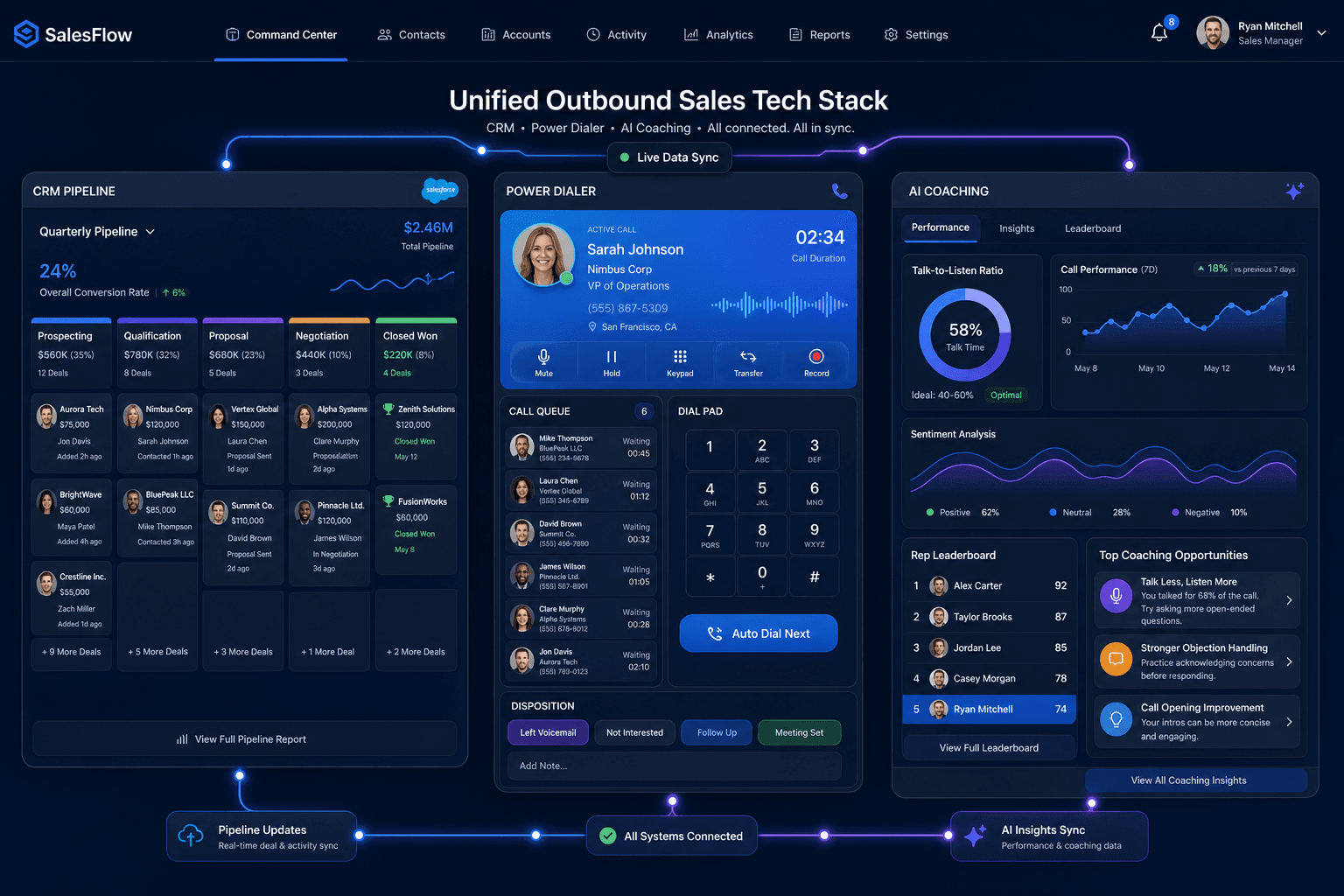
What a Good B2B Sales Stack Looks Like in 2026 for Small and Midsize Teams
If you lead a small or midsize B2B sales team in 2026, you’re probably overwhelmed by tools. Every week there’s a new “AI sales platform” or “must‑have” Chrome extension...

If you lead a small or midsize B2B sales team in 2026, you’re probably overwhelmed by tools. Every week there’s a new “AI sales platform” or “must‑have” Chrome extension, and your stack slides are starting to look like a SaaS conference sponsor wall.
The truth is most teams don’t have a strategy for their sales tech stack. They add one app at a time, chase hype, and wake up paying for features nobody uses. A good B2B sales stack looks very different: it’s lean, integrated, and built around a handful of tools that directly support conversations and revenue.
This guide shows what “good” looks like for a small or midsize B2B team in 2026, which tools you actually need, and how to avoid stack bloat.
What do we mean by “B2B sales stack”?
A sales tech stack (or sales stack) is the set of software your sales team uses to find prospects, engage buyers, manage pipeline, and forecast revenue.
Most modern definitions agree that a complete B2B sales stack usually spans several categories:
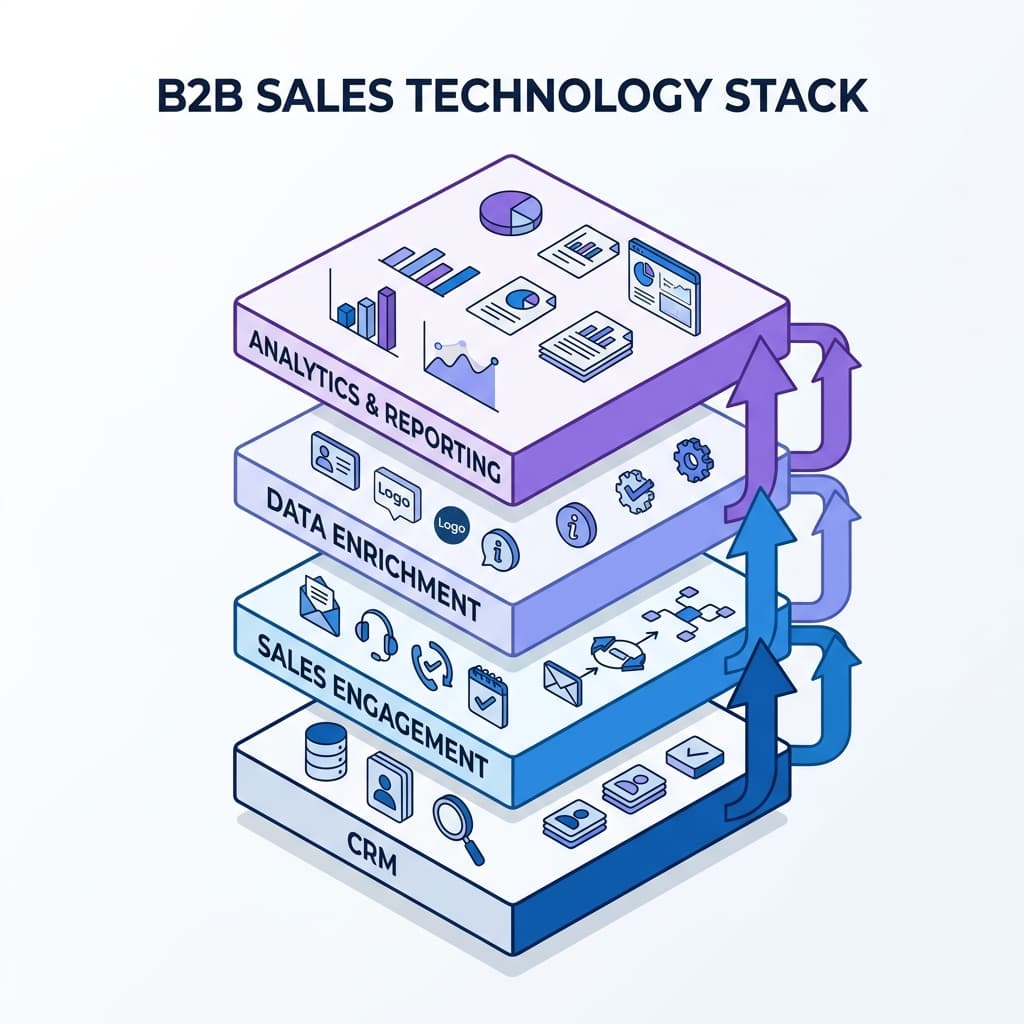
- CRM and contact management.
- Sales engagement (email, dialer, sequences).
- Data and enrichment tools.
- Conversation intelligence and coaching.
- Analytics, reporting, and forecasting.
For large enterprises this can mean dozens of tools. For small and midsize teams, it doesn’t have to—and shouldn’t.
Principles of a healthy 2026 sales stack for smaller teams
Across 2026 stack guides from Salesforce, ZoomInfo, Highspot and others, three principles for a high-performing B2B sales stack come up repeatedly:
Fewer tools, better integration.
The best stacks use a small set of tools that talk to each other, instead of many overlapping apps that require manual work.
CRM is the foundation.
All other tools should read from and write back to the CRM cleanly. If your CRM isn’t the source of truth, reporting and forecasting will always be broken.
Start simple, then layer sophistication.
Small teams get the highest ROI from tools that cut admin and improve deal velocity. AI and advanced automation only help once basics—clean data, consistent activity, and clear processes—are in place.
Layer 1: CRM – your non‑negotiable foundation
A CRM is the core of any B2B sales stack: it stores contacts, accounts, deals, and activities, and it’s where you track pipeline and forecast revenue.
Guides aimed at small businesses highlight platforms like HubSpot’s free tier, Zoho CRM, and Pipedrive as common starting points for small and midsize B2B teams because they are easier to implement and more affordable than enterprise CRMs.
For a small or midsize team, a good CRM should:
- Be deployable in days or weeks, not months.
- Have affordable starter tiers with core features—pipeline management, basic automation, and email logging.
- Offer native integrations with your email, calendar, and engagement tools so activity automatically syncs.
If your CRM is too complex or expensive, reps will avoid it, and your B2B sales stack will fail no matter how good the other tools are.
Layer 2: Sales engagement – email, dialer, and tasks
Next is the sales engagement layer: the tools reps use every day to talk to prospects. In 2026, stack guides list engagement software as a must‑have category alongside CRM.
For smaller teams, this layer should:
- Enable multi‑step email sequences and simple cadences (email + call + task).
- Include at least click‑to‑call or an integrated dialer so phone outreach is tracked automatically.
- Sync every activity—emails sent, opens, calls, notes—back to the CRM, building a single timeline per contact.
Modern engagement tools often bundle AI features like subject line suggestions or email drafts. Experts recommend using AI primarily to reduce drafting time and admin, not to blast generic outreach that hurts deliverability.
Layer 3: Data and enrichment – fewer, better sources
B2B data and enrichment tools give you company and contact information, technographic data, and sometimes intent signals.
For a small or midsize stack:
- Start with one main data provider that covers your ICP (industry, geography, company size) reasonably well, rather than paying for multiple overlapping databases.
- Ensure you can push data directly into your CRM and engagement tool with proper field mapping.
- Add email verification to protect sender reputation when running cold campaigns.
The goal is to give reps a consistent, reasonably accurate pool of leads—“perfect” data is less important than usable data that doesn’t break your budget.
Layer 4: Analytics, reporting, and forecasting
Most small and midsize teams can get by with the reporting and forecasting features inside their CRM.
At this stage, you mainly need:
- Pipeline views by rep, deal stage, and source.
- Core metrics like conversion rates between stages and average sales cycle length.
- A simple forecast based on pipeline stages and close dates.
Advanced BI tools can come later; what matters first is that leadership and reps share a single view of the truth.
Layer 5 (optional): AI for scoring and coaching
Many teams now ask: “Should we invest in AI‑powered sales tools or stick with basics?”
Recent reviews of AI for sales suggest that small and midsize teams get the best ROI when AI is used to:
- Automate low‑value tasks like summarizing calls and drafting follow‑up emails.
- Provide simple lead scoring and “next best action” suggestions using data they already have.
- Offer AI‑assisted coaching based on call recordings and transcripts, once there’s enough call volume for patterns to emerge.
If you’re still fighting with basic data hygiene and adoption, focus on those first. AI will amplify whatever process you already have—good or bad.
What a “good” B2B sales stack looks like at small/midsize scale
Bringing it all together, a solid B2B sales stack for a small or midsize team in 2026 typically looks like this:
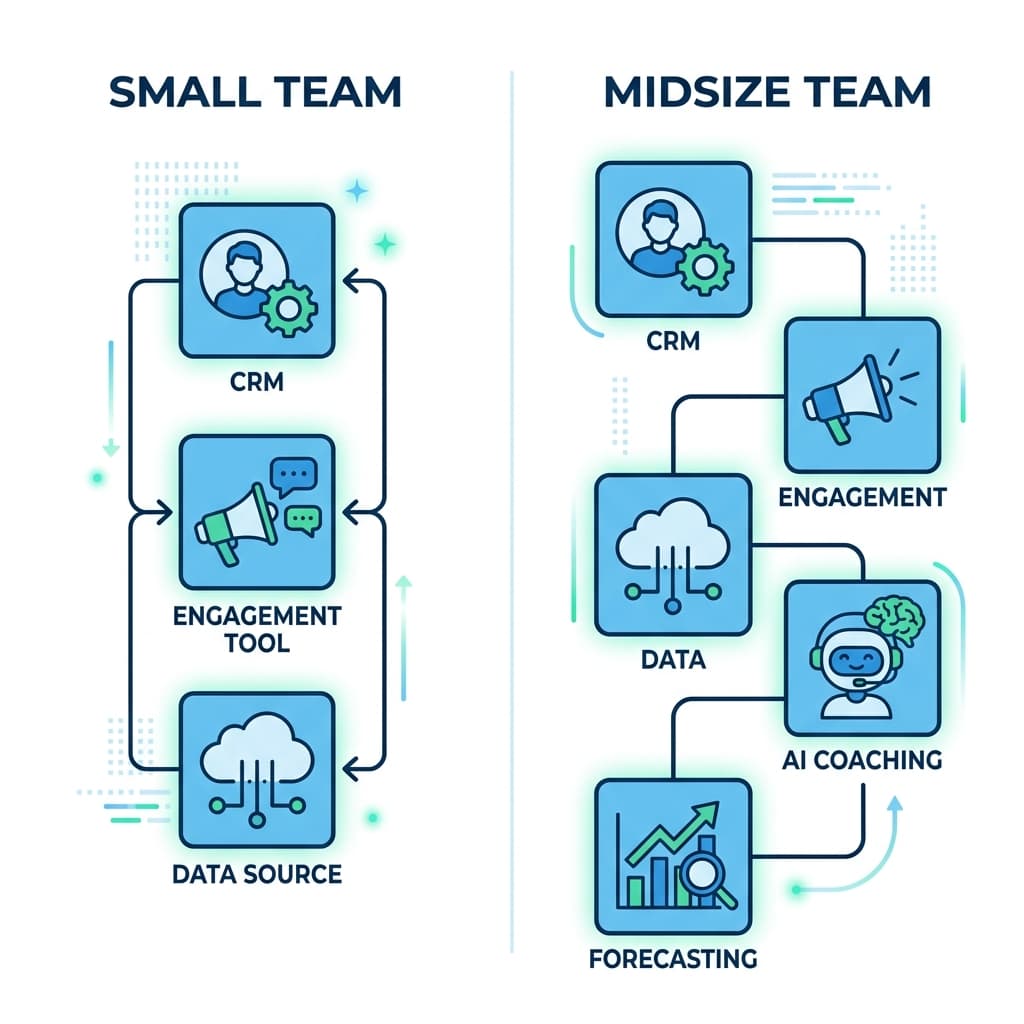
For early‑stage teams (1–3 sellers)
- CRM – simple, low‑cost (or free tier) with contact/deal tracking.
- Engagement tool – email sequences + basic dialer or click‑to‑call.
- Data/enrichment – one provider + email verification.
This can often be assembled for $50–$100 per user/month depending on vendors.
For small teams (5–10 sellers)
- CRM as above, with light automation (lead routing, workflows).
- Stronger engagement/dialer with templates, team reporting, and maybe LinkedIn touchpoints.
- Data/enrichment with more filters and intent signals.
- Simple AI assist for email content and call recap.
For midsize teams (20–30 sellers)
- Mature CRM with defined processes and admin support.
- Engagement platform with advanced dialing options and multi‑channel sequences.
- Data + conversation intelligence / AI coaching, especially for team‑wide coaching at scale.
- More structured forecasting and territory coverage analysis.
In all cases, the stack stays manageable when you keep one core tool per category and audit regularly.
How to tell if your sales stack is broken
A lot of companies aren’t sure whether their stack is “good enough” or truly broken. Red flags include:

- Reps spend more time updating systems than talking to customers.
- Data is inconsistent, and no one trusts the CRM’s reports.
- You have multiple tools doing similar jobs (e.g., two email tools, two dialers).
- Integrations constantly break, causing duplicate or missing records.
- It’s hard to answer basic questions like “Which activities actually create pipeline?”
Any two of those are a strong signal your stack needs simplifying.
How to keep your stack lean as you grow
To prevent “tool creep” as you scale from 3 to 30 people:
- Run a light audit every quarter and a deeper audit annually. Check actual usage, logins, and feature adoption.
- Group tools by category (CRM, engagement, data, intelligence, analytics) and identify overlaps.
- Kill or consolidate tools that are low‑usage, duplicative, or not clearly tied to pipeline or revenue.
- When adding new tools, always define a clear primary job and a target metric (e.g., “reduce time to first touch” or “improve meeting‑set rate”).
Done well, this keeps your stack focused on outcomes instead of vanity logos.
Written by
Jake Morrison
Head of Content, Switchstack
Jake has spent 8 years writing about sales technology, dialer systems, and outbound strategy. Before Switchstack, he led content at a leading sales engagement platform.
Newsletter
Tactics worth your inbox.
Outbound tactics and product updates — only when we have something genuinely worth sharing.